Introduction
AI tools reshape job descriptions every quarter. Hybrid work rewired how teams collaborate. Talent shortages keep leaders scrambling. Yet most organizations still respond to this pace of change with the same rigid playbooks they used a decade ago.
The results show it. Just 32% of mid- to senior-level leaders say their last major change achieved healthy employee adoption, according to Gartner's 2025 HR research. That's a two-thirds failure rate on change initiatives leaders themselves led.
Command-and-control cultures, siloed departments, and fear-based communication are the usual culprits. Employees disengage and turnover climbs, while competitors move faster. Breaking that cycle requires a different kind of culture, one built to adapt.
This article defines adaptive organizational culture, breaks down its core pillars, and shares practices that actually build it, including how personality-based communication frameworks like True Colors International's can speed up the shift.
Key Takeaways
- Psychological safety and decentralized decisions help teams adapt fast without losing their identity
- Only 16% of employers invest in adaptability training despite widespread recognition of its need
- Top-quartile engagement correlates with 23% higher profitability and up to 51% lower turnover
- Leadership modeling and feedback loops turn adaptability into daily behavior, not just a slogan
What Is Adaptive Organizational Culture?
Adaptive organizational culture is a set of shared values, behaviors, and norms that let an organization sense change, adjust quickly, and still hold onto its core identity and purpose. The structure stays coherent enough to guide decisions, yet loose enough to let teams move fast when conditions shift.
Adaptive vs. Traditional Command-and-Control Cultures
Traditional cultures lean on heavy administrative control and top-down decision chains. Every choice routes through approval layers before action happens. Adaptive cultures flip that model.
Complexity theory offers a useful lens here. Organizations that operate as complex adaptive systems allow patterns and solutions to emerge from many local interactions, rather than from a single command post trying to predict everything.
Leadership researchers Eisenhardt and Sull have argued that a small set of clear strategic rules guides action more effectively in volatile markets than elaborate master plans.
In practice, this means leadership defines the "what" (purpose, goals, and non-negotiable guardrails), while teams own the "how" (the execution path, tools, and daily decisions).
The Traits That Signal Adaptability
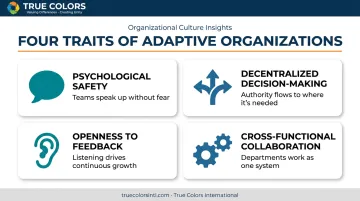
Adaptability isn't just crisis response. It's proactive (anticipating shifts before they hit) and reactive (responding once disruption arrives). Organizations that do both well tend to share these traits:
- Psychological safety to speak up without fear of punishment
- Decentralized decision-making at the point closest to the information
- Genuine openness to feedback, not just a suggestion box
- Cross-functional collaboration that breaks down departmental walls
Here's the catch: knowing this doesn't mean doing it. Only 16% of employers invested in adaptability and continuous-learning programs, per McKinsey's research on workforce resilience, even though employees consistently name adaptability as a top skill gap. Strategy on paper and behavior on the ground are two different things.
Why Adaptive Culture Matters More Than Ever
Business models don't last as long as they used to. AI, automation, and shifting workforce expectations have compressed the shelf life of strategies that once worked for years. What guaranteed relevance in 2015 can become a liability by 2025.
The financial case is hard to ignore. Gallup's meta-analysis of over 3.3 million employees found that top-quartile engagement units post 23% higher profitability, 18% higher sales productivity, and 21% to 51% lower turnover than bottom-quartile units, according to Gallup's Q12 Meta-Analysis.
Engagement isn't the same thing as culture alignment, but the two are deeply connected: engaged teams tend to exist inside cultures where people trust leadership and feel heard.
Real-world pivots make the stakes concrete:
- Netflix shifted from DVD-by-mail to streaming years before competitors took the threat seriously, then kept adapting its recommendation models through 2016 and 2017
- Adobe abandoned packaged software sales in 2013 for a subscription model, accepting short-term revenue pain for long-term relevance — a bet that paid off, as subscriptions still anchor its revenue today
Neither company got it right on the first try. Both built cultures that tolerated the discomfort of reinvention long enough to see it through.
Core Pillars of an Adaptive Organizational Culture
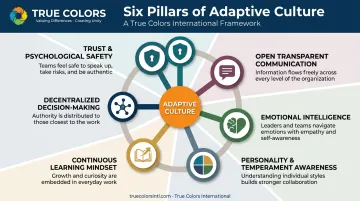
Adaptive culture rests on six interconnected pillars. Weaken one, and the whole system gets sluggish.
Trust and Psychological Safety
Organizations that loosen top-down control and trust employees to self-organize consistently outperform those clinging to rigid oversight. Google's Project Aristotle, which studied 180 internal teams, found psychological safety was the single most important factor in team effectiveness — more than talent, tenure, or even clear roles.
Open, Transparent Communication
Change stalls when people don't understand why it's happening. Two-way dialogue, clearly defined goals, and consistent messaging reduce resistance. Yet only 28% of employees strongly agree their opinions count at work, according to Gallup research on workplace engagement. That gap fuels skepticism the moment leadership announces something new.
Emotional Intelligence and Self-Awareness
Leaders and teams with higher emotional intelligence manage ambiguity better. Research published in Frontiers in Psychology links emotional intelligence to lower job stress and higher organizational commitment, both critical during periods of uncertainty when morale tends to crack first.
Personality and Temperament Awareness
People don't process change the same way. Some crave detail and structure before moving forward. Others want to jump in and adjust as they go. Without a shared language for these differences, teams misread each other's hesitation or urgency as resistance or recklessness.
This is exactly where frameworks like True Colors' personality assessment earn their place, giving colleagues a common vocabulary for why a teammate needs more planning time, or why another pushes to act now.
Continuous Learning Mindset
MIT Sloan's "test, don't guess" approach treats experimentation as a hypothesis-driven cycle: predict, test, measure, adjust. Failure becomes feedback, not a career risk. Cultures that punish failed experiments train people to stop experimenting altogether.
Decentralized, Distributed Decision-Making
Centralized approval chains slow everything down. McKinsey found that organizations combining employee empowerment with adequate coaching were 3.2 times more likely to make fast, high-quality delegated decisions. Empowerment without coaching, though, just shifts risk downward without building capability.
Best Practices to Build an Adaptive Organizational Culture
Building this culture takes deliberate action, not a memo. Six practices move the needle consistently:
- Model it from the top. Leaders must show humility, admit uncertainty out loud, and resist making every decision themselves. Employees mirror leadership behavior far more closely than leadership rhetoric.
- Set the destination, not the route. Define purpose and guardrails clearly upfront, then give teams real autonomy over execution.
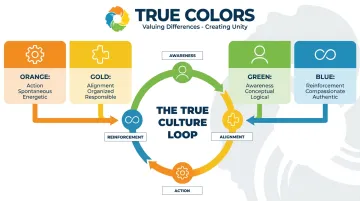
- Build a shared communication language. Personality assessments give teams common terms for discussing how colleagues process change. True Colors International's True Culture Loop (Awareness, Alignment, Action, Reinforcement) offers a structured, repeatable path toward stronger culture alignment.
- Create tight feedback loops. Biweekly check-ins or short "pit stop" reviews let teams test solutions in real time and course-correct fast, instead of waiting for a quarterly review to notice a problem.
- Reward adaptive behavior publicly. Recognition keeps flexibility alive as a permanent operating norm well beyond the initial town hall announcement.
- Invest in ongoing EQ and collaboration training. Emotional intelligence, conflict navigation, and cross-functional skills require reinforcement over time; a single onboarding session won't sustain them.
Common Challenges to Building an Adaptive Culture
Even motivated organizations hit predictable friction points.
- Fear of the unknown. Employees who succeeded under legacy processes often resist abandoning what "worked" — even when it's clearly no longer working.
- Low trust between leadership and staff. Decentralizing decisions requires confidence that employees will use autonomy well. Without that trust, leaders re-centralize control the moment stress rises.
- Siloed teams and mismatched communication styles. McKinsey research names functional silos the top obstacle to a responsive culture, as departments speaking different "languages" struggle to coordinate any unified response.
None of these are permanent conditions. They're symptoms of missing infrastructure: the trust-building, communication tools, and feedback systems covered above.
How True Colors International Helps Organizations Build Adaptive Cultures
True Colors International has spent more than 45 years helping organizations move from culture confusion to culture confidence. Its personality-based assessment gives teams a shared, color-coded language (Orange, Gold, Green, and Blue) for understanding how colleagues communicate, make decisions, and respond under pressure.
That shared awareness is the foundation of the True Culture Loop, a structured framework built around four stages: Awareness, Alignment, Action, and Reinforcement. Rather than treating culture change as a one-time workshop, the loop builds understanding first, then aligns teams around shared goals before asking anyone to act differently.
Backing that loop is an assessment methodology carrying ASI certification, and True Colors has delivered its programs to organizations including Google, Amazon, Ford, and Marriott across corporate, education, healthcare, and government sectors.
For organizations ready to go deeper, True Colors offers Advanced Certification programs in:
- Communication
- Conflict Navigation
- Consultative Selling
- Teaching & Learning Styles
- Team Building
These programs equip leaders and facilitators with the emotional intelligence and communication skills adaptive cultures depend on, turning a two-day workshop insight into a permanent organizational capability.
Frequently Asked Questions
What is adaptive organizational culture?
It's a set of shared values and behaviors that let an organization sense change, adjust quickly, and still maintain its core identity and purpose. It combines proactive anticipation with reactive responsiveness.
How is adaptive culture different from organizational agility?
Agility usually refers to processes and methodologies, like agile project management. Adaptive culture is the underlying mindset, trust, and behavior patterns that make agility actually work in practice.
What are the signs of a low-adaptability culture?
Watch for siloed departments, fear-based communication, slow decision chains, and strong resistance to new initiatives. Change fatigue and low trust in leadership are common companions.
How long does it take to build an adaptive culture?
There's no finish line. Culture change unfolds over months to years through consistent reinforcement, not a single training event or leadership announcement.
Can small businesses build adaptive cultures too?
Yes, and often more easily. Smaller, less bureaucratic structures can implement trust-based decision-making and feedback loops faster than large enterprises weighed down by legacy layers.
What role does leadership play in adaptive culture?
Leaders set the tone by modeling humility, transparency, and trust rather than controlling every decision. Teams mirror what leadership actually does under pressure, not what's written in a values statement.