Introduction
Most companies keep investing in training and still struggle to make learning stick. Culture is usually the gap.
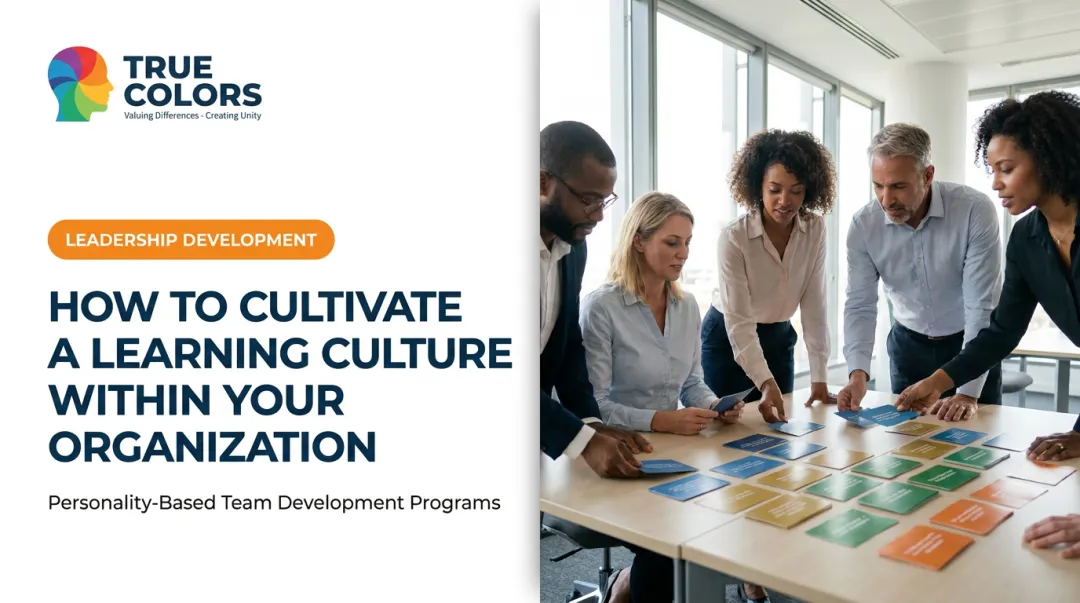
A learning culture is an environment where curiosity, knowledge-sharing, and growth are woven into everyday work, not scheduled as occasional events. Employees ask questions without fear, share what they know, and treat mistakes as data rather than failure.
Yet many organizations pour budget into new learning management systems and content libraries only to see flat engagement. Culture, not content quality, determines whether learning actually sticks.
This article breaks down what a real learning culture looks like, the exact steps to build one, the factors that shape success, and the mistakes that quietly sabotage even well-funded programs.
Key Takeaways
- Leadership behavior and psychological safety drive learning culture, not tools or platforms
- Learning must be embedded into daily workflows, not run as a standalone program
- Understanding communication and learning-style differences speeds adoption and cuts resistance
- Recognition tied to measurable outcomes, not completion rates, sustains long-term momentum
- Organizations with strong learning cultures are 92% more likely to develop novel products and 52% more productive (Deloitte)
What Is a Learning Culture?
A learning culture exists when employees feel safe asking questions, admitting what they don't know, and sharing lessons from mistakes without worrying it will hurt their standing. It's a mindset baked into how work gets done, not a checkbox in the HR calendar.
In practice, that looks like people who:
- Ask questions without fear of looking incompetent
- Admit knowledge gaps early instead of hiding them
- Share lessons from mistakes so the team improves together
Set that next to compliance-driven training: mandatory modules, annual certifications, a pass/fail quiz, then nothing changes until next year. Compliance training checks a legal box. A learning culture changes behavior.
The Microsoft Example
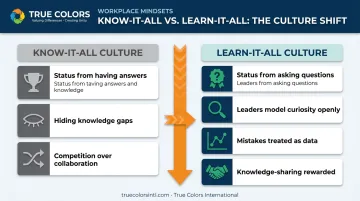
Microsoft's shift under Satya Nadella shows what this looks like at scale. The company moved from a "know-it-all" culture, where status came from having answers, to a "learn-it-all" culture, where status comes from asking better questions. Leaders modeled curiosity, learned openly from failed experiments, and rewarded employees who shared what they discovered.
Use of optional learning resources rose after the shift, though Microsoft has not published an exact figure tying that outcome directly to the culture change.
The same idea holds at any company size: a true learning culture shows up in daily behavior, not in how many training modules sit in a portal. MetroStar Systems puts it plainly. As their training manager said, "We don't see a failure as an error or a mistake. They are an opportunity to learn."
How to Create a Learning Culture in Your Organization
Building a learning culture isn't a single initiative. It's a sequence of deliberate steps that compound over time.
Step 1: Secure Leadership Commitment and Model Learning Behavior
Leaders must visibly pursue their own development. That means sharing what they're learning, admitting knowledge gaps, and doing it in front of the team, not behind closed doors.
Leadership alignment on vision and budget has to happen before any organization-wide rollout. Skipping this step is why so many learning initiatives stall within the first quarter.
Practical tools that make this concrete:
- A leader learning journal, shared periodically with the team
- Recurring "what did you learn this week" check-ins during staff meetings
- Leaders publicly naming a skill gap they're working to close
This isn't a soft nicety. McKinsey found that transformations were 5.3 times more likely to succeed when senior leaders visibly modeled the behavior change they were asking for. Employees don't follow policy memos. They follow what they watch leaders actually do.
Step 2: Build Psychological Safety and Open Communication
Psychological safety determines whether employees take risks, ask questions, or admit they're stuck. Without it, learning goes underground.
Reframe mistakes as input, not performance risk. That shift needs structure, not just good intentions:
- Regular 1:1s where managers ask about roadblocks, not just deliverables
- Pulse surveys that surface friction before it becomes attrition
- Town halls where leaders answer hard questions directly
Managers are the bottleneck here. Training them on active listening and two-way feedback matters more than any policy document.
True Colors International's Communication Advanced Certification addresses this gap directly. It teaches managers to adjust tone and listening approach based on how each person prefers to receive information. The Conflict Navigation track builds on that foundation, developing the empathy needed to deliver feedback without triggering defensiveness.
Step 3: Build Self-Awareness Through Personality and Learning-Style Insights
People don't absorb feedback or instruction the same way. Ignoring that creates friction that quietly stalls adoption, even when the content is good.
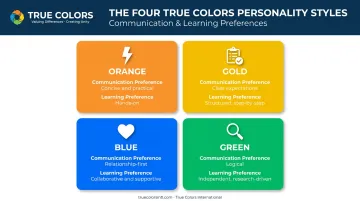
This is where validated personality frameworks earn their place. True Colors International's methodology sorts communication and learning tendencies into four styles:
| Style | Communication Preference | Learning Preference |
|---|---|---|
| Orange | Concise, practical, fast-paced | Hands-on, applicable immediately |
| Gold | Clear expectations, direct exchange | Structured, step-by-step |
| Blue | Relationship and rapport first | Collaborative, emotionally supportive |
| Green | Logical, no ambiguity | Independent analysis, research-driven |
No one is purely one style. Everyone carries a full spectrum, with certain traits more dominant than others. That nuance is what makes the framework useful for tailoring how training gets delivered, rather than boxing people into a single label.
This isn't a guess. The underlying assessment is backed by an N=10,000 validation study, with Cronbach's alpha reliability scores in the "Very Good to Excellent" range across all four themes. The Assessment Standards Institute certifies it through 2027.
Facilitators trained through True Colors' Teaching & Learning Styles certification learn to adapt instructional delivery to these differences. That adaptation is a direct lever for retention and participation.
Step 4: Embed Learning Into Daily Workflows
Learning that lives in a separate destination gets ignored. Learning embedded into tools employees already use gets absorbed.
Practical ways to do this:
- Drop microlearning content directly into existing collaboration tools instead of a standalone LMS tab
- Use time-blocking so learning has protected space on the calendar, not leftover minutes
- Set up job shadowing and cross-functional stretch assignments as informal learning vehicles
- Open team meetings with a two-minute lesson, article, or case study
This matters because time is the top obstacle to development. 89% of CHROs cite time away from job responsibilities as the leading barrier, according to Gallup's 2025 workforce research. If learning isn't built into the flow of work, it competes with the job instead of supporting it.
Step 5: Recognize, Reward, and Measure Learning Progress
Learning that goes unrecognized fades fast. Publicly celebrate milestones and knowledge-sharing contributions so visibility reinforces value.
Beyond public recognition, tie demonstrated growth to something concrete:
- Promotions or new project opportunities tied to skill application, not tenure
- Career progression conversations that reference specific capabilities gained
- Stretch assignments offered as a reward for initiative, not just seniority
Completion rates tell you almost nothing about whether learning worked. Track skill application, behavior change, and performance impact instead. Organizations with strong learning cultures see the payoff. Deloitte research found these companies are 56% more likely to be first to market and 17% more profitable than peers with weaker learning environments.
Key Factors That Determine Learning Culture Success
Learning culture outcomes hinge on a handful of controllable variables.
| Factor | Why It Matters | Impact on Results |
|---|---|---|
| Leadership visibility | Employees mirror what leaders prioritize and model | Without visible participation, initiatives stall early and lose credibility |
| Psychological safety | Determines whether employees take risks or hide gaps | Low safety produces surface-level compliance, not real skill growth |
| Accessibility | Ease of access inside existing workflow drives participation | Friction like separate logins or inconvenient timing kills engagement fast |
| Recognition and career linkage | Employees sustain effort when growth is visibly rewarded | Unrecognized learning fades; visible reward compounds participation |
Among these, psychological safety often carries the most weight. Google's Project Aristotle, a study of 180 internal teams, found it ranked first among five team-effectiveness factors. Teams with stronger safety were rated effective twice as often by executives and were less likely to lose members. That foundation strongly influences whether employees engage with learning at all.
Common Mistakes to Avoid When Building a Learning Culture
Even well-intentioned programs fail for predictable reasons:
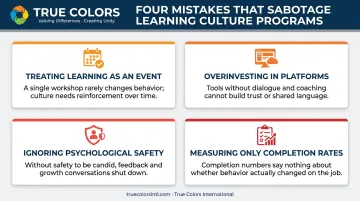
- Treating learning as an event, not a habit. A kickoff webinar or annual workshop doesn't create culture. Culture forms through repetition embedded in daily work.
- Overinvesting in platforms, underinvesting in people. A polished LMS won't fix a manager who shuts down questions in team meetings.
- Ignoring psychological safety. Employees hide knowledge gaps instead of closing them when they fear judgment.
- Measuring only completion rates. A 100% completion rate proves nothing about whether skills transferred to actual performance.
Conclusion
A learning culture is built through consistent leadership behavior, psychological safety, and systems that embed learning into daily work. Software and content libraries support that foundation. They don't replace it.
Organizations that invest in understanding how people actually communicate and learn build that foundation faster. True Colors International's four-stage True Culture Loop (Awareness, Alignment, Action, and Reinforcement) gives leaders a structured, research-validated path from culture confusion to culture confidence.
Ready to see where your organization stands? Take the True Colors Culture Reality Check or connect with a specialist to start building a learning culture that lasts.
Frequently Asked Questions
How do you create a learning culture?
Start with leadership modeling learning behavior openly, then build psychological safety so employees feel safe asking questions. Embed learning into daily workflows and recognize progress consistently over time.
What is a learning culture?
A learning culture is an environment where curiosity, knowledge-sharing, and growth are part of daily work rather than isolated training events. Employees treat mistakes as learning input, not personal failure.
What is an example of a learning culture?
Microsoft's shift under Satya Nadella from a "know-it-all" to a "learn-it-all" culture is a widely cited example, where leaders modeled curiosity and rewarded knowledge-sharing over having all the answers.
What is the 70-20-10 rule for learning?
It's a guideline suggesting 70% of learning comes from on-the-job experience, 20% from social or peer interaction, and 10% from formal training. It's a heuristic, not a strict budget formula.
How long does it take to build a learning culture?
There's no fixed timeline. It's an ongoing process that typically takes months to years, depending on leadership commitment, organizational size, and how deeply learning gets embedded into daily systems.
What role does leadership play in creating a learning culture?
Leaders set the emotional tone and behavioral example for the entire organization. Their visible participation determines whether learning becomes genuine practice or just another checkbox exercise.