Introduction
Leadership used to mean managing performance. Now it means building capability, at every level, not just at the top.
That shift matters because most organizations still get it wrong. Many treat leadership development as a reward reserved for a handful of high performers, while frontline and mid-level employees are left to figure things out on their own.
The cost of that gap is real. According to a Center for Creative Leadership report, 41% of employees who recently changed jobs left specifically for better development opportunities.
Another 60% of Gen Z and Millennial workers see access to leadership development as inequitable.
This article breaks down how leadership's role has changed, the skills modern leaders need, proven frameworks like the 70-20-10 rule, and practical ways to make development part of everyday culture, not a once-a-year event.
Key Takeaways
- Leadership has shifted from managing talent to actively building it at every organizational level
- Communication, coaching, and self-awareness now separate talent-focused leaders from traditional managers
- Frameworks such as 70-20-10 and continuous culture loops help scale development beyond a select few
- Understanding personality and communication styles strengthens leader-employee trust and cuts turnover
- Closing skill gaps takes a blend of formal training, real-time coaching, and mentorship
What Is Talent Development—and Why Leadership Is Central to It
Talent development is the strategic process of building employees' skills and capabilities so they can grow individually while helping the organization hit its goals. It's often confused with talent management, which is the broader umbrella covering recruitment, succession planning, and workforce strategy.
Talent development is the piece that happens after someone is hired: the coaching, the stretch assignments, the skill-building that turns potential into performance.
Leadership sits at the center of this because strategy on paper doesn't do anything on its own. Someone has to translate it into daily behavior.
Leaders are the ones who:
- Spot potential before it's obvious on a resume
- Deliver feedback that actually changes behavior
- Model the growth mindset employees mirror
The manager relationship is the biggest lever here. Gallup's global workplace research consistently finds that managers account for the majority of variance in team engagement scores. When managers disengage, teams follow. When they invest in development conversations, retention and performance both improve.
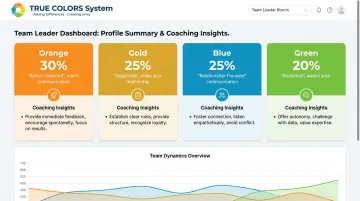
This is also where a shared framework for understanding people helps. At True Colors International, the True Colors System gives leaders a common language for recognizing how team members process feedback, make decisions, and respond to stress. Coaching lands the way it's intended, instead of getting lost in translation.
How the Role of Leadership in Talent Development Has Evolved
From Gatekeepers to Growth Enablers
For decades, leadership development was an exclusive club. It happened at off-site retreats and executive workshops, reserved for people already tagged as "high potential." Everyone else got a performance review and maybe a training video.
That model is breaking down. Talent scarcity after the Great Resignation exposed how costly it is to develop only the top 5%. McKinsey found that more than 19 million U.S. workers quit between April 2021 and late 2021 alone, and a large share of those who stayed said they'd leave again within months if nothing changed.
Employees now expect growth as a condition of employment, not a bonus. McKinsey reports that 85% of people believe businesses are obligated to train or reskill employees to stay competitive, especially with AI reshaping job requirements.
The result: leadership development is spreading downward and outward, not staying locked in the C-suite.
From Talent Management to Talent Leadership
The concept itself has expanded. It's no longer just about training a handful of high-potentials for future promotions. Talent leadership now spans:
- Recruitment and onboarding
- Day-to-day coaching and feedback
- Retention strategy
- Succession and internal mobility
Leaders must now champion inclusive culture and coach continuously, not just review performance twice a year. That's a distinctly different job description than the one most managers were trained for.
One clear sign of this shift: development is moving into the flow of work. Microlearning, real-time coaching, and short workshops are replacing multi-day retreats. Growth happens in fifteen-minute conversations now, not annual offsites.
Essential Leadership Skills and Qualities for Talent Development
Core Skills Every Talent-Focused Leader Needs
The Center for Creative Leadership identifies four skills every leader needs, regardless of level: self-awareness, communication, influence, and learning agility. Each one connects directly to talent growth:
- Self-awareness helps leaders spot blind spots before those blind spots limit someone else's growth
- Communication turns feedback into action instead of confusion
- Influence models the sound judgment and behavior employees learn to emulate
- Learning agility lets leaders adjust their approach as team needs shift
Emotional intelligence deserves its own mention here. Research cited by Harvard Business School Online found that leaders who lead with empathy perform over 40% better at coaching, engaging others, and making decisions. Active listening isn't a soft skill; it's how leaders catch skill gaps before they widen into performance problems.
The Role of Self-Awareness in Effective Leadership
Leaders who understand their own communication tendencies, and recognize how those tendencies differ from the people they manage, build trust faster and coach more effectively.
This is exactly where personality-based frameworks earn their keep. True Colors International's assessment methodology sorts communication and temperament styles into four color-coded types:
- Gold-dominant employees want structure and clear process
- Blue-dominant employees want authentic, personal connection
- Green-dominant employees want logic and data
- Orange-dominant employees want speed and results
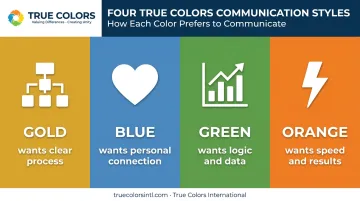
A leader who knows their own default style, and learns to recognize these patterns in others, stops assuming everyone wants to be managed the same way.
The Qualities That Define Talent-Focused Leaders
Beyond skills, certain qualities separate leaders who genuinely develop people from those who just manage tasks:
- Competence: the knowledge and judgment to guide others credibly
- Credibility: consistency between what a leader says and does
- Commitment: visible investment in employees' long-term growth, not just quarterly output
- Contribution: connecting each person's work to something meaningful
These qualities show up in small moments: a leader who remembers a career goal mentioned months ago, or who assigns a stretch project instead of a routine task.
Proven Frameworks Leaders Use to Scale Talent Development
The 70-20-10 Rule in Practice
This model, refined by the Center for Creative Leadership, breaks learning into three buckets:
- 70% challenging assignments — real work that stretches current ability
- 20% developmental relationships — coaching, mentoring, peer feedback
- 10% formal training — courses, certifications, structured programs
A leader applying this might give a promising analyst a cross-functional project (the 70%), pair them with a mentor two levels up (the 20%), and enroll them in one relevant certification (the 10%).
The ratio isn't a scientific law, though. Researchers have flagged that the split lacks precise empirical backing, so treat it as a planning guide rather than a formula to follow to the decimal point.
Building Leadership Pipelines and Succession Plans
Succession planning is where a lot of organizations fall short. Leaders need to systematically identify high-potential employees and map them against roles the business will need filled in two, five, or ten years.
Gallup's research on managerial selection is a useful warning here: organizations pick the candidate with the right talent for a management role only 18% of the time. Potential isn't the same as current performance, and leaders who confuse the two often promote the wrong person.
Embedding Development into Culture for Long-Term Impact
One-off training rarely changes behavior. What sticks is continuous reinforcement.
True Colors International's True Culture Loop illustrates this well: a four-stage cycle of Awareness, Alignment, Action, and Reinforcement that keeps development active instead of treating it as a single event.
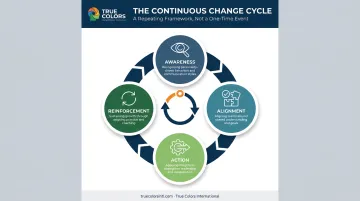
Rather than a workshop that ends when the slides do, this kind of loop builds in follow-up, application, and repeated reinforcement. That ongoing cycle is what drives lasting behavior change and reduces turnover over time.
Overcoming Challenges in Leadership-Driven Talent Development
Skills shortages mean leaders can't rely on recruiters alone. According to ManpowerGroup's global survey of over 39,000 employers, 72% report difficulty filling roles. Leaders now need to actively identify and grow internal talent instead of waiting for the perfect external hire.
Beyond hiring, retention problems often trace back to poor communication, not pay. Gallup research on voluntary departures found that 42% of employee turnover is preventable. Nearly half of departing employees had no proactive conversation with a manager about their satisfaction or future before leaving, meaning regular, proactive check-ins can prevent much of this loss.
Multigenerational and diverse teams add another layer. Communication preferences vary widely, not always along generational lines. A shared framework, such as True Colors International's system for describing communication and temperament styles, gives leaders a consistent way to bridge these differences instead of guessing at what each person needs.
Frequently Asked Questions
What is talent and leadership development?
Talent development builds employees' skills and capabilities to improve performance, while leadership development grows a person's capacity to lead others. Increasingly, organizations combine both into one integrated system.
What are the 4 basic leadership skills?
The most commonly cited foundational skills are communication, decision-making, delegation, and motivation or coaching. Together, they form the base every other leadership competency builds on.
What is the 70-20-10 rule for leadership development?
It's a learning model suggesting roughly 70% of growth comes from challenging assignments, 20% from developmental relationships like coaching and mentoring, and 10% from formal training or courses.
What are the 5 C's of talent?
The most defensible version, from Ulrich and Smallwood's research, is a three-factor formula: competence, commitment, and contribution. Some practitioners add credibility and communication, though that extended version isn't standardized.
Why does leadership matter in talent development and retention?
Leaders directly shape engagement, growth opportunity, and culture alignment, the top drivers behind whether employees stay or leave. Weak leadership undermines even the best-designed development programs.