Introduction
A patient admitted for a four-day hospital stay will likely meet dozens of different people responsible for their care: nurses, physicians, technicians, pharmacists, and specialists rotating through shifts. Every interaction is a handoff. Every handoff is a chance for critical information to get lost.
Preventable medical errors rarely trace back to a clinician not knowing enough. They trace back to teams that fail to share what they know at the right time, in the right way.
This guide covers why communication sits at the center of patient safety, which barriers keep tripping up healthcare teams, and which structured tools close those gaps. You’ll also see how personality awareness training helps teams build communication habits that hold up under real shift pressure.
Key Takeaways
- Communication breakdowns, not clinical knowledge gaps, drive the majority of preventable safety incidents.
- Hierarchy, cultural background, and personality-style mismatches are the most common barriers between clinicians.
- SBAR and Crew Resource Management give teams a shared structure for critical information.
- Lasting change requires leadership commitment plus individual awareness of communication style differences.
Why Teamwork and Communication Are Critical in Healthcare
A single multi-day hospital stay can involve dozens of practitioners touching one patient's care. According to the Agency for Healthcare Research and Quality, a patient may interact with as many as 50 different employees during just a four-day admission, including physicians, nurses, technicians, and support staff. That's 50 documented touchpoints where information can be lost, distorted, or misunderstood.
The Joint Commission has repeatedly flagged communication failures among the leading root causes behind sentinel events, including delays in treatment, medication errors, and wrong-site procedures. That pattern shows up again and again in voluntarily reported incidents.
The Institute of Medicine's landmark To Err Is Human report estimated that between 44,000 and 98,000 Americans die annually from preventable hospital errors—a range still cited today despite debate over the exact methodology.
Multidisciplinary vs. Interdisciplinary Teams
Not all team structures are equal:
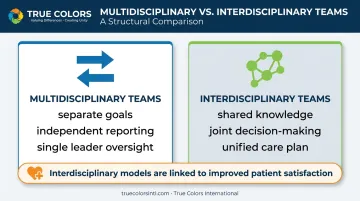
- Multidisciplinary teams work in parallel, each discipline pursuing its own goals independently, often reporting to a single leader
- Interdisciplinary teams work interdependently, sharing knowledge and decisions to build one coordinated care plan
Interdisciplinary models consistently produce better continuity of care because everyone is working toward the same defined outcome, not separate departmental goals.
The payoff is measurable. A systematic review of hospital team-based care found statistically significant improvements in patient satisfaction in the majority of studies examined. Stronger information flow cuts errors and shows up in morale, retention, and how patients rate their experience.
Common Barriers to Effective Communication in Healthcare Teams
Most teams don't lack good intentions. They lack shared structure. Three barriers show up again and again.
Hierarchical and Power Dynamics
When one role is perceived to hold more authority, people lower on that ladder tend to stay quiet, even when something looks wrong.
In a simulation study of residents and nurses during a rapid-sequence-induction scenario, participants stayed silent in 72% of situations that called for a verbal intervention. They challenged the attending physician in only 28% of cases where it mattered — nearly three in four concerns left unspoken.
Common reasons staff give for staying silent:
- Fear of confrontation or retaliation
- Belief that speaking up won't change anything
- Lack of a clear, low-friction way to escalate
Cultural, Gender, and Personality-Style Differences
Clinicians bring different communication defaults to every shift:
- Cultural background can shape assertiveness, eye contact, and how directly someone raises a concern
- Gender-linked communication norms can add friction to physician-nurse dynamics
- Training itself creates a mismatch: physicians are typically trained to be concise, while nurses are trained to be descriptive and thorough
Neither style is wrong. Without a shared framework, though, a doctor's brief update and a nurse's detailed report can talk past each other.
Disruptive Behavior and Its Ripple Effect
Multi-hospital surveys of healthcare workers have found that most have witnessed disruptive physician or nurse behavior firsthand. A majority link that behavior to medical errors and adverse events.
The downstream cost isn't abstract. It shows up in:
- Higher staff turnover
- Eroded trust across roles
- Teams that stop reporting near-misses
Proven Communication Tools and Frameworks for Healthcare Teams
Structure beats good intentions. These frameworks give teams a repeatable format instead of relying on individual communication styles to line up naturally.
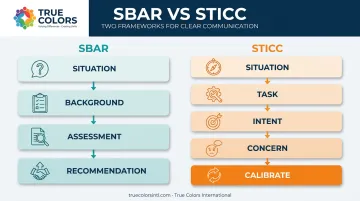
SBAR (Situation-Background-Assessment-Recommendation) was formalized as a structured tool by Kaiser Permanente in 2002 for communicating urgent patient information. It breaks a handoff into four fixed parts:
- Situation — what's happening right now
- Background — relevant clinical context
- Assessment — what the communicator believes the problem is
- Recommendation — the proposed next action
Because every discipline uses the same four-part structure, a nurse's descriptive update and a physician's concise response speak the same language.
Crew Resource Management (CRM) came from aviation, where the FAA has attributed 60% to 80% of air-carrier incidents to human error broadly, not communication alone. That distinction matters, but it's still why aviation built CRM around teamwork, situational awareness, and structured decision-making, then healthcare adapted it.
The MedTeams project trained 684 emergency department clinicians and technicians in CRM-based teamwork behaviors across nine EDs. The trained group's clinical error rate dropped from 30.9% to 4.4%, according to a 2002 study on structured teamwork training and clinical errors.
STICC (Situation-Task-Intent-Concern-Calibrate) adds what SBAR leaves out: it explicitly invites questions and surfaces uncertainty before a plan moves forward. It walks a team through five parts:
- Situation — the current state
- Task — what needs to be done
- Intent — why the plan matters
- Concern — risks or unknowns
- Calibrate — invite pushback and adjust
That final calibrate step matters most in fast-changing inpatient situations, where unspoken doubt can hide a critical gap.
Building a Culture of Teamwork Among Healthcare Staff
Tools only work inside a culture that lets people use them. That starts at the top.
Leadership matters more than most organizations assume. A large survey of nearly 17,000 healthcare respondents found that work settings where leaders conducted WalkRounds and followed up with feedback scored 15% to 27% higher on safety-culture measures than settings without that practice.
Practical ways leadership can build this culture:
- Set clear, visible behavioral standards and model them personally
- Create a non-punitive environment where staff feel safe flagging concerns
- Build two-way channels: staff feedback loops, interdisciplinary rounds, regular huddles
A scoping review of 158 studies on clinical huddles found positive effects on team processes in roughly two-thirds of cases, with nearly a quarter reporting fewer medical errors or adverse drug events tied directly to the practice.
Those habits only hold if leaders keep reading the culture underneath them. Culture assessment shouldn't be a one-time event. Surveys, incident reports, and focus groups help leadership spot recurring friction points before they become safety incidents. The same inputs show whether interventions are actually working.
Leveraging Personality Awareness to Strengthen Healthcare Team Communication
Here's the piece most communication training misses: the doctor-nurse "concise versus descriptive" mismatch isn't a training failure. It's a personality-style mismatch that no one ever named out loud.
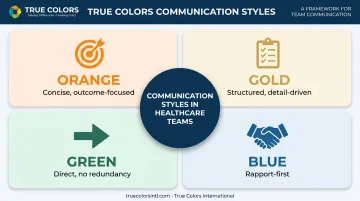
True Colors International's framework maps this directly. In its four-color spectrum:
- Orange communicators lean concise and outcome-focused
- Gold communicators lean structured and detail-driven
- Green communicators want direct information without redundancy
- Blue communicators need rapport before they engage with the message
A physician who leans Orange and a nurse who leans Gold aren't communicating badly. They're communicating in two different native languages. Once teams have a shared vocabulary for that, friction drops fast.
In the L.A. County Workforce Program, True Colors delivered an interactive Live Show for a diverse nursing staff. Actors portrayed each color type in realistic clinical scenarios, then nurses built their own characters and revealed their styles to colleagues.
Program representatives and SEIU Local 721 reported the training had "a powerful effect in developing their nurses into positive, productive, and healthy workers."
A healthcare leader who went through True Colors training put it plainly:
"When our teams are aligned, we are better equipped to care for our patients. True Colors was a solid investment in our biggest asset, our people."
The approach rests on an ASI-certified assessment methodology, validated against a 10,000-person sample and refined across 45-plus years of cross-industry work. That gives clinical teams something SBAR alone can't: a shared language for why colleagues communicate the way they do, not only a script for what to say.
Frequently Asked Questions
What are the four main types of communication used in healthcare?
Healthcare teams rely on verbal, non-verbal, written, and electronic communication. Each carries distinct risks: verbal exchanges can be misheard, non-verbal cues can be misread, and written or electronic records need to stay accurate and current.
What are the 7 Cs of effective communication in healthcare?
The 7 Cs are clear, concise, concrete, correct, coherent, complete, and courteous. They act as a quick mental checklist for any clinical message, whether it's a handoff or a patient conversation.
What are the five C's of communication in healthcare?
A commonly cited version uses caring, customized, clear, concise, and correct. It overlaps with the 7 Cs on clarity and correctness but adds an explicit focus on empathy and tailoring the message to the listener.
What is SBAR and why is it used in healthcare communication?
SBAR stands for Situation, Background, Assessment, Recommendation. It standardizes handoffs so critical patient information arrives in the same structure every time, regardless of who's speaking.
How can hospitals improve teamwork among nursing staff?
Mentorship programs, open dialogue channels, and leadership that models clear behavioral standards build stronger nursing teams. Structured interdisciplinary rounds and regular huddles give nurses a consistent forum to raise concerns early.
Why is communication skills training important for healthcare teams?
Training reduces errors, improves morale, and strengthens patient outcomes by aligning how people communicate with how they're understood. Personality-based training is one proven way to make those style differences visible instead of invisible friction points.