Here's the pain point many leaders won't say out loud: their teams are full of hardworking, talented people who still underperform. Goals stay fuzzy. Communication breaks down mid-project. Personality-driven friction festers in silence until it stalls decisions.
Low engagement alone costs the global economy an estimated $10 trillion annually, roughly 9% of global GDP, according to Gallup's State of the Global Workplace 2026 report. That's not a technology problem. That's a leadership problem.
This guide covers the foundations of team productivity, your direct role in driving it, the often-overlooked power of personality awareness, how to build real accountability, and how to measure whether any of it is working.
Key Takeaways
- Productivity comes from alignment, not addition: coordinated effort outperforms isolated individual output
- Poor communication drains nearly 7.5 hours per employee, per week
- Personality-based misunderstandings, not effort or skill gaps, cause most productivity problems
- Structured accountability beats micromanagement every time
- Measuring output alone misses half the picture; morale matters just as much
What Is Team Productivity, and Why Does It Start With Leadership?
Team productivity isn't the sum of everyone's individual to-do lists. It's the synergy created when people align their contributions toward a shared goal. Two teams can log identical hours and produce wildly different results, depending on whether that alignment exists.
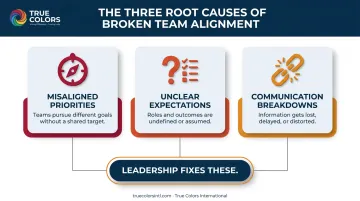
Three things reliably break that alignment:
- Misaligned priorities — people working hard on the wrong things
- Unclear expectations — nobody agrees on what "done" looks like
- Communication breakdowns — information gets lost, delayed, or distorted between people
Notice something about that list: a leader is positioned to fix all three, and none of them require new software. They require clearer direction, better dialogue, and consistent follow-through from the top.
The Real Cost of Getting This Wrong
The financial stakes are larger than most executives realize. Gallup's most recent State of the Global Workplace report, drawing on data from 141,444 employees across more than 140 countries, found that global employee engagement sits at just 20%. That productivity loss reaches into the trillions of dollars, not thousands.
That's a global estimate, not a guaranteed cost for every business. But it signals something important: leadership behavior, not team effort, is usually the bottleneck. Fix the leadership layer, and productivity tends to follow.
The Leader's Role in Building a Productive Team
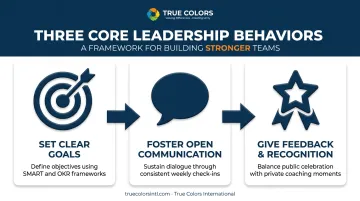
Once you accept that productivity starts with leadership, the next question is practical: what should leaders actually do differently? Three behaviors matter most.
Setting Clear Goals and Expectations
Without clearly defined, measurable goals, teams waste effort. People work hard, but on the wrong priorities, or they duplicate work because nobody clarified who owns what.
Two frameworks solve this reliably:
- SMART goals — Specific, Measurable, Assignable, Realistic, Time-related, introduced by George Doran in a 1981 Management Review article to turn vague ambitions into concrete action items.
- OKRs (Objectives and Key Results) — pairs a qualitative Objective with measurable Key Results that prove it was met. Andy Grove created the approach at Intel; John Doerr brought it to Google in 1999.
Pick one. Apply it consistently. The framework matters less than the discipline of connecting daily tasks to organizational strategy.
Fostering Open Communication and Collaboration
Transparent communication builds the trust that efficient collaboration depends on. Without it, teams default to guessing, and guessing is expensive.
Business leaders surveyed by Grammarly and The Harris Poll estimated their teams lost an average of 7.47 hours per week to poor communication, nearly 19% of a 40-hour week. That's almost a full workday, every week, disappearing into miscommunication.
Structured check-ins fix this faster than most people expect:
- Weekly team stand-ups to surface blockers early
- One-on-ones focused on progress, not status updates
- Clear escalation paths when priorities shift mid-project
Providing Feedback and Recognition
Frequent, specific feedback drives engagement far more than annual reviews ever could. Employees who receive regular, meaningful feedback stay engaged; those who don't tend to disengage and quietly check out of their work.
But feedback only works if it's delivered the way the recipient can actually hear it. Recognition is not one-size-fits-all:
- Some team members thrive on public praise in front of the group
- Others prefer private, one-on-one acknowledgment
- Getting this backward can make recognition feel awkward instead of motivating
Which raises an obvious question: how do you know which approach fits which person? That's where personality-based frameworks, like the one True Colors International has taught leaders for over 45 years, earn their place as leadership tools rather than soft-skills afterthoughts.
Why Understanding Your Team's Personality Styles Is a Productivity Multiplier
Here's an uncomfortable truth: most "productivity problems" aren't about effort or skill. They're miscommunication problems, and they're rooted in differing personality styles that nobody ever named out loud.
A detail-oriented team member gets labeled "slow" by a fast-moving colleague who processes information differently. A big-picture thinker gets dismissed as "disorganized" by someone who values structure. Neither judgment is accurate. Both reflect a lack of shared vocabulary for describing how people naturally operate.
A Shared Language Changes Everything
This is where a temperament-based framework earns its keep. True Colors International built its methodology on exactly this idea over 45 years ago: give leaders and teams a common language for understanding how each person prefers to communicate, make decisions, and stay motivated.
The True Colors System uses a four-color framework (Orange, Gold, Green, and Blue) to map dominant behavioral tendencies. A Gold-dominant team member typically values structure and process. A Green-dominant colleague tends to lead with logic and data. Both styles work well; they simply operate differently.
Once leaders understand this spectrum, three things happen fast:
- Task-matching improves since you assign work based on how someone actually operates, not assumptions
- Disagreements get reframed as style differences instead of personal conflicts, cutting friction fast
- Delegation speeds up too, because leaders stop second-guessing who can handle what
What This Looks Like in Practice
When True Colors facilitated a customized Personal Success Workshop for the accounting department at the University of Texas Permian Basin, the team had already collaborated for three years. Even with that history, the workshop surfaced blind spots around communication stressors that pure tenure hadn't resolved.
A similar pattern showed up with Shortcut Software's remote team, where a customized virtual session focused on addressing the specific communication gaps that distance creates. In both cases, the real value was giving existing skills a shared vocabulary to operate through.
This mirrors a broader pattern in workplace research. A peer-reviewed meta-analysis covering 93 effect sizes across 2,650 teams found consistent, moderate positive relationships between team training and both team performance and teamwork processes. Personality awareness is a lever leaders can pull immediately.
Building a Culture of Accountability and Trust
Personality awareness solves the "why" behind friction. Accountability solves the "how" of getting consistent execution once that friction is reduced.
Encouraging Ownership of Tasks
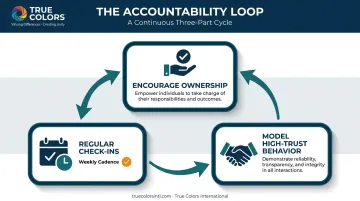
Autonomy and clearly defined roles drive accountability more reliably than pressure does. When people understand exactly what they own, and can see how their work connects to team success, ownership follows naturally.
Leaders should visibly connect individual contributions to outcomes:
- Name specific contributions in team updates, not just team-level wins
- Give people decision-making authority within their own scope
- Avoid rescuing tasks the moment something looks difficult
Implementing Regular Check-Ins and Progress Tracking
Structured check-ins aren't micromanagement. They're the mechanism that keeps autonomy from drifting into confusion.
The gap here is larger than most leaders assume. Harvard Business Review found that 46% of managers were rated "too little" on holding people accountable when they don't deliver, meaning roughly one out of every two managers struggles with this exact behavior.
A consistent rhythm of check-ins closes this gap:
- One meaningful conversation per week, per team member
- Progress tracked against agreed milestones, not hours logged
- Course corrections made early, before small issues become large ones
Modeling High-Trust Leadership Behaviors
Accountability creates the rhythm; trust determines whether people stay engaged in it. Character and competence build trust more reliably than authority does. Leaders who follow through on commitments, admit mistakes, and communicate transparently give their teams implicit permission to do the same.
This is the multiplier effect of leadership behavior: what leaders consistently do shapes team behavior more than what they say.
How to Measure Team Productivity
You can't improve what you don't track, but tracking the wrong things creates its own problems. Balance quantitative and qualitative measures.
Core quantitative metrics:
| Metric | What It Tells You |
|---|---|
| Task completion rate | Whether commitments are being met |
| Timeline adherence | Whether planning accuracy is improving |
| Quality benchmarks | Whether speed is coming at the cost of standards |
Qualitative measures:
- Engagement surveys that capture how people feel about their work
- Regular morale check-ins, not just annual reviews
- Informal pulse checks during one-on-ones
Productivity data without a read on well-being paints an incomplete picture. A team hitting every deadline while burning out isn't actually winning.
A critical caution: don't over-index on hours logged. Tracking time alone rewards busyness, not output. Someone working 10-hour days isn't necessarily more productive than someone who solves the same problem in six focused hours.
Common Roadblocks That Kill Team Productivity
Even well-intentioned leaders run into predictable obstacles. Recognizing them early prevents small issues from becoming cultural problems.
- Unclear roles and expectations: cause duplicated effort on some tasks and dropped ownership on others
- Communication breakdowns and personality clashes: slow decision-making and erode trust over time
- Unrealistic workloads: lead directly to burnout, disengagement, and rising turnover
Across industries, from healthcare teams under constant pressure to corporate departments juggling competing priorities, the same pattern repeats. In most cases, the failure traces back to structural and interpersonal friction that leadership hasn't addressed.
Frequently Asked Questions
What is the 3-3-3 rule for productivity?
The 3-3-3 method, popularized by author Oliver Burkeman, structures a workday into three hours of focused deep work, three shorter tasks, and three maintenance activities. Leaders can adapt this at the team level by protecting blocks of uninterrupted focus time before scheduling meetings.
What are the 4 pillars of team performance?
While no single universal framework exists, Harvard Business Review identifies four enabling conditions for team effectiveness: compelling direction, strong structure, supportive context, and a shared mindset. Many leaders informally translate these into goals, roles, communication, and accountability.
How do you measure team productivity?
Track task completion rates, timeline adherence, and quality benchmarks alongside qualitative signals like engagement surveys and morale check-ins. Relying on any single metric, especially hours logged, gives an incomplete picture.
What are the 4 types of productivity?
Leaders often think in terms of individual, team, organizational, and tool-driven productivity. These are useful working categories rather than a formally standardized research classification.
What is the leader's biggest lever for improving team productivity?
Clear goal-setting combined with consistent communication and personality-aware leadership. Leaders who understand how their team members prefer to communicate and stay motivated remove friction faster than those relying on generic management tactics.
How does understanding personality styles improve team productivity?
Personality awareness reduces miscommunication by giving teams a shared language for their natural differences. It improves task-fit, speeds up delegation, and builds trust faster than trial-and-error management ever could.