Introduction
A manager sits down for the annual review and delivers a full year's worth of feedback in 45 minutes. The employee looks blindsided. Nothing on that list was a surprise to the manager, but it's the first time the employee is hearing any of it.
This scenario plays out constantly. Only 18% of US workers feel they get as much purpose from their job as they want, even though 70% say work largely defines their sense of purpose, according to McKinsey's research on employee purpose. Consistent, meaningful feedback is one of the clearest ways employees measure whether their work matters, yet most managers give it poorly, rarely, or both.
Giving feedback sounds simple. In practice, the same message can land as motivating or demoralizing depending on timing, delivery, and who's receiving it. This article walks through a practical framework, the right timing for different feedback types, the factors that determine whether feedback actually sticks, and the mistakes that undo good intentions.
Key Takeaways
- Specific, timely, two-way feedback outperforms vague praise or annual-only check-ins
- Frequent, meaningful feedback boosts engagement and cuts employee turnover risk
- Communication style shapes how feedback is received, so one script rarely fits every employee
- Skipping the sandwich method and limiting feedback to one focus area improve how it's absorbed
How to Give Effective Employee Feedback: A Step-by-Step Framework
Good feedback isn't improvised. It follows a structure, even when the conversation feels casual.
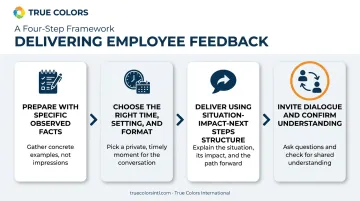
Step 1: Prepare With Specific, Observed Facts
Walk in with facts, not impressions. Note the date, the project, and the measurable outcome, not a general sense that "things have been off."
Before you open your mouth, get clear on two things:
- The one core message you want the employee to walk away with
- Your own emotional state — feedback delivered while you're frustrated or reactive almost always lands badly
If you're still annoyed about Monday's missed deadline on Thursday, wait until you've cooled off. A calm manager gets heard, while a frustrated one gets tuned out.
Step 2: Choose the Right Time, Setting, and Format
Default to a private, face-to-face or video conversation. Slack messages and emails strip out tone, and readers fill that gap with whatever mood they're already in.
Two timing rules matter most:
- Stay close to the event. Feedback on a presentation from three weeks ago has already lost its punch.
- Check the employee's state first. If they're mid-crisis on another project or visibly stressed, postpone. Timing a hard conversation badly can undo weeks of trust-building.
Step 3: Deliver Using a Situation-Impact-Next Steps Structure
Describe what happened, explain why it mattered, then map out what comes next. This three-part structure keeps feedback grounded and actionable:
- Situation: "In yesterday's client call, the pricing details weren't ready."
- Impact: "The client asked to reschedule, which pushed our close date back a week."
- Next steps: "Let's build a pre-call checklist together so this doesn't happen again."
Skip absolute language like "always" or "never," since nobody always does anything, and that word alone can turn a productive conversation into a defensive one.
Step 4: Invite Dialogue and Confirm Understanding
Feedback isn't a monologue. Ask, "What's your take on this?" and actually pause for the answer, since you might be missing context that changes the entire conversation.
Close every feedback conversation by:
- Summarizing what you both agreed on
- Setting a specific follow-up date to check progress
- Confirming the employee understands the "why," not just the "what"
When Should You Give Employee Feedback?
Timing isn't one-size-fits-all. It depends on what kind of feedback you're giving:
- Recognition should be immediate. If someone nails a presentation, say so that day, since waiting dilutes the emotional payoff and makes praise feel like an afterthought.
- Pattern-based feedback needs a few data points first. One missed deadline might be a fluke, but three in a row is a pattern worth addressing calmly and privately.
- Constructive feedback needs the right room. Never deliver it in front of peers, during a team meeting, or when someone's already stressed about something unrelated, since public correction breeds resentment, not improvement.
Beyond matching the moment, avoid the single biggest timing mistake: saving everything for the annual review. Employees who receive weekly rather than annual feedback are 2.7 times more likely to be engaged, according to Gallup's research on performance reviews.
They're also 3.2 times more likely to feel motivated to do outstanding work. An annual review can summarize the year, but it shouldn't be the only place feedback happens.
Key Factors That Determine Whether Feedback Actually Lands
The same message, delivered two different ways, can produce completely opposite reactions. These four variables explain why.
Specificity and Behavioral Focus
Telling someone to "be more of a team player" gives them nothing to act on. What does that even mean on a Tuesday morning?
Feedback that names a specific behavior and its outcome works better than general labels. Research backs this up: a large meta-analysis by Kluger and DeNisi covering over 600 effect sizes found that feedback effectiveness declined sharply once attention shifted from the task to the person.
More than a third of the feedback interventions in that study actually hurt performance. The lesson: talk about the work, not the person's character.
Frequency and Timeliness
Feedback has a shelf life. The longer you wait after the behavior occurred, the less motivational punch it carries and the harder it is for the employee to even remember the details clearly.
That said, more isn't automatically better. In some organizations, well-structured monthly feedback has outperformed daily feedback, since constant correction can start to feel like micromanagement. The goal is consistent, useful check-ins, not maximum volume.
Employee Personality and Communication Style
This is where most feedback conversations break down. A direct, results-driven employee wants the point fast, with minimal cushioning. A relationship-oriented employee often needs more context and reassurance before they can hear the corrective part at all.
Deliver the wrong style to the wrong person, and you'll trigger defensiveness even when your message was accurate.
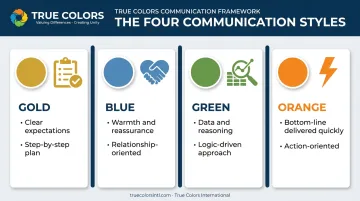
This is exactly the gap that temperament-based frameworks are built to close. True Colors International's methodology, for example, groups communication tendencies into four styles: Gold, Blue, Green, and Orange, each reflecting how a given employee is likely to process information:
- Gold (structure-oriented) employees want clear expectations and a step-by-step plan
- Blue (relationship-oriented) employees need warmth and reassurance woven into the message
- Green (logic-driven) employees respond best to data and reasoning
- Orange (action-oriented) employees want the bottom line delivered quickly, without excess buildup
Managers who learn to spot these patterns can adjust tone, pace, and structure before the conversation even starts, instead of guessing and hoping it lands.
Tone, Body Language, and Psychological Safety
An accusatory tone or crossed arms can trigger a stress response before you've even finished your first sentence. Once someone feels attacked, their brain shifts into defense mode, and defense mode isn't built for listening or learning.
A calm, curious tone paired with real listening does the opposite. It signals safety, and psychological safety is what allows employees to actually act on what you've told them instead of just nodding until the conversation ends.
Common Mistakes to Avoid When Giving Feedback
Even well-intentioned managers fall into predictable traps. Watch for these:
- Waiting for the annual review. Small issues left unaddressed for months tend to snowball into much bigger performance problems.
- Relying on the feedback sandwich. Praise-criticism-praise sounds gentle, but employees often see through it, and repeated use can breed cynicism toward all future praise.
- Overloading one conversation. Listing five issues at once causes employees to disengage and forget most of what you said, so focus on the single issue that matters most right now.
- Criticizing circumstances outside their control. Unclear expectations, missing resources, and KPIs nobody assigned are management problems, not performance ones.
Conclusion
Effective feedback relies on preparation, specificity, timing, and empathy—skills any manager can develop with practice. Most failed feedback conversations share a common thread: the message ignored how the specific person receiving it actually processes information.
That's why organizations serious about building a real feedback culture go beyond training managers on structure alone. They invest in a shared language for navigating communication differences, using resources like True Colors International's workshops. This ensures every manager and employee works from the same playbook, relying on shared understanding instead of guessing at each other's intentions.
Frequently Asked Questions
What is the best way to give feedback to an employee?
Keep it specific, private, and timely. Frame it as a two-way conversation focused on observed behavior, not personality traits, and always end with a clear next step.
What are some good employee feedback examples for performance?
Positive: "Your client presentation directly addressed their concerns and moved the deal forward." Constructive: "The report was submitted two days late, delaying the client review. Let's set an earlier deadline."
What are the five R's of feedback?
One practitioner model defines them as Request, Receive, Reflect, Respond, and Resolve, a sequence for processing feedback thoughtfully rather than reacting instantly. It's a useful mental checklist, though not a formally standardized HR framework.
How often should managers give employees feedback?
Most experts recommend brief, informal check-ins weekly or biweekly, paired with more structured quarterly or annual reviews. Frequent conversations catch issues early and keep feedback from feeling like a surprise.
How do you handle an employee who reacts defensively to feedback?
Stay calm and avoid matching their energy. Ask about their perspective, listen without interrupting, and give them time to process before expecting immediate agreement.
What's the difference between constructive and negative feedback?
Constructive feedback is specific, forward-looking, and solution-oriented, focused on what to do differently next time. Negative feedback tends to be vague, personal, or purely critical, with no path forward offered.