Healthcare customer service asks for more than a friendly smile. Professionals need empathy, clarity, active listening, reliability, privacy awareness, and sound judgment — often while a patient is anxious, in pain, or unsure what happens next.
Patients aren't shopping for a product. They're navigating fear, cost concerns, and complex systems, sometimes on the worst day of their year. That context changes what "good service" actually means.
This article breaks down seven essential customer service skills for healthcare professionals, shows how to apply them across the patient journey, and outlines a practical framework for building and measuring them on your team.
Key Takeaways
- Customer service skills work alongside clinical expertise, helping patients feel heard, respected, and informed.
- Seven core skills matter most: active listening, empathy, clear communication, problem-solving, emotional self-management, teamwork, and reliability.
- Role-play, coaching, and communication-style awareness build these skills faster than one-time training sessions.
- Patient feedback, complaint patterns, and team observations reveal where service is breaking down.
Why Customer Service Skills Matter in Healthcare
Healthcare service differs from retail or hospitality service in one critical way: the stakes are personal. A patient calling about a delayed test result isn't mildly inconvenienced; they may be terrified. Someone confused about a bill might skip a needed follow-up visit rather than call again.
Communication quality directly affects clinical outcomes, not just satisfaction scores. A peer-reviewed meta-analysis covering more than 100 studies found that poor physician communication was linked to a 19% higher risk of patients not following treatment plans, while communication training raised the odds of adherence by 1.62 times compared to no training at all.
That's not a minor statistic. It means the way a nurse explains a discharge plan, or the way a scheduler handles a rescheduled appointment, can shape whether a patient actually follows through on their care.
Service breaks down in predictable ways:
- Inconsistent communication between visits or departments
- Long waits with no status update
- Confusing or unexplained billing charges
- Missed callbacks after a promised follow-up
- Dismissive tone during an already stressful conversation

None of this requires a clinical error to damage trust. A patient can receive excellent treatment and still leave feeling unheard.
Every role touches this experience. Receptionists, schedulers, nurses, physicians, technicians, billing staff, call-center agents, and managers all shape the same patient's journey.
Customer service in healthcare still has clear boundaries. It should never mean making promises staff can't keep, cutting corners on privacy, or putting a patient's mood ahead of safety, informed consent, or clinical protocol.
7 Essential Healthcare Customer Service Skills
These aren't personality traits some people are born with and others aren't. They're observable behaviors, which means they can be taught, practiced, and reinforced on any team.
Active Listening
Active listening means understanding not just what a patient says, but what they actually need. A patient asking "when will the doctor call?" might really be asking "should I be worried?"
Key behaviors include:
- Avoiding interruptions, even when the answer seems obvious
- Using attentive body language (eye contact, an open posture, no glancing at a screen mid-conversation)
- Asking clarifying questions instead of guessing
- Summarizing what was heard before responding
- Confirming the patient's understanding before ending the interaction
Example: A patient calls confused about a new prescription. Instead of jumping straight to instructions, the pharmacy tech reflects back: "It sounds like you're not sure if this replaces your old medication or adds to it. Is that right?" That single question prevents a dangerous mix-up.
When a concern falls outside a professional's role, active listening still matters . Pair it with proper documentation and a clean handoff to the right person.
Empathy and Compassion
Empathy is recognizing what a patient is going through. Compassion is what turns that recognition into action. One notices the fear; the other does something about it.
The distinction matters in practice. Saying "that sounds frustrating" acknowledges emotion without confirming assumptions the professional can't verify , such as whether a diagnosis is serious or a bill is definitely wrong.
Tone and pacing should shift depending on the person in front of you:
- Slower pace and simpler language for a distressed patient
- Extra patience and repetition for someone with accessibility needs
- Interpreter services or written materials for limited English proficiency
- Direct engagement with the patient even when a caregiver is present, unless the patient prefers otherwise
A 2024 umbrella review of empathy training programs found that effective approaches share common traits: longitudinal learning, structured debriefing, and deliberate practice, rather than a single seminar or checklist.
Clear and Respectful Communication
Jargon creates distance. "Your EOB shows a copay adjustment" means nothing to most patients. "Your insurance changed how much you owe for this visit" does.
Clear communication also means being honest about what's known and what isn't:
- State wait times as ranges, not guarantees
- Explain costs before a service, not just after
- Walk through next steps and referrals in plain terms
- Confirm preparation instructions verbally and in writing
Each channel carries its own risks:
- Phone calls need verbal clarity, since there's no body language to soften a hard message
- Patient portal messages must stay precise, because tone doesn't always translate
- Written materials should avoid dense medical terminology
- In-person conversations require attention to who else might overhear sensitive information
Ask patients how they prefer to be reached, and document that preference. It's a small step that prevents repeated frustration.
Problem-Solving and Service Recovery
When something goes wrong (a scheduling error, an insurance denial, a delayed result), patients don't expect perfection. They expect ownership.
AHRQ outlines a straightforward service recovery sequence:
- Acknowledge the problem and apologize
- Listen, ask open questions, and understand the full concern
- Fix what can be fixed quickly and fairly
- Offer appropriate atonement when warranted
- Follow up
- Keep every promise made during the process

This process comes from AHRQ's guidance on healthcare service recovery, which frames recovery as restoring trust and confidence, not just closing a ticket.
Taking ownership of the next step , even when three departments are involved, matters more than explaining whose fault it was. "Let me find that out and call you back by 3 p.m." beats "that's billing's department" every time.
Emotional Self-Management and De-escalation
Healthcare staff regularly face anger, fear, and grief that has nothing to do with them personally. Staying calm anyway is a skill, not a personality trait.
The Joint Commission's de-escalation guidance recommends:
- Speaking slowly and calmly, without matching an escalated tone
- Acknowledging the concern directly, without minimizing it
- Setting respectful boundaries when a conversation crosses a line
- Offering choices where possible to restore a sense of control
- Involving a supervisor or security team when safety is at risk
This isn't a small concern. OSHA data shows that 70% to 74% of annual workplace assaults occur in healthcare and social-service settings, with healthcare workers facing assault-related injury rates roughly three times higher than the private sector average.
De-escalation doesn't mean absorbing abuse or disclosing protected information just to calm someone down. It also isn't a substitute for adequate staffing. No communication technique fixes a systemic capacity problem.
Teamwork and Reliable Handoffs
A patient experience is rarely shaped by one department. It's built across front desk, clinical staff, billing, scheduling, lab, pharmacy, and leadership — all working from the same information.
When handoffs break down, patients feel it directly. The Joint Commission reports that communication failures contributed to 30% of malpractice claims, and nearly 70% of clinical training environments lacked a standardized handoff process at all. Structured formats change that picture: facilities using the I-PASS handoff method cut preventable adverse events by 30%.
Example: A nurse tells a patient their referral was submitted. Billing never received the note. Two weeks later, the patient calls confused, and now three people have to untangle a problem that a five-second confirmation would have prevented.
Handoff gaps often start with mismatched communication styles between coworkers. Some staff default to frequent updates; others assume no news is good news. Neither approach is wrong, but the gap is what patients feel.
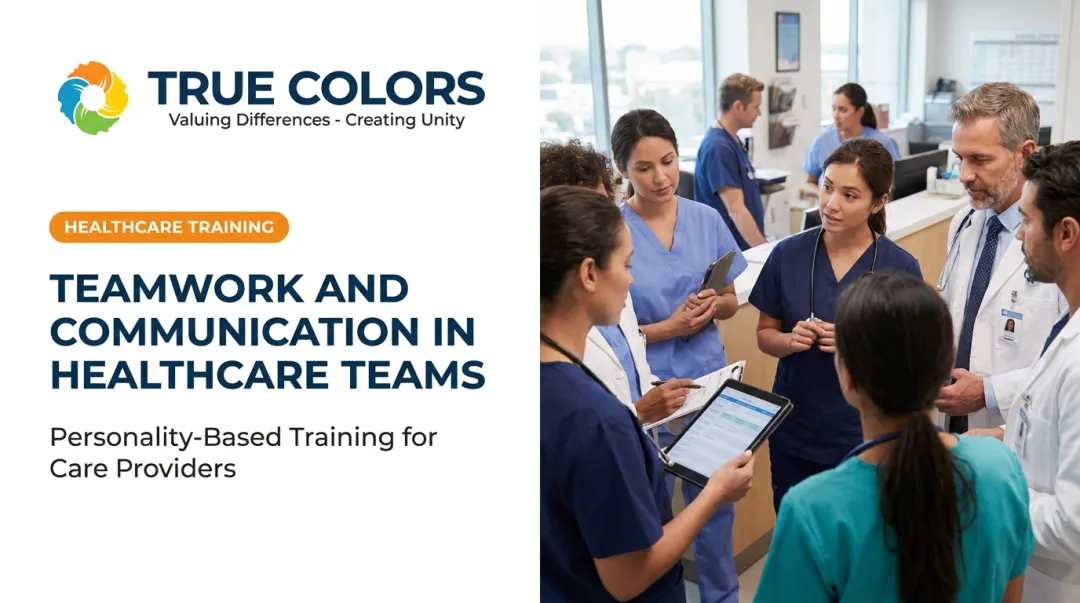
True Colors International helps healthcare teams build a shared language for how colleagues give and receive information. That framework supports teamwork. It does not replace clinical protocols, compliance requirements, or standardized handoff tools like I-PASS.
Reliability, Adaptability, and Time Management
Trust is built on kept promises. A callback that happens when promised matters more than almost any other single interaction.
Reliable professionals:
- Keep commitments, including ones that seem small
- Prioritize urgent needs without abandoning others mid-conversation
- Communicate delays proactively, before a patient has to ask
- Track callbacks and follow-ups instead of relying on memory
Wait times may matter less than how they're communicated. A study of more than 4,600 breast cancer inpatients in Germany found that when communication quality was high, the negative relationship between long waits and patient satisfaction disappeared. A well-explained wait beats a fast one with no explanation.
Practical tools help here: callback tracking sheets, standardized intake checklists, clear escalation pathways, and realistic promises about timing. Adaptability matters too. Schedules and staffing shift constantly, but privacy and respect standards shouldn't.
How to Apply These Skills Across the Patient Journey
These skills don't live in one department. They show up at every touchpoint: appointment requests, registration, waiting-room updates, clinical conversations, billing, complaints, discharge, and follow-up.

Before and During the Appointment
First contact sets the tone. A welcoming greeting, accurate scheduling, and clear preparation instructions establish trust before a patient even sees a provider.
Practical steps that help:
- Use names appropriately without over-familiarity
- Verify information respectfully rather than making patients repeat everything
- Explain delays honestly instead of leaving patients guessing
- Protect privacy in waiting rooms and on the phone: no discussing details within earshot of others
Teams should regularly audit friction points: confusing intake forms, poor wayfinding, limited interpreter access, or reminder systems that don't reach patients who need them.
During Difficult Conversations
Billing disputes, denied coverage, long waits, and distressed family members all call for the same basic framework:
- Listen and empathize before responding
- Use plain language
- Offer real options
- Set boundaries where needed
- Escalate when appropriate
- Follow through afterward
One rule matters across every scenario: staff shouldn't speculate about diagnoses, guarantee outcomes, or offer advice outside their role. Route clinical questions to the person authorized to answer them. Doing so protects the patient from inaccurate information.
After the Visit
The patient journey doesn't end at checkout. Accurate discharge instructions, confirmed referrals, and clear results-communication timelines shape whether patients follow through on care.
Close the loop by confirming:
- What was completed during the visit
- Who owns the next action item
- When the patient should expect an update
Gathering feedback afterward, through approved channels that protect confidentiality, reveals whether instructions actually landed clearly, or just sounded clear in the moment.
How to Develop Healthcare Customer Service Skills
Skill-building works best as an ongoing system, not a one-time seminar that gets forgotten by Friday.
Start with a baseline. Pull from patient feedback, complaint themes, permitted call reviews, peer observations, and manager input. Don't invent metrics that don't exist yet — an honest starting point matters more than an impressive one.
Use realistic role-play scenarios, such as:
- An angry caller demanding immediate answers
- A confused patient unsure of next steps
- A billing dispute involving multiple departments
- A language or accessibility barrier
- A handoff that requires precise information transfer
Short practice sessions built into shift huddles, onboarding, or team meetings work better than lengthy annual workshops, since staff can apply what they learn without stepping away from patient care for long stretches.
Those drills also surface a gap coaching alone often misses. Two well-intentioned staff members can clash simply because one processes information quickly and directly while the other prefers detail and reassurance.
Communication-style awareness training closes that gap. True Colors International's personality assessment gives teams a shared vocabulary for recognizing these differences, which cuts the friction that shows up as miscommunication between coworkers and, eventually, in front of patients.
Coaching should target observable behavior, not personality labels. Ask whether the professional:
- Summarized the concern
- Explained the next step
- Closed the loop afterward
Those behaviors are coachable. Personality judgments are not.
How to Measure and Sustain Improvement
Improvement needs evidence, not assumptions. Useful indicators include:
- Patient-experience survey themes (HCAHPS captures communication with doctors and nurses, care coordination, and discharge clarity)
- Complaint resolution time
- Abandoned or unanswered call patterns
- Callback completion rates
- Documented communication errors
- Online review themes
- Staff confidence in handling difficult conversations

Combine numbers with stories. A satisfaction score tells you something changed. Patient and staff feedback tells you why.
Break results down by role and touchpoint. A pattern of complaints might trace back to scheduling delays, unclear billing explanations, inconsistent clinical handoffs, or outdated technology — each requires a different fix.
Build a reinforcement cycle: share findings with the team, recognize specific behaviors that worked, address the process barriers getting in the way, provide targeted practice, and reassess after changes take effect.
One warning: never use these metrics to pressure staff into rushing conversations or discouraging legitimate complaints. Speed at the expense of privacy or respect isn't an improvement — it's a new problem wearing a better score.
Conclusion
Exceptional healthcare customer service is built from repeatable behaviors: listen carefully, communicate clearly, show empathy, solve problems responsibly, collaborate reliably, manage emotions under pressure, and follow through on your promises.
Pick one touchpoint this week. Practice one skill. Gather feedback. Use what you learn to build a broader training plan from there.
True Colors International has spent over 45 years helping healthcare teams build the communication foundation behind service excellence, grounded in the belief that valuing differences creates unity.
Personality-based training won't replace clinical judgment or compliance procedures. It can give your team the shared language to work together more smoothly, and that shows up in every patient interaction that follows.
Frequently Asked Questions
How can I improve customer service in healthcare?
Start with staff training focused on active listening, empathy, and clear expectations. Use role-play for realistic scenarios, gather regular feedback, and fix process issues like scheduling errors or unclear billing that undermine even great communication.
What are the 7 skills of good customer service?
In healthcare, they're active listening, empathy and compassion, clear communication, problem-solving, emotional self-management, teamwork, and reliability. Each skill addresses a different part of the patient's experience, from first contact to follow-up.
What are the 5 C's of healthcare?
Frameworks vary by organization. One common version describes Caring, Customized, Clear, Concise, and Correct communication. Check your organization's specific framework rather than assuming a single standard.
Why are customer service skills important for healthcare professionals?
They shape whether patients feel heard, understand their care, and stay engaged with treatment plans. Research links strong communication to better treatment adherence, though clinical outcomes depend on many factors beyond service alone.
How can healthcare staff handle angry or upset patients?
Listen without interrupting, acknowledge the emotion directly, and keep your tone calm and steady. Offer practical options where you can, set respectful boundaries when needed, and escalate to a supervisor if the situation requires it.
How can healthcare organizations train employees in customer service?
Begin with a baseline assessment from patient feedback and complaint themes, then build healthcare-specific role-play scenarios. Pair this with coaching, communication-style awareness, and ongoing reinforcement rather than a single training event.