Leaders can build the perfect roadmap and still watch it collapse under the weight of unaddressed fear, frustration, and fatigue. This is where the Change Curve comes in. Originally developed to describe grief, it's now one of the most widely used tools for anticipating how people emotionally react to workplace disruption.
This article walks through the stages of the curve, how personality shapes each person's path through it, the coaching mistakes that stall progress, and what it actually takes to make change stick.
Key Takeaways
- The Change Curve spans five to six emotional stages, rarely in a straight line
- Coaching needs differ by stage: listen early, direct and build skills later
- Personality shapes how fast someone moves through resistance, so no single coaching style fits everyone
- Change sticks only when leaders reinforce it after acceptance, not before it
What Is the Organizational Change Curve?
The Change Curve traces back to psychiatrist Elisabeth Kübler-Ross, who introduced five stages of grief, denial, anger, bargaining, depression, and acceptance, in her 1969 book On Death and Dying. The framework wasn't built for business. It described how terminally ill patients processed loss.
Over time, organizational development practitioners adapted it to describe how employees process major workplace disruption: restructures, mergers, new systems, leadership turnover.
Why this matters for coaches specifically: A project manager tracks milestones, budgets, and go-live dates. A coach tracks the person. The Change Curve gives coaches a shared language for what an employee is feeling right now, and what they need in response.
A few ground rules for using it well:
- It is not a fixed sequence — people can skip stages, loop back, or sit in two stages simultaneously
- Progress depends heavily on communication quality and individual temperament
- Productivity almost always dips before it recovers
That dip is real and well documented. Gartner's 2023 HR Leaders survey found that change fatigue can cut employee performance by as much as 27% and increase turnover intent by as much as 42%.
Coaches who expect this dip, rather than panicking over it, are far better positioned to guide people through it.
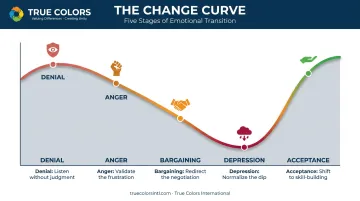
The 5 Stages of the Change Curve and How to Coach Through Them
Each stage of the curve calls for a different coaching posture. Push too hard, too early, and you'll trigger backsliding instead of progress. Understanding whether someone leans toward Gold's need for structure, Blue's need for connection, Green's need for logic, or Orange's need for freedom helps you read these signals sooner and respond well.
Denial
Employees dismiss the change as temporary or "not really happening." They cling to old workflows and may quietly ignore new instructions altogether. During a system rollout, this might look like staff still logging data in old spreadsheets.
Coaching move: Repeat the message often, and don't sugarcoat it. Use active listening without judgment. Denial fades faster when people feel heard, not lectured.
Anger
Frustration surfaces: sharp comments in meetings, complaints to peers, sometimes outright pushback against leadership decisions. Fear is usually driving it.
Coaching move: Give people a safe space to vent. Validate the emotion without agreeing to reverse the change or rushing to fix it. Naming the feeling ("This feels unfair, and I hear that") often does more than any solution.
Bargaining
People start negotiating: "Can we keep the old process for this one team?" Productivity may tick up temporarily as they try to control the outcome.
Coaching move: Acknowledge the compromise attempt, then gently redirect toward full adoption. A short trial period or a temporary support buddy can be offered as a small win, but the core change shouldn't bend.
Depression
This is the lowest point for engagement. Watch for withdrawal, missed deadlines, and flat affect in one-on-ones.
Coaching move: Normalize the dip, don't minimize it. Build individualized support plans and keep check-ins consistent, even short ones. Silence here usually signals disengagement, not calm.
Acceptance
Energy returns. People start asking "how do I do this well?" instead of "why is this happening?"
Coaching move: Shift from emotional support to skill-building. Recognize early wins publicly and start embedding new behaviors into daily routine.
Coaching Through Personality: Why One Approach Doesn't Fit Everyone
Temperament shapes how fast, and how intensely, someone moves through the curve. A detail-oriented person may need a written plan before they'll even acknowledge the change is real.
A relationship-driven colleague might need reassurance that the team dynamic won't fall apart. Coaching one style to everyone almost guarantees you'll miss most of the room.
True Colors International's four-color personality framework gives coaches a fast way to read what someone needs, stage by stage:
- Gold personalities (structure-seekers) want clear plans, timelines, and defined roles before they'll engage
- Blue personalities (relationship-oriented) need empathy, connection, and reassurance that people won't be left behind
- Green personalities (big-picture thinkers) want the rationale, the data, and the "why" before the "how"
- Orange personalities (spontaneous types) respond to flexibility, momentum, and quick, visible wins
Understanding the personality mix on a team lets coaches predict, with real accuracy, who's likely to dig in and resist longest and who'll move to acceptance quickly. That's not guesswork.
True Colors' assessment is ASI-certified, built on a validation study spanning a 10,000-person population sample, and structured to meet EEOC guidelines for fair, reliable use in organizational settings.
For coaches and leaders who want to go deeper, True Colors' Advanced Certification tracks in Conflict Navigation and Communication train facilitators to apply this personality lens directly inside change initiatives. Facilitators build this into an ongoing coaching practice they use across every project.
Common Coaching Mistakes to Avoid During Change
Even well-intentioned coaches derail progress with a few predictable habits:
- Rushing to acceptance. Pushing someone past denial or anger before they've processed it often causes backsliding into resistance, sometimes worse than before.
- Using one communication style for everyone. A structure-seeker and a spontaneous type need different pacing and tone, and treating them identically risks losing one of them mentally.
- Assuming silence means agreement. Once leadership has mentally "moved on," it's tempting to assume the team has too. Individual check-ins usually reveal otherwise.
Coaches who skip these traps tend to see steadier, faster progress across the whole team, not just with the most vocal employees.
Sustaining Change: From Acceptance to Lasting Culture
Reaching acceptance feels like the finish line. It isn't. Without reinforcement, old habits creep back in, and momentum quietly disappears.
Prosci's change management research found that 81% of organizations that planned reinforcement activities met or exceeded their change objectives, compared with just 15% of those that didn't. That gap is the clearest argument for treating reinforcement as a required phase, not an afterthought.
Practical reinforcement tactics include:
- Celebrating milestones publicly, not just internally in leadership meetings
- Recognizing early adopters by name, which encourages peer-level modeling
- Building feedback loops so employees can flag friction before it becomes disengagement
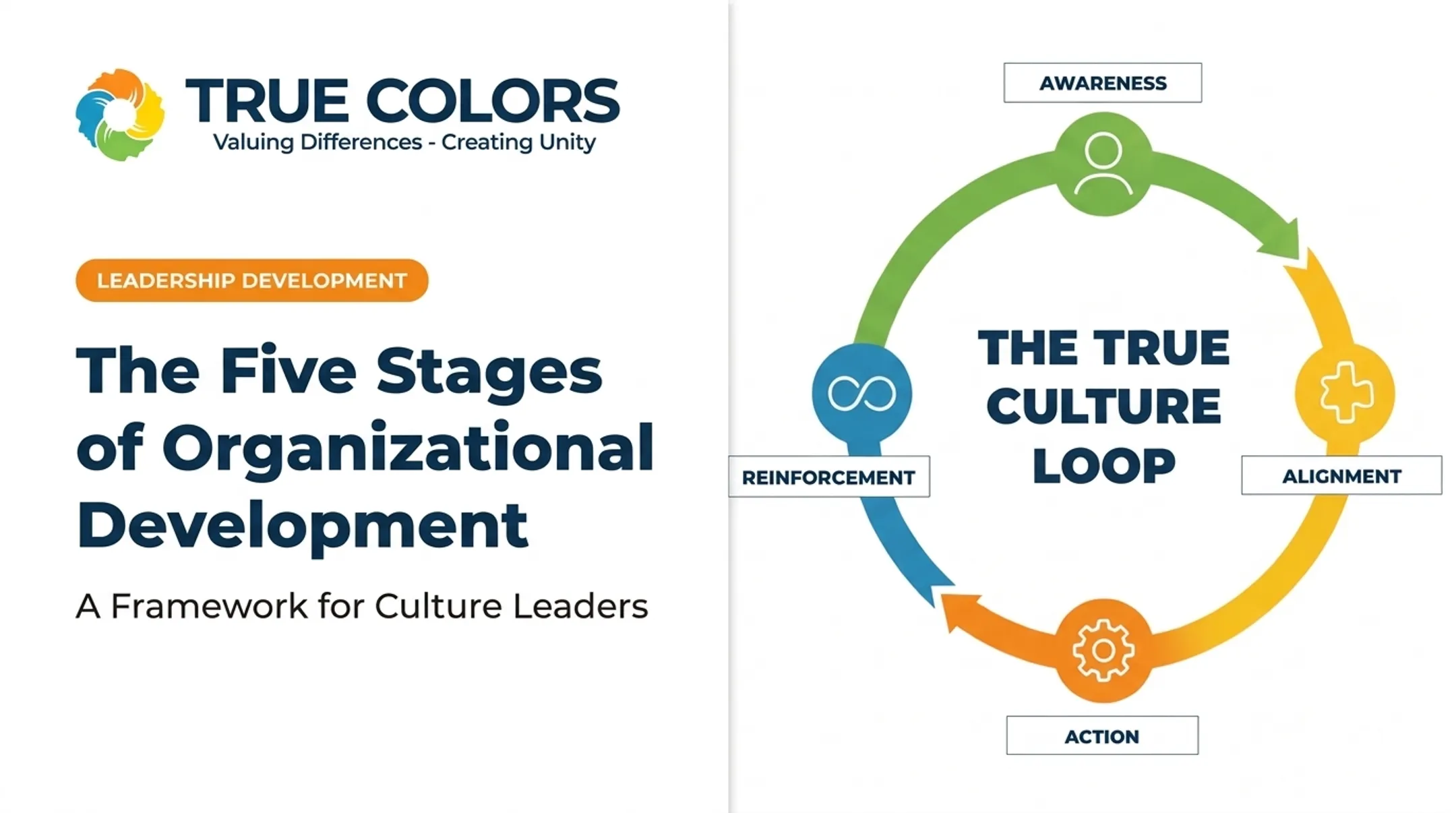
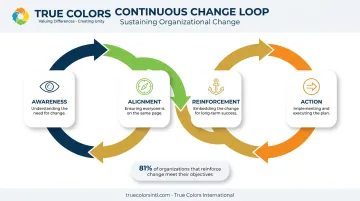
These tactics work best as an ongoing practice, not a one-time checklist. True Colors International frames this idea as a continuous cycle through its True Culture Loop: Awareness, Alignment, Action, and Reinforcement. Instead of treating change as a single push, the loop treats reinforcement as an ongoing part of culture, revisited regularly rather than declared "done" after the initial rollout.
Frequently Asked Questions
What are the stages of the organizational change curve?
The core model includes denial, anger, bargaining, depression, and acceptance. Some adapted versions add exploration and integration as later stages, reflecting how people apply new skills once they've accepted the change.
What are the 5 C's of organizational change?
Different practitioners cite slightly different versions of this framework, commonly including clarity, communication, commitment, culture, and continuity. These complement the Change Curve by focusing on organizational systems, while the curve tracks individual emotional response.
What is the Belbin change curve?
Belbin is best known for its Team Roles model, not a standalone change curve. Belbin's materials apply Team Roles insights alongside the existing Kübler-Ross-based Change Curve, helping coaches tailor support based on team role tendencies.
How long does it typically take to move through the change curve?
There's no fixed timeline. Duration depends on the individual, how well the change was communicated, and the level of support provided along the way. Some people move through in weeks, others take much longer.
Can coaching really speed up someone's acceptance of change?
Coaching can't skip the emotional stages, but tailored, personality-aware coaching can shorten time spent stuck in resistance and reduce the odds of backsliding into anger or denial after progress has been made.