Proving training's financial and cultural impact has become table stakes for HR and L&D leaders, not a nice-to-have. ROI data shapes budget approval, program design, employee performance, and whether leadership keeps writing checks for people development.
Yet most organizations are flying blind here. In ATD's 2025 survey of talent-development professionals, only 30% of organizations said they were good at using learning-program data to make business decisions, and just 43% reported alignment between business goals and learning goals, according to ATD's 2025 research on measuring training's impact.
This guide breaks down exactly how to calculate training ROI step by step, walks through a realistic example, and shows what a defensible, ongoing measurement process actually looks like.
Key Takeaways
- Training ROI compares a program’s monetary benefits to its costs, expressed as a percentage
- The core formula: ROI = ((Benefits – Costs) / Costs) x 100
- Reliable ROI needs baseline data, full cost tracking, and isolation of training’s true effect
- An ROI well above 100% means the program paid for itself and generated additional profit
- Soft-skills training is tracked through proxy metrics such as turnover, engagement, and error rates
What Is Training ROI and Why Does It Matter?
Training ROI is a financial metric that quantifies the monetary return a training program generates relative to its total cost. It answers the question every finance leader eventually asks: was this worth it?
The formula itself is straightforward:
ROI = ((Benefits – Costs) / Costs) x 100
- Benefits: the monetary value of results the training produced (increased sales, reduced errors, saved labor hours, lower turnover costs)
- Costs: the fully loaded cost of designing, delivering, and supporting the program
- The result: a percentage showing how much value you got back per dollar spent
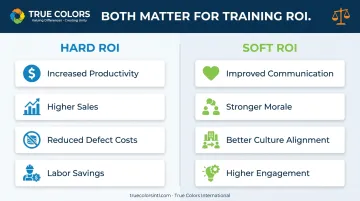
Not every benefit fits neatly into a spreadsheet, though. That's where the distinction between hard ROI and soft ROI matters:
- Hard ROI covers quantifiable financial gains, such as increased productivity, higher sales, or reduced defect costs
- Soft ROI covers intangible gains, like improved communication, stronger morale, or better culture alignment
Both types matter. Soft ROI just requires a different measurement path, which we'll cover later.
Why Measuring Training ROI Is Critical
Without ROI data, training budgets tend to be the first line item cut when finance starts trimming costs. There's no paper trail proving the spend was worth defending.
Measuring ROI matters because it:
- Justifies training spend to leadership with numbers, not opinions
- Aligns programs with business objectives instead of running training for training's sake
- Identifies which programs to scale or cut, freeing up budget for what actually works
- Drives continuous improvement of content, delivery, and facilitator quality
There's no single "typical" ROI percentage that applies across every industry. Published case studies from the ROI Institute show real variation.
A customer-care turnover program returned 96% ROI, while a first-level manager leadership program returned 47% ROI, according to the ROI Institute's ROI Application Guide. The range depends heavily on the program, the industry, and how rigorously the measurement was done.
How to Measure Training ROI – Step by Step
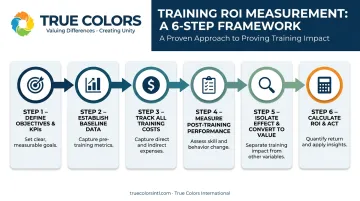
Measuring training ROI is a six-stage process. Skip any one stage and you weaken the final number.
The most common mistake? Relying only on post-training satisfaction surveys. A "loved the workshop" score tells you nothing about whether behavior changed or the business benefited. You need baseline data and cost isolation to get a defensible answer.
Step 1 – Define Objectives and KPIs
Set specific, business-aligned goals before training even begins. Reduce customer complaint volume by 20%? Cut onboarding time by two weeks? Improve retention in a specific department?
Vague goals like "improve communication" produce vague, unusable ROI data later. Pick metrics you can actually count.
Step 2 – Establish Baseline Data
Capture current performance on your chosen KPIs before the training starts. Without this, you have nothing valid to compare post-training results against.
Skip this step and your entire ROI calculation becomes guesswork, no matter how good the math looks afterward.
Step 3 – Track All Training Costs
Record every cost, not just the obvious ones:
- Direct costs: trainers, materials, technology, facilitator fees
- Indirect costs: employee time away from regular work, travel, lost productivity during sessions
Leaving out indirect costs is a common shortcut that inflates ROI artificially. Finance teams will catch it.
Step 4 – Measure Post-Training Performance
Use surveys, skills assessments, manager observations, and actual workplace performance data. Kirkpatrick's four-level model gives a useful structure here: Reaction, Learning, Behavior, and Results, as defined by Kirkpatrick Partners' official training evaluation framework.
Most organizations stop at Level 1 (Reaction). The real value shows up at Level 3 (Behavior) and Level 4 (Results): did people actually change what they do at work?
Step 5 – Isolate Training's Effect and Convert to Monetary Value
This is where most ROI calculations fall apart. Other factors, such as a new manager, a market shift, or seasonal demand, can influence performance alongside training.
Use control groups or trend-line analysis to separate training's actual impact from everything else happening in the business. Once isolated, convert the performance gain into a dollar figure using wages, output value, or cost-savings data.
Step 6 – Calculate ROI and Act on the Results
Plug your isolated, monetized benefit into the formula, then compare it against your program costs. Once you have the percentage:
- Benchmark it against the program's original objectives, not an arbitrary industry number
- Decide what happens next: scale the program, refine it, or cut it
- Document the process so future evaluations follow the same rigor
Training ROI – Example Case Walkthrough
Here's a simplified example that applies across industries, not just manufacturing.
The scenario: A mid-sized company rolls out an internal communication and teamwork training program after noticing miscommunication is driving costly rework across departments.
Setting the objective: Reduce rework hours caused by miscommunication by 25% within six months. Specific, measurable, tied to a business outcome.
Capturing baseline data: Before training, the company tracks 400 hours of monthly rework tied to miscommunication, at an average fully loaded labor cost of $35 per hour (roughly $14,000 per month in avoidable cost).
Tracking total cost: The program runs for 150 employees across two departments. Total cost, including facilitator fees, materials, and time away from work, comes to $45,000.
Measuring post-training performance: Three months later, rework hours drop to 260 per month. Employee feedback also shows improved collaboration scores on internal engagement surveys. The company uses that run rate as the basis for its six-month projection.
Watch for these common missteps:
- Skipping baseline measurement — without the "before" number, the 140-hour drop means nothing
- Failing to isolate other factors — did a new project management tool also launch that quarter? That needs accounting for
- Ignoring intangible gains — improved morale and smoother collaboration don't show up in the rework number but still matter to retention
The math: 140 hours saved monthly x $35/hour x 6 months = $29,400 in direct savings. Add reduced turnover risk (conservatively valued at $15,000 based on retained staff) and total benefits reach roughly $44,400 over six months.
Plug those figures into the ROI formula and you land near break-even at month six. Savings keep compounding after that, so the return turns clearly positive past the one-year mark and often climbs well above 100% over a longer window. That trajectory alone is often enough to justify scaling the program company-wide.
How True Colors International Can Help
Measuring ROI gets a lot easier when training is built with outcomes in mind from day one, not delivered once and forgotten.
That's the structural gap True Colors International was built to close. Rather than a single workshop that creates a temporary spike in awareness, the company's True Culture Loop framework runs on four connected stages:
- Awareness — establishes a measurable baseline through Culture Clarity Assessments and Employee Experience Surveys
- Alignment — sets shared expectations for communication and accountability that make future behavior observable
- Action — embeds new behaviors into real meetings and projects, not just training-room exercises
- Reinforcement — sustains change through ongoing coaching and cultural champions, so habits stick long after the workshop ends
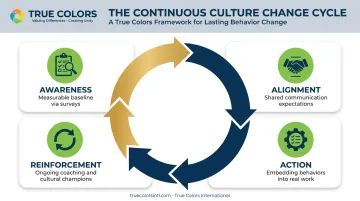
This matters for ROI tracking because a one-time workshop has no built-in feedback loop. There's nothing to compare against six months later. A structured system does.
True Colors International backs this with an ASI-certified personality assessment, validated against a 10,000-person sample and compliant with EEOC 80% guidelines for fairness and reliability.
The company has spent 45+ years across corporate, healthcare, education, government, and non-profit sectors. A nationwide network of certified Master Trainers and Elite Facilitators delivers the work, with advanced certifications in communication, conflict navigation, and team building.
Organizations like Amazon, Google, Ford, and Salesforce have used True Colors' communication and leadership programs to strengthen how teams collaborate. To frame your next training investment in financial terms, download the Culture ROI Guide.
Conclusion
Measuring training ROI gives HR and L&D leaders what budget reviews demand: clarity, control, and a data-backed case for investing in people.
ROI tracking isn't a one-time report you file away after launch. Revisit it as behaviors change and business conditions shift.
Programs built for measurable culture and communication change from day one make that ongoing tracking far easier. True Colors International's reinforcement model is designed that way—so you're not retrofitting metrics onto training after the fact.
Frequently Asked Questions
What is the formula for calculating ROI?
ROI = ((Benefits – Costs) / Costs) x 100. Benefits must first be converted into a monetary value before applying the formula, often the hardest step.
What is a good ROI for training?
There's no single universal benchmark. Documented programs range widely, from under 50% to well over 1,000%, depending on the industry and training type. Anything well above 100% counts as a strong result.
What does an ROI of over 100% indicate about a training program?
It means the training generated more financial benefit than it cost. The program effectively paid for itself and produced additional profit on top of that.
How long does it take to see ROI from training?
Timing varies by program. Reaction and behavior changes can show up within weeks. Quantifiable financial ROI usually takes longer and depends on when the relevant business data is available.
What are the biggest challenges in measuring training ROI?
The top three hurdles are isolating training's effect from other business factors, converting intangible benefits into dollar figures, and collecting consistent data before and after the program.
Can ROI be measured for soft-skills or culture-based training?
Yes. Soft-skills ROI relies on proxy metrics like reduced turnover, fewer communication-related errors, and improved engagement scores, then convert those into dollars with the same core formula.