Leadership assumed it was pay. It wasn't. When they finally sat down and asked employees directly, the real answer surfaced: people felt invisible, overworked, and unsure whether anyone above them actually cared.
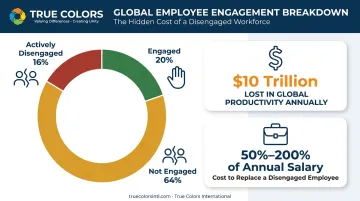
That story repeats itself in offices everywhere. Gallup's 2026 State of the Global Workplace report found that global employee engagement fell to just 20% in 2025, a decline that cost the world economy an estimated $10 trillion in lost productivity. Morale problems rarely announce themselves. They erode quietly until turnover, absenteeism, and disengagement force the issue.
This article gives you 30 categorized morale survey questions, plus guidance on measuring and acting on results, drawing on True Colors International's decades of work helping organizations build stronger workplace cultures.
Key Takeaways
- Morale and engagement overlap, but your survey should measure both.
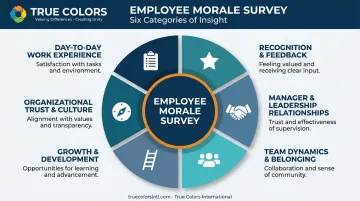
- Strong surveys cover six areas: experience, recognition, management, dynamics, growth, and trust.
- Anonymity, consistent frequency, and visible follow-through build trust; skipping them erodes it.
- Personality dynamics behind low scores, not just raw numbers, are what make culture change stick.
What Is Employee Morale (and How It Differs from Engagement)
Morale and engagement often get used interchangeably, but they measure different things:
- Employee morale: The collective mood of your workforce — how satisfied, motivated, and emotionally steady people feel day to day
- Engagement: An employee's investment in outcomes and willingness to go beyond the minimum
You can have engaged employees with sagging morale during a rough quarter. But morale that stays low for long enough eventually drags engagement down with it. People stop volunteering ideas. They do the job, then check out.
The scale of the problem is bigger than most leaders assume. Gallup's global workplace research consistently finds that 64% of employees worldwide are not engaged, and another 16% are actively disengaged, leaving only one in five truly engaged.
The cost isn't abstract, either. According to SHRM, replacing an employee can cost 50% to 200% of that employee's annual salary, depending on seniority and role complexity. Add absenteeism, lost productivity, and the drag on remaining employees who inherit the workload, and low morale becomes a line item, even if it never shows up labeled as one on a P&L.
How to Measure Employee Morale the Right Way
A single annual survey tells you almost nothing about morale in real time. Culture shifts month to month, sometimes week to week. Measuring it well requires a system, not a snapshot.
Design a Survey System You Can Trust
Run a comprehensive survey quarterly or biannually to capture the full picture. Supplement it with short pulse checks (five to ten questions) monthly to catch shifts before they become resignations.
Employees won't tell you the truth about their manager or workload if they think it's traceable back to them. Keep responses anonymous, report results in aggregate, and say so clearly before employees answer a single question.
Relying on one question format flattens your data, too. Use a combination:
- Rating scales (1–10 or Likert) to track trends over time
- Yes/no questions for quick, unambiguous signals
- Open-ended prompts to capture context numbers can't
Segment the Data and Look Beyond "What" to "Why"
Company-wide averages hide the truth. A team with a toxic manager can drag down an otherwise healthy average, so break results down by team, tenure, and role. Morale problems are almost never distributed evenly across an organization.
Surveys reveal what employees feel, not why. Two employees on the same team, facing the same workload, can report wildly different morale scores, and personality differences often explain that gap.
Personality-based frameworks like True Colors International's temperament model show how people experience identical working conditions in different ways. A heavy meeting schedule might energize one employee and exhaust another, and it's rarely about effort or attitude.
30 Employee Morale Survey Questions to Gauge Team Spirit
These 30 questions span six categories that together cover the full employee experience. Don't send all 30 at once — that's a fast route to survey fatigue. Pick 10 to 15 relevant questions per cycle and rotate categories over time.
Questions About Day-to-Day Work Experience
These surface whether employees have clarity, manageable workloads, and the resources to do their job.
- Do you feel a sense of accomplishment at the end of most workdays?
- Do you have a clear understanding of what's expected of you in your role?
- Do you have the tools and resources you need to do your job well?
- How would you rate your current stress level at work?
- Do you feel your workload is manageable most weeks?
Questions About Recognition and Feedback
Recognition is one of the most under-delivered morale drivers in most organizations. Gallup found that only 22% of employees say they receive the right amount of recognition for their work — a figure that hasn't moved in years.
- When did you last receive recognition for your work?
- Do you feel your contributions are valued by your manager?
- Do you feel your contributions are valued by your teammates?
- How often do you receive feedback that helps you improve?
- Do you feel comfortable giving honest feedback to your manager?
Questions About Manager and Leadership Relationships
The manager relationship is consistently identified as one of the biggest drivers of day-to-day morale and retention. Employees far more often point to a manager, not the company itself, as the reason they walked away.
- Does your manager seem to genuinely care about you as a person?
- Do you trust your manager to have your back?
- How comfortable are you bringing problems or concerns to your manager?
- Does your manager communicate expectations and changes clearly?
- Do you have regular, meaningful conversations with your manager about your work?
Questions About Team Dynamics, Belonging & Collaboration
Morale is partly collective. A strained team dynamic drags down even your best performers, and differing communication or working styles are often the unspoken root of team friction.
- Do you feel like you truly belong on your team?
- How would you rate overall morale on your team right now?
- Do team members support each other when workloads get heavy?
- Are conflicts within your team addressed constructively rather than ignored?
- Do you feel understood by your teammates, even when your working styles differ?
Questions About Growth, Development & Career Path
Employees who don't see a future at a company mentally check out long before they resign. Development access is now one of the top retention levers organizations have.
- Do you see a future for yourself at this company?
- Do you feel you're learning and growing in your current role?
- Do you understand what it would take to advance your career here?
- Has your manager discussed your career goals with you in the last six months?
- Do you have access to mentorship or professional development opportunities?
Questions About Organizational Trust, Culture & Purpose
These gauge whether employees trust leadership and feel connected to the company's mission — a strong predictor of long-term morale and advocacy.
- Do you believe leadership communicates openly and honestly with employees?
- Do you understand how your work contributes to the company's larger goals?
- Would you recommend this company to a friend as a good place to work?
- Do you feel proud to tell others where you work?
- Do you feel the company's values are reflected in day-to-day decisions?
Turning Survey Results into Real Culture Change
Collecting the data is the easy part. Companies that survey employees and then say nothing about the results teach their people one lesson: don't bother being honest next time.
Feedback that disappears into a black hole erodes trust fast. Response rates drop. The next survey gets fewer honest answers, not more. Avoiding that requires two things:
- Share results transparently, including the uncomfortable ones
- Communicate a concrete action plan, not just acknowledgment
- Set a realistic timeline for when employees will see changes
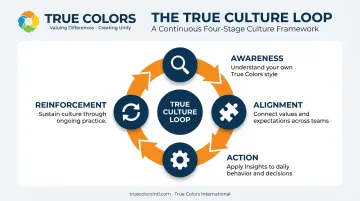
True Colors International built its True Culture Loop framework around this exact problem. It moves organizations through four continuous stages (Awareness, Alignment, Action, and Reinforcement), turning morale data into an ongoing culture-building cycle instead of a one-time report that gathers dust.
Here's the part most action plans miss: many low-morale scores trace back to communication breakdowns or personality clashes, not policy problems. A manager who feels "distant" to one employee might just have a more direct, task-focused communication style that another employee reads perfectly well.
True Colors' ASI-certified assessment, validated against a sample of 10,000 respondents and built to meet EEOC 80% guideline standards, gives leaders and teams a shared language to name and resolve these root causes instead of guessing at them.
Before you finalize any action plan, pair your survey numbers with a qualitative layer. A short focus group or a personality-based workshop often explains in an hour what a spreadsheet couldn't explain in a month.
Frequently Asked Questions
How do you measure employee morale?
You measure morale through a mix of anonymous surveys, pulse checks, and behavioral signals like attendance and work quality. Track it consistently over time, not as a one-time snapshot.
What are good employee morale survey questions?
Good questions are specific, non-leading, and cover work experience, recognition, manager relationships, team dynamics, growth, and trust. The 30 questions listed above follow exactly these categories.
How often should you send employee morale surveys?
Combine a comprehensive survey every quarter or two with brief monthly pulse checks. This catches shifts in morale early, before they show up as resignations.
Should employee morale surveys be anonymous?
Yes. Anonymity increases honest responses, especially on sensitive topics like management style or workload. Communicate the anonymity policy clearly before employees respond.
What's the difference between employee morale and employee engagement?
Morale is the day-to-day emotional state of your workforce. Engagement reflects how invested employees are in outcomes and their willingness to go beyond the minimum. Sustained low morale eventually erodes engagement, too.
How many questions should an employee morale survey include?
Stick to 10 to 15 focused questions per survey. This balances depth of insight with completion rates and helps avoid the drop-off that comes with survey fatigue.