That's not a hypothetical risk. A 2024 BCG analysis found that only 1 in 4 corporate transformations delivered both value creation and change that actually lasted, meaning roughly 75% fell short. Assembling "smart, senior people" sounds simple. It rarely is, because most leadership benches lack aligned mindsets, complementary skills, or a shared way of talking about risk and priority.
This article walks through when to build or rebuild a leadership team, what you need before you start, the exact steps to follow, the traits that separate high-performing transformation teams from stalled ones, and the mistakes that quietly sink good intentions.
Key Takeaways
- Building a transformation leadership team means selecting for mindset and role fit, not just seniority
- Misaligned communication styles and uneven change-readiness are the most common failure points
- Self-awareness tools accelerate trust and cut friction during high-stakes change
- Transformation leadership is a continuous loop of awareness, alignment, action, and reinforcement
- Diversity of thinking style matters more than headcount or title count
How to Build a Leadership Team for Transformation
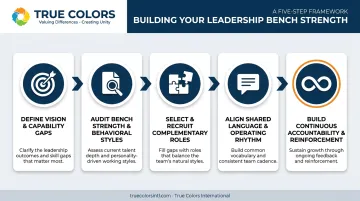
Building this team is a deliberate, sequential process. Skip a step, and it tends to resurface later as resistance, confusion, or quiet disengagement among the very leaders who were supposed to drive the change.
Step 1: Define the Transformation Vision and the Leadership Capabilities It Demands
Before naming a single name, get specific about what "transformed" actually looks like:
- Operationally — what processes, systems, or workflows change
- Culturally — how people are expected to behave, decide, and collaborate differently
- Financially — what results define success, and by when
Translate that vision into concrete leadership capability gaps. Do you need more digital fluency? Stronger cross-functional influence? Someone who can communicate change without triggering panic? Name the gap before you name the person.
Confirm executive sponsorship is locked in at this stage, too. Transformation teams without top-level backing rarely survive their first real setback.
Step 2: Audit Current Leadership Bench Strength and Behavioral Styles
Assess your existing leaders against the capability gaps you just identified, not their current titles. A VP of Operations with the right title might be the wrong fit if the transformation demands a communication style they don't naturally have.
This is where a validated behavioral assessment earns its place. True Colors International's ASI-certified assessment maps each leader across four temperament styles. It was built on a research population of 10,000 respondents and evaluated by an independent reviewer for reliability, construct validity, and EEOC 80% guideline compliance:
- Orange — fast-moving, action-oriented, thrives on momentum
- Gold — structured, detail-driven, values process and dependability
- Green — analytical, logic-first, drawn to data and problem-solving
- Blue — relationship-focused, needs trust before engaging with a message
Once you see the map, look for clustering. A bench that's heavily Orange and Green but light on Blue will move fast and solve problems well. It may also blindside people on the relational side of change. That clustering is a warning sign worth acting on before launch, not after.
Step 3: Select and Recruit for Complementary Roles and Perspectives
Don't fill every C-suite seat for the sake of symmetry. Prioritize functional coverage instead:
- Vision-setting and strategic direction
- Operations and execution
- Finance and resource allocation
- HR and culture
- Communications and change messaging
Bring in at least one outside perspective—an external advisor, executive coach, or newly hired leader. Internal teams develop blind spots and legacy habits that outsiders spot immediately.
When weighing seniority against adaptability, adaptability usually wins. A leader willing to unlearn old playbooks often outperforms a tenured leader who can't let go of "how we've always done it."
Step 4: Align the Team Around a Shared Language and Operating Rhythm
Before the transformation launches, the team needs a common vocabulary for discussing risk, priorities, and decision rights. Otherwise, they're relearning how to communicate mid-crisis—the worst possible time.
Run a structured alignment session first: a workshop, offsite, or facilitated assessment debrief. True Colors' Personal Success Workshop format, for instance, walks leadership groups through personalized results and group-level Team and Leader Reports. Everyone leaves with a shared framework for how colleagues process information, make decisions, and respond under stress.
That shared language becomes the operating system the team returns to when tensions rise.
Step 5: Build in Continuous Accountability and Reinforcement Mechanisms
Set shared metrics and review cadences so the leadership team, not one individual, owns the outcome. Then institutionalize periodic re-alignment check-ins. Transformation isn't a single reorganization event; it's an ongoing loop.
This maps closely to the four-stage model True Colors calls the True Culture Loop:
- Awareness — surfacing blind spots and building shared understanding
- Alignment — turning insight into shared communication and decision practices
- Action — embedding new behaviors into daily leadership habits
- Reinforcement — sustaining the change through coaching, champions, and structured check-ins
Skip Reinforcement, and everything built in the first three stages tends to erode within a few months.
When Should You Build or Rebuild Your Leadership Team for Transformation?
Not every change effort requires a leadership overhaul. Sometimes an existing team just needs realignment, not replacement.
Typical triggers for a rebuild:
- Entering a new market with unfamiliar competitive dynamics
- Major M&A activity that requires leaders to align on integration, culture, and value capture
- A digital or AI-driven business model shift that demands new capabilities
- Repeated failure of past change initiatives, signaling deeper misalignment
When a full rebuild is overkill:
- Minor process improvements confined to one team
- Single-department initiatives that don't require enterprise-wide realignment
- Leadership already aligned on vision, with only execution support still missing
Once you know whether to rebuild or realign, scale shapes who sits on the team. A 200-person company might need a lean five-person leadership group. A multi-layered enterprise typically needs broader representation: business unit heads, HR, finance, and communications. The change has to land consistently across more layers of the organization.
What You Need Before Building Your Transformation Leadership Team
Preparation determines how fast the team gels once it's assembled. Rushing this stage almost always costs more time later.
Organizational Readiness Requirements
Before recruiting begins, you need:
- A documented transformation vision that leaders can reference and repeat
- Confirmed board or executive sponsorship
- A realistic timeline that accounts for both quick wins and longer cultural shifts
Assessment and Insight Tools
You need visibility into how current and prospective leaders think, communicate, and handle conflict—ideally before you finalize the roster. Research-validated assessments shorten the trust-building curve.
True Colors' online assessment, for example, produces a 25-plus-page individual report covering personality strengths, stress responses, and the gap between self-image and how peers actually perceive a leader. That gap is often where transformation friction starts.
Skill and Change-Readiness Checks
Round out your prep with a baseline evaluation of each candidate leader's:
- Change tolerance under pressure
- History of cross-functional collaboration
- Willingness to be coached rather than simply directed
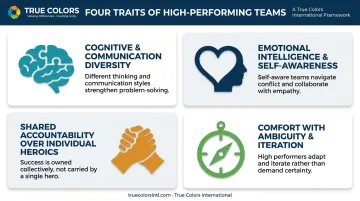
Key Traits That Determine Whether a Transformation Leadership Team Succeeds
Outcomes hinge less on individual brilliance and more on how the team collectively thinks, decides, and communicates under pressure.
Cognitive and Communication Diversity
A team locked into one dominant thinking style misses risks and opportunities other styles would catch immediately.
Harvard Business Review research on cognitively diverse teams found that groups with greater diversity in perspective and information processing finished a complex, uncertain strategy exercise faster than less-diverse teams. The less diverse teams either took longer or failed the exercise entirely.
Complex, ambiguous problems—exactly what transformation produces—reward varied thinking styles.
Emotional Intelligence and Self-Awareness
Leaders who know their own triggers and biases de-escalate conflict faster during high-pressure change instead of letting friction compound.
Stronger emotional intelligence on the leadership team shows up as lower turnover and fewer rework cycles caused by unresolved friction. Without a shared EQ baseline, teams see more task conflict and more relationship conflict—both of which slow transformation.
Shared Accountability Over Individual Heroics
Transformation fails when one leader is expected to carry it alone. That model burns out the sponsor and leaves everyone else waiting for direction instead of acting.
McKinsey's survey of 1,034 transformation participants found successful transformations were far more likely to give influencers across the organization real ownership of specific initiatives or milestones—not just the top sponsor. Distributed ownership keeps momentum alive well past launch.
Comfort With Ambiguity and Iteration
Transformation rarely follows a clean, linear plan. Leaders who need total certainty before acting stall decisions the team cannot afford to delay.
Teams that treat plans as working drafts course-correct faster and meet less internal resistance when priorities shift mid-stream—which they almost always do. That comfort with iteration keeps the program moving when the original roadmap no longer matches reality.
Common Mistakes When Building a Transformation Leadership Team (and How to Fix Them)
Even strong transformation plans stall when the leadership team is built on habit instead of fit. These four mistakes show up often—and each one has a clear fix.
Assembling the team from org-chart seniority instead of capability fit
- Cause: Defaulting to who already holds the title, not who matches the transformation’s needs
- Fix: Re-map roles against the capability gaps you identified earlier before locking in names
Skipping alignment work and assuming shared understanding
- Cause: Pressure to move fast crowds out structured onboarding and communication-style discussions
- Fix: Run a dedicated alignment session or assessment debrief before launch—not after friction appears
Ignoring early warning signs of leadership misalignment
- Cause: Leaders bury disagreement to look unified in front of the wider organization
- Fix: Schedule regular check-ins where friction can be named early and handled directly
Overloading the team without external support or coaching
- Cause: Assuming internal leaders can absorb every new demand with no added capacity
- Fix: Bring in coaching or facilitation support, especially if the team has never operated in the future state you’re building toward
Catch these early and the team spends its energy leading the change—not recovering from avoidable missteps.
Frequently Asked Questions
What are the key principles for building a leadership team for transformation?
Align on a clear vision before recruiting, prioritize complementary skills and communication styles over seniority, and build continuous accountability loops rather than treating team formation as a one-time restructuring.
What is a transformation leadership team?
It's a cross-functional group of leaders specifically assembled to drive and sustain large-scale organizational change. It differs from a standard management team because its mandate is temporary, focused, and tied to a specific transformation outcome.
How many people should be on a transformation leadership team?
Keep the team small enough to decide quickly—usually covering vision, operations, finance, HR/culture, and communications. Exact headcount matters less than having each of those functions represented.
What roles are essential on a transformation leadership team?
Most effective teams cover an executive sponsor, an HR or culture lead, a finance partner, a communications or change lead, and someone focused on execution or coaching who keeps the group moving. The exact titles matter less than making sure each function has a voice.
How do personality assessments help build stronger leadership teams?
They surface communication and decision-making differences early, before those gaps turn into friction. With a shared language for how people prefer to work, teams build trust faster than trial-and-error alone.
How long does it take to build an effective transformation leadership team?
Initial team formation can happen in a matter of weeks. Real alignment and trust, though, typically take several months of consistent collaboration and reinforcement to solidify.