Left unmanaged, disagreements quietly drain time and money. A widely cited CPP Inc. workplace conflict study found that U.S. employees spent an average of 2.8 hours per week dealing with conflict, translating to roughly $359 billion in paid working hours in 2008 alone.
Unresolved tension doesn't stay contained, either. It seeps into engagement, drives turnover, and erodes trust between coworkers who might otherwise work well together. This article breaks down what causes workplace conflict, the skills that actually resolve it, and how to choose a training program that fits your team, including personality-based approaches that help people understand each other before friction turns into a formal complaint.
Key Takeaways
- Structured training gives employees practical tools to de-escalate disputes before they require formal HR intervention
- Programs built on communication, active listening, emotional intelligence, and mediation equip teams to resolve conflict early
- Formats range from three-hour workshops to multi-day certification tracks based on how deep the organization needs to go
- Personality-based frameworks, such as True Colors' ASI-certified assessment, speed mutual understanding before differences escalate
Understanding Workplace Conflict: Common Causes & Why Training Matters
Workplace conflict resolution training is a structured program designed to teach employees and managers how to handle disagreements constructively, rather than avoiding them or letting them fester. It typically combines skill-building (communication, listening, negotiation) with self-awareness tools that help people recognize their own conflict patterns.
So what actually causes conflict at work? Research points to a mix of interpersonal and structural factors, and the ranking shifts depending on when and who you ask.
- Personality clashes and ego — cited by 49% of employees in CPP's 2008 global survey as the leading driver
- Poor communication — identified as the top cause (47%) in a more recent Myers-Briggs Company TKI research report from 2022
- Lack of role clarity — the second most common cause in that same 2022 survey, at 42%
- Heavy workloads and competing priorities — a consistent factor across both studies
- Poor leadership or management — cited by nearly a third of respondents in the older CPP data
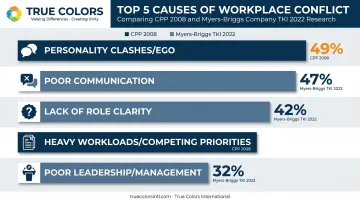
No single cause stays on top forever. Communication breakdowns and role ambiguity now sit alongside personality friction as leading drivers, so training must cover both interpersonal skills and structural clarity—not just "getting along better."
From Reactive to Proactive
Most organizations only address conflict after it's visible: a heated meeting, a formal complaint, a resignation. Training flips that sequence.
Instead of managers scrambling to mediate after damage is done, employees learn to recognize friction early and address it directly. That shift matters because unaddressed tension doesn't stay neutral; it damages morale and trust the longer it sits.
Core Skills and Components of Effective Conflict Resolution Training
Effective conflict resolution training builds interlocking capabilities that activate together when tension rises.
Communication skills. Employees learn to express concerns constructively, without accusation, and to adjust their delivery based on who they're talking to. A direct, fast-moving colleague needs a different approach than someone who values relationship-building before diving into specifics.
Active listening. This means paraphrasing what the other person said, asking clarifying questions, and validating their perspective before jumping to a response. Harvard Business Review notes that active listening involves attention to words, tone, and body language, not just waiting for your turn to speak.
Emotional intelligence and self-regulation. Recognizing personal triggers and staying composed under pressure prevents small disagreements from escalating into shouting matches or cold-shoulder standoffs.
Mediation and negotiation techniques. Employees and managers learn to use neutral facilitation to guide two parties toward a solution both can live with, rather than picking a winner.
Assertiveness and problem-solving. Training also teaches people to advocate for their own needs respectfully while working toward outcomes that don't leave anyone worse off.
Where Personality Awareness Fits In
One layer often missing from generic programs is helping employees understand why certain communication styles clash. Personality and temperament frameworks fill that gap.
True Colors International's proprietary assessment, certified by the Assessment Standards Institute (ASI) through 2027, sorts communication tendencies into four categories:
- Orange (Action-Oriented): moves fast, prioritizes results, gets impatient with over-explanation
- Gold (Organized): values structure, clear roles, and defined expectations
- Green (Analytical): listens for logic and data, tunes out emotional appeals
- Blue (Relationship-Oriented): needs rapport and connection before engaging with the actual message
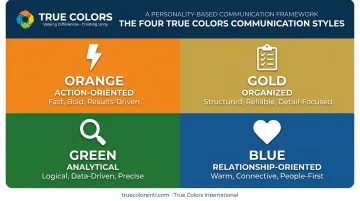
When teams share a vocabulary for these differences, a fast-moving Orange colleague stops looking "reckless" and a careful Gold planner stops looking "obstructionist." The friction gets named instead of misread.
Benefits of Conflict Resolution Training for Employees and Organizations
The case for training holds up on both sides of the ledger: what the organization gains, and what individual employees gain.
Organizational Benefits
CPP's research found that among employees who'd received formal conflict-management training, more than 95% said it helped them manage conflict, and 58% reported actively looking for win-win outcomes afterward. That shift shows up in a few practical ways:
- Fewer disputes escalate to formal HR intervention, freeing up management time
- Projects experience less disruption from unresolved interpersonal tension
- Teams build psychological safety, meaning people raise concerns before they fester
Google's work with True Colors International, for example, focused on communication, conflict resolution, and emotional intelligence in leadership roles. Even large, resource-rich organizations invest in structured, ongoing training rather than one-off fixes.
Employee Benefits
Employees benefit just as directly:
- Greater confidence handling disagreements, which raises job satisfaction and reduces avoidance of tough conversations
- Lower day-to-day stress through better emotional regulation, so fewer conflicts follow people home
- Stronger career trajectory as emotional intelligence and mediation skills feed into leadership potential
Training Formats and Delivery Methods
Not every organization needs the same depth of training. Choose a format based on goals, team size, and whether you need a one-time skill boost or lasting internal capability.
In-person workshops. Live, facilitated sessions allow for role-play and real-time feedback. True Colors International's Personal Success Workshop, for instance, runs about three hours and helps participants map communication strengths and stressors—their own and their teammates'.
Virtual and self-paced options. Live virtual workshops keep facilitation interactive for hybrid or remote teams. Self-paced microlearning works when you need consistent skill-building without pulling everyone into a room at once.
Certification and advanced programs. HR professionals and managers who need deeper mediation skill can take multi-day tracks focused on conflict navigation. Programs accredited by SHRM or HRCI often count toward professional recertification credit.
Match the format to the job:
- In-person workshops for practice-heavy skill building and team alignment
- Virtual or microlearning for distributed teams and ongoing reinforcement
- Certification tracks when managers or HR must mediate conflict independently
Choosing the Right Conflict Resolution Training Program for Your Organization
A generic, one-size-fits-all course rarely solves organization-specific conflict patterns. Before selecting a program, work through a few practical checks.
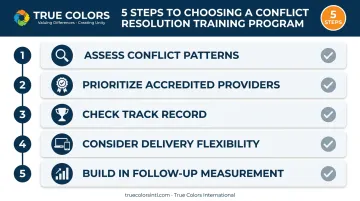
- Assess your conflict patterns first. Is friction driven mostly by unclear roles, communication style mismatches, or workload imbalance? Industry and team size matter too. A 12-person startup and a 3,000-person hospital system need different approaches.
- Prioritize accredited providers. Look for credentials like SHRM Recertification Provider status, HRCI Approved Provider status, or ICF membership. These signal adherence to recognized professional standards and often unlock recertification credit for HR attendees.
- Check for a proven track record across industries. True Colors International, for example, has operated for more than 45 years and counts Amazon, Google, Ford, Oracle, and Marriott among its clients. That reach is evidence of a methodology that scales across sectors, not just one niche.
- Consider delivery flexibility. Hybrid and multi-location workforces need programs available in-person, virtually, or blended so every team member gets the same foundation.
- Build in follow-up measurement. Training shouldn't end when the session does. Track behavior change, dispute frequency, and engagement scores afterward. True Colors International uses the True Culture Loop (Awareness, Alignment, Action, and Reinforcement) to keep culture change active well beyond the initial workshop.
Frequently Asked Questions
What are the 5 C's of conflict resolution?
Common versions include Communication, Collaboration, Compromise, Calmness, and Commitment (wording varies by source). Each is a mindset shift that moves disagreement toward resolution instead of escalation.
What is the 5-5-5 conflict resolution rule?
This informal technique asks whether an issue will still matter in five minutes, five months, or five years before you react. It is a pause-and-reflect habit, not a formal research framework.
What are the 5 skills for conflict resolution?
Active listening, assertiveness, composure, empathy, and problem-solving form the core skill set most training programs teach. These skills work together, helping employees de-escalate tension while still advocating for their own needs.
What are the 5 main conflict resolution strategies?
Based on the Thomas-Kilmann Conflict Mode Instrument, first published in 1974, the five modes are competing, collaborating, compromising, avoiding, and accommodating. Each fits different situations depending on the stakes and relationship involved.
How long does workplace conflict resolution training typically take?
A foundational workshop often runs a few hours; facilitator certification programs can span multiple days. Match the format to your goal: broad employee skills or internal facilitators who can scale training.
Who should attend conflict resolution training in an organization?
All employees benefit, but managers, HR professionals, and team leads should prioritize attendance—they most often mediate disputes between others. Building the skill at the leadership level has the broadest organizational impact.