The stakes are real. Gallup's 2026 State of the Global Workplace report found that only 20% of employees worldwide were engaged in 2025, a gap that cost the global economy an estimated $10 trillion in lost productivity.
This guide breaks down 20 team building ideas for in-person, virtual, and hybrid teams, plus how to pick the right one and avoid the mistakes that turn a good idea into a wasted afternoon.
Key Takeaways
- Tie team building to a clear goal—trust, communication, or retention—not a filled calendar slot
- The 20 ideas below span three formats: in-person, virtual, and hybrid
- Choose activities by team size and work format, not LinkedIn trends
- One-off events spark connection; lasting culture change needs knowing how your people communicate
Why Team Building Matters in the Corporate World
Poor communication doesn't just cause awkward meetings. It creates silos, erodes trust, and pushes good employees out the door. As hybrid work becomes permanent rather than temporary, the gap between teams who communicate well and teams who don't is widening fast.
Gallup's research on managing hybrid and remote teams found that 48% of leaders and managers cite communication as a top challenge, while 44% point to collaboration as their biggest hybrid-work headache, according to Gallup's strategic guide for hybrid and remote teams.
Without deliberate effort, a few predictable things happen:
- Departments operate in silos, duplicating work or missing handoffs
- Small misunderstandings calcify into long-term trust issues
- Turnover rises as employees feel disconnected from their team and their purpose
- Meetings become transactional instead of collaborative
Structured team building activities interrupt that pattern. They give people low-stakes reasons to interact outside their usual roles, which is often where real trust gets built. Heading into 2026, with hybrid work now the norm for remote-capable teams, deliberate connection-building is simply how well-run companies operate.
20 Corporate Team Building Activities for 2026
Team building activities generally fall into three buckets: in-person, virtual, and hybrid. The right choice depends less on what's popular and more on how your team actually works day to day.
In-Person Team Building Activities
In-person formats shine for co-located teams, offsites, and retreats where face-to-face connection is the whole point.
- Office Olympics / Team Challenges — Mini-competitions (think marshmallow-and-spaghetti towers) spark friendly rivalry and show how people collaborate under a clock.
- Escape Room Challenge — Solving timed puzzles together forces fast communication and critical thinking. A short debrief afterward is where the real insight happens.
- Cooking Competition — A themed cook-off puts people in small groups, with leaders as judges for a light power reversal.
- Scavenger Hunt — Add photo challenges, trivia, or mini-tasks at each stop to keep energy up and push teams toward creative problem-solving.
- Volunteering & Community Service — Let teams pick the cause. Deloitte's 2024 workplace volunteering survey found 91% of professionals say volunteer opportunities can strengthen their connection to their employer.
- Board Game Tournament — Mix quick games with strategic ones so people naturally rotate tables and network across departments they rarely talk to.
- Improv Workshop — Improv's "yes, and" principle builds active listening and psychological safety—even for introverts—in a low-stakes setting.
- Personality & Communication Styles Workshop — A facilitated session with a validated framework helps teams see why they clash, not only that they clash. True Colors International's three-hour Personal Success Workshop uses four temperament styles—Orange, Gold, Green, and Blue—to give teams a shared vocabulary for pace, detail, and decisions. The assessment is ASI-certified against EEOC fairness standards, which matters when HR needs a defensible tool. Use it as the foundation other activities build on.
Virtual Team Building Activities
Virtual formats work best for remote and distributed teams, and the golden rule is genuine interactivity over passive Zoom-watching.
- Virtual Trivia — Tools like Kahoot or Mentimeter mix general knowledge with company-specific rounds, so new hires and veterans can both compete on equal footing.
- Online Cooking or Mixology Class — Ship ingredient kits ahead of time, then cook or mix along with a live instructor. Messier than a slide deck—and more memorable.
- Virtual Escape Room — Facilitated online puzzle sessions built for distributed teams make escape rooms work cleanly over video.
- Remote Talent Show — A low-pressure showcase for singing, comedy, pets, or hobbies lets colleagues see each other as people, not just Slack avatars.
- Virtual Book or Documentary Club — Pick leadership- or industry-relevant titles to create a recurring, reflective touchpoint instead of a one-off event.
- Virtual Icebreaker Session — Simple options like Two Truths and a Lie or a shared personality quiz open a remote meeting without eating up the whole hour.
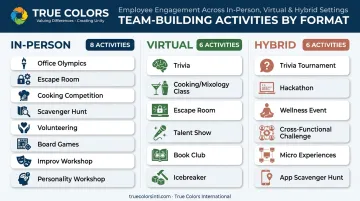
Hybrid Team Building Activities
Hybrid is the hardest format to get right. The goal is giving remote and in-person participants equal, active roles, not bolting a Zoom link onto an in-person party.
- Hybrid Trivia Tournament — Score so neither remote nor in-office players gain an edge from audio delay or side conversations.
- Innovation Hackathon — Mixed remote and in-person teams tackle a real business problem async, then present live finals together.
- Hybrid Wellness Event — Guided yoga, meditation, or nutrition sessions led by a facilitator experienced with hybrid audiences keep both groups equally engaged.
- Cross-Functional Project Challenge — Pair employees across departments and locations on a short challenge tied to an actual business goal, not a hypothetical one.
- Department-Led Micro Experiences — Smaller 10–20 person gatherings owned by individual teams are rising for 2026. Amex GBT's 2026 forecast found 27% of meeting professionals already planning smaller events amid economic uncertainty.
- Gamified App-Based Scavenger Hunt — GPS-based apps handle logistics and scoring so multi-location teams share a live leaderboard—no spreadsheet chaos.
How to Choose the Right Team Building Activities for Your Team
The "right" activity depends on your team's goals and constraints, not on what worked for the company down the street.
Consider these factors before booking anything:
- Define the goal first — Trust, communication, innovation, and onboarding all call for different activities. Pick the goal, then the format.
- Match it to your team's structure — Size, location, and work format (in-person, remote, hybrid) will eliminate half the list immediately.
- Factor in budget and logistics — Decide whether you need outside facilitators or can run it with internal staff, and how much time you can realistically block off.
- Design for inclusivity — Mix high- and low-energy options so introverts, extroverts, and people with different abilities or cultural backgrounds can participate without being put on the spot.
Two mistakes come up constantly:
- Skipping the debrief. A 2021 meta-analysis of 61 studies found that structured after-action reviews produced a strong overall improvement effect (d = 0.79). Skip the debrief and you're left with a fun memory instead of a lasting insight.
- Treating it as a one-off. A single great event fades fast without a recurring cadence and a way to measure impact, like a short follow-up survey a few weeks later.
Building a Lasting Culture Beyond One-Off Team Building Events
Fun activities create a burst of bonding. That's real and worth doing. But sustainable culture change comes from something deeper: an ongoing, shared understanding of how your people communicate, make decisions, and handle conflict.
This is where a structured framework earns its keep. True Colors International has spent 45+ years building this framework. Organizations including Amazon, Google, Ford, and Marriott have used its methodology to give teams a common language for collaboration.
The True Culture Loop runs on four stages:
- Awareness — Team members learn their own communication style and how it differs from others'
- Alignment — The group establishes shared norms for communication, decisions, and accountability
- Action — Teams apply those norms in real meetings, projects, and feedback conversations
- Reinforcement — Coaching and internal champions keep the habits alive long after the workshop ends
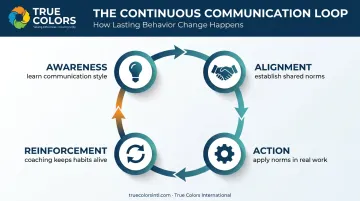
Pairing a single fun activity with a framework like this is what separates a nice afternoon from an actual shift in how a team operates.
Conclusion
Team building in 2026 is a strategic response to how work actually happens: across offices, home desks, and time zones. With 20 activities spanning in-person, virtual, and hybrid formats, there's something here for nearly every team size, budget, and goal.
The biggest returns come from pairing memorable activities with a steady effort to understand how your people communicate and work together. One builds a moment. The other builds a culture.
When you're ready to move past one-off events, True Colors International helps teams build that shared language through personality-based team building and communication programs.
Frequently Asked Questions
What are good corporate team building activities?
Good activities span multiple formats—escape rooms, scavenger hunts, personality workshops, and hackathons—so you can match the activity to your goal. There's no single "best" option; it depends on your team's needs and what you're trying to build.
How often should companies run team building activities?
A larger quarterly event paired with lighter monthly touchpoints, like a virtual icebreaker or trivia round, keeps engagement consistent without constant planning. Consistency matters more than scale.
What are the best team building activities for hybrid teams?
Look for formats that give in-person and remote participants equal, active roles, such as hybrid trivia tournaments or innovation hackathons. Avoid anything that treats remote employees as an afterthought to an in-person event.
How do you make team building inclusive for all personality types?
Offer opt-in formats, mix high- and low-energy activities, and use a personality framework to understand team preferences before you plan. That approach keeps introverts and reserved members from being put on the spot.
What's the difference between in-person, virtual, and hybrid team building?
In-person offers the richest, most spontaneous connection. Virtual works best for fully distributed teams. Hybrid requires the most careful design because both groups need an equal experience.
How do you measure the success of a team building event?
Use a short post-event survey, follow up with a pulse check a few weeks later, and track trends in engagement or retention over time. Success shows up in what sticks afterward.