Introduction
Organizational communication is the system through which information, ideas, and direction flow across a business, connecting leadership, teams, and customers. Get it wrong, and even the most talented workforce falls out of sync.
Remote and hybrid teams, cross-functional projects, and diverse workforces mean messages now travel through more channels, more time zones, and more audience types than a decade ago. Decisions must happen faster too, leaving less room for miscommunication.
This article breaks down what organizational communication actually means and the main types businesses rely on. You'll see real examples from companies like Google and Amazon, plus guidance on choosing the right approach for your team.
TL;DR
- Organizational communication moves information across a company to align people, culture, and goals
- It directly shapes engagement, productivity, decision-making, and customer trust
- Core types include internal/external, formal/informal, and vertical/horizontal/diagonal flows
- The right type depends on audience, purpose, and urgency, not a single formula
What Is Organizational Communication?
Organizational communication is the structured and unstructured exchange of information among employees, teams, leadership, and outside stakeholders. It functions as the entire nervous system of a business, extending well beyond any single channel or meeting.
This includes internal channels like team meetings, memos, and company intranets, plus external ones such as press releases, marketing campaigns, and customer service interactions. Both directions matter equally.
The business case is strong. In Gallup's Q1 2025 survey of over 7,500 U.S. employees, 29% cited a lack of clear, honest, or consistent communication from leadership as the largest factor behind their disengagement, according to Gallup's 2025 workplace research.
When communication breaks down, the consequences show up fast:
- Siloed teams that duplicate work or contradict each other
- Inconsistent messaging to customers and partners
- Higher turnover as employees feel disconnected from leadership
- Slower decisions because information doesn't reach the right people in time
Types of Organizational Communication
No single communication style works for every situation. Most organizations run several types simultaneously. The real skill is matching the right type to the right moment.
Internal vs. External Communication
Internal communication keeps the business running day to day: team meetings, memos, intranet updates, and Slack or Teams channels. External communication shapes how the outside world sees the company: press releases, social media, and customer service.
Best-fit use cases:
| Type | Best-Fit Use Cases |
|---|---|
| Internal | Alignment, operational updates, policy rollouts |
| External | Brand reputation, customer relationships, public trust |
The two are more connected than most leaders realize. When internal teams share a common language and clear expectations, external messaging becomes more consistent by default.
This is one reason companies invest in personality-based communication training, such as the True Colors International methodology, to help colleagues understand how each other processes and delivers information before it ever reaches a customer.
The limitation to watch for: organizations that pour resources into external polish while neglecting internal alignment often see morale and culture erode, even as the brand looks great from the outside.
Formal vs. Informal Communication
Formal communication includes official reports, scheduled meetings, and policy documents. Informal communication covers casual chats, instant messages, and the office grapevine.
| Type | Best For | Key Strength |
|---|---|---|
| Formal | Compliance, critical decisions, documentation | Builds accountability and traceability |
| Informal | Relationship-building, fast problem-solving | Builds trust, speeds up idea-sharing |
The trade-off matters. Too much formality slows responsiveness, while too little oversight on informal channels invites misinformation.
Research cited by the American Management Association puts real numbers behind that risk:
- 70% of organizational communication travels through the informal grapevine
- 80% of grapevine rumors, in a survey of 837 professionals, were reported as true
- 47% of those professionals trusted the grapevine more than official leadership statements
None of this means shutting down informal channels. Instead, keep formal channels clear and frequent enough that the grapevine isn't filling gaps leadership left open.
Vertical, Horizontal & Diagonal Communication
Three directional flows shape how information moves through a hierarchy:
- Vertical: moves up and down the chain of command (feedback, direction-setting, policy updates)
- Horizontal: moves between peers at the same level (team collaboration, project coordination)
- Diagonal: crosses both levels and departments (common in matrixed, fast-moving projects)
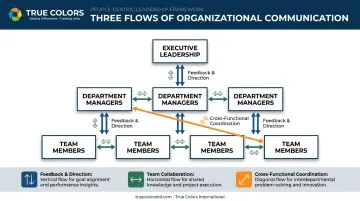
Each serves a different kind of agility. Vertical communication sets direction. Horizontal communication keeps teams synced. Diagonal communication, increasingly common in flatter organizational structures, lets a marketing coordinator loop in a senior engineer without routing everything through three managers first.
The risk: organizations that lean too heavily on vertical-only communication create bottlenecks and top-down silos, where employees wait on approval chains instead of solving problems in real time.
Understanding individual temperament and communication style differences, a core focus of the True Colors framework, helps teams navigate these flows without one person's directness being mistaken for another's disengagement.
Business Examples of Organizational Communication in Action
Leading companies don't treat communication as an afterthought. They build it into how they operate.
Google: Open Dialogue Fuels Innovation
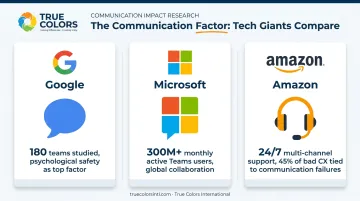
Google's Project Aristotle studied 180 teams, applying more than 35 statistical models to identify what separates high-performing teams from the rest. The top factor: psychological safety, the sense that team members can speak up without fear of embarrassment.
According to Google's own research, employees on teams with stronger communication dynamics were less likely to leave the company and were rated effective by executives twice as often as those on weaker teams. Open feedback channels and regular all-hands meetings deliver a measurable competitive advantage beyond simple culture-building.
Microsoft: Technology-Enabled Global Collaboration
Microsoft Teams became the backbone of collaboration for a workforce spread across time zones and departments, surpassing 300 million monthly active users during a recent reporting year. That scale reflects a broader shift: dispersed teams now depend on real-time digital tools to replace the hallway conversations that used to carry informal updates.
Software alone won't fix communication gaps. Horizontal and diagonal communication need infrastructure, not just good intentions, to function at scale.
Amazon: Customer-Centric External Communication
Amazon runs its customer service operation through multiple channels, including 24/7 live chat, phone support, and a self-service help center. That redundancy matters. Consumer research from Qualtrics found that among the top reasons for bad customer experiences, 45% of respondents cited communication failures, nearly tied with service delivery itself.
Amazon's multi-channel approach reflects a simple principle: customers don't care which department handles their issue. They care that someone responds, clearly and quickly.
Google and Amazon are also client partners of True Colors International, which applies similar communication-focused training across industries worldwide.
How to Choose and Strengthen the Right Type of Communication for Your Organization
There's no universal "best" communication type. The right choice depends on your goals, your audience, and your culture, not on what's popular or convenient.
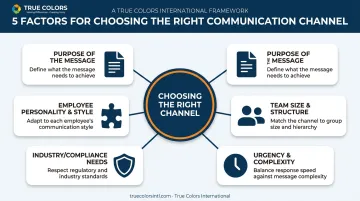
Key factors to weigh before choosing a channel:
- Purpose of the message: informational updates need different handling than sensitive feedback
- Team size and structure: flat teams lean informal; larger, matrixed teams need more formal structure
- Urgency and complexity: a quick Slack message works for simple updates; complex policy changes need documentation
- Industry or compliance needs: regulated industries often require formal, traceable communication
- Employee personality and communication styles: how people prefer to receive information varies widely
Personality-based frameworks help here. The True Colors International methodology, used across organizations in corporate, healthcare, education, and government sectors, gives teams a shared language for temperament differences. When a manager understands that one direct report processes feedback analytically while another needs relational context first, message delivery improves and miscommunication drops.
Even with a solid framework in place, certain habits can quietly undo that progress. Common mistakes to avoid:
- Over-formalizing communication in small, agile teams
- Ignoring informal or grapevine channels instead of managing them
- Skipping two-way feedback loops
- Assuming one channel or style fits every audience
Communication training isn't a one-time fix. Building it into ongoing culture-alignment programs, rather than a single workshop, produces results that hold up over time.
Conclusion
Organizational communication is the connective tissue that keeps a business aligned and adaptable. Internal and external, formal and informal, vertical, horizontal, and diagonal: none of these types compete with each other. They each solve a different problem.
Understanding when to use which one, and investing in the skills to do it well, leads to a stronger culture and faster, more confident decisions. That's the transformation True Colors International helps organizations achieve every day.
Frequently Asked Questions
What is the meaning of organizational communication?
It's the exchange of information within and outside a company that supports collaboration, decision-making, and alignment. It covers everything from team meetings to customer service interactions.
What are the 4 types of organizational communication?
Most frameworks cite internal, external, formal, and informal communication as the core types, sometimes paired with vertical, horizontal, and diagonal flows. Organizations typically use several simultaneously.
What is an example of organizational communication?
A weekly team stand-up meeting is a common example, along with a company-wide newsletter or a customer service chat interaction. Each represents a different type and audience.
Why is organizational communication important for business success?
Strong communication drives higher engagement, better decision-making, and lower turnover. Industry research links top-quartile engagement to far higher profitability and productivity than bottom-quartile teams.
What are common barriers to effective organizational communication?
Unclear messaging, personality and cultural differences, poor channel choice, and missing feedback loops top the list. Many breakdowns happen because the wrong communication type was used for the situation.
How can companies improve organizational communication?
Companies benefit from structured training, clear objectives, and regular feedback mechanisms. Personality-based approaches, like True Colors International's methodology, help teams tailor messages to individual communication styles.