Companies with a strong innovation culture are 60% more likely to be innovation leaders, according to BCG's research on innovation strategy. Yet many organizations still chase innovation through labs, hackathons, and new software, while ignoring the cultural conditions — psychological safety, honest communication, diverse thinking — that determine whether ideas ever see daylight.
This guide breaks down what an innovation culture actually looks like inside a real organization, how it functions day to day, and the specific levers leaders can pull to build one on purpose.
Key Takeaways
- Culture acts as the operating system deciding whether innovation repeats or fades.
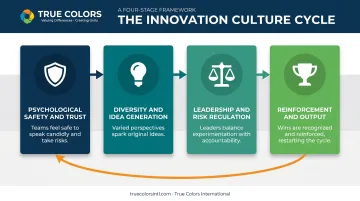
- Innovation flows through four stages: safety, idea generation, risk regulation, and reinforcement.
- Four categories drive most innovation: product, process, business model, and structure.
- Diverse leadership teams earn 45% of revenue from new products, versus 26% elsewhere.
- Building this culture requires a repeatable system, not a one-time hackathon.
What Is an Innovative Organizational Culture?
An innovative organizational culture is an environment that systematically encourages idea generation, calculated risk-taking, open communication, and continuous learning at every level of the organization — not just inside an R&D department.
That word "systematically" matters. Occasional bursts of creativity used to be enough when product cycles lasted years. They aren't anymore. Shorter cycles and faster competitors mean organizations need a repeatable cultural system that produces good ideas on an ongoing basis, not a lucky one that shows up once a year.
Innovation culture is also defined by what it isn't:
- An innovation lab tucked away from the rest of the business
- A digital suggestion box nobody checks
- An annual hackathon followed by silence
- A slogan on the break room wall
Those are activities. Culture is what happens when leadership isn't watching.
Incremental vs. Disruptive Innovation
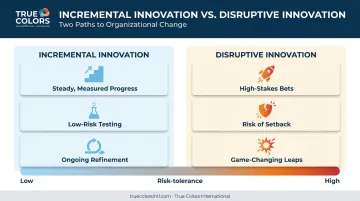
Innovation culture isn't one-size-fits-all. Incremental innovation (small, continuous improvements to existing products or processes) requires steady encouragement and low-stakes experimentation.
Disruptive innovation demands bolder risk tolerance and leaders willing to fund ideas that might fail entirely. Organizations that sustain both usually shift leadership style depending on which mode a given team or project needs.
Intuit's rise against a far better-resourced Microsoft is a useful, if partial, illustration. Stanford's business school and Fortune's reporting both point to a culture where employees across the company, not just a central innovation team, continuously observed customers and ran experiments. Consistent behavior across the company drove the difference, not the size of the budget.
How Organizational Culture Drives Innovation
Culture doesn't drive innovation through one magic trait. It works through a connected sequence: each stage depends on the one before it.
Psychological Safety and Trust (The Foundation)
Innovation starts the moment an employee feels safe challenging a leader's decision or questioning the status quo without fear of getting punished for it. That safety isn't automatic. Leaders build it deliberately, through consistent behavior repeated over months, not a single "open door" announcement.
The common failure point is a fear-based culture that punishes failed experiments even while claiming to welcome risk. Once employees learn that a bad outcome means blame, idea flow stops at the source, long before it ever reaches a manager's inbox.
Diversity, Collaboration, and Idea Generation (The Core Mechanism)
Diverse perspectives (in age, background, career path, and communication style) surface more varied ideas and break up groupthink before it forms. This is where cross-functional collaboration matters: open channels that let ideas travel across hierarchy levels instead of stalling at a manager's desk.
The numbers back this up. BCG surveyed 1,700 companies across eight countries and found that companies with above-average management diversity reported 45% of revenue from products launched in the prior three years, compared with 26% at below-average-diversity companies. That 19-point gap ties directly to differences in gender, age, national origin, and career background.
This is precisely where a shared communication framework earns its keep. When teams understand each other's temperament and thinking style, cross-functional friction drops and diverse ideas actually get heard instead of talked over.
Leadership and Risk Regulation
Leaders act as the regulator between raw experimentation and business reality. They balance new ideas against available resources and strategic priorities, deciding what gets funded and what waits.
Tolerance for failure is the corrective mechanism here. Treating a failed experiment as data, not a mistake to bury, keeps the pipeline honest. HBR's research on innovative cultures describes this as holding two things at once: tolerance for failure paired with intolerance for incompetence, and psychological safety paired with candor.
This stage prevents two opposite failure modes: reckless risk-taking with no strategic direction, and risk-aversion that kills promising ideas before they're tested.
Reinforcement and Innovation Output
The output of a functioning innovation culture is a steady pipeline: validated ideas converting into new products, tighter processes, or entirely new business models. Consistency, not a single breakthrough, is the goal.
Recognizing innovative behavior, not just successful outcomes, is what keeps the cycle alive. An employee who tried something bold and learned from a miss needs acknowledgment too, or the next person won't bother trying.
Types of Organizational Innovation and the 5 C's Framework
The 4 Types of Organizational Innovation
Most frameworks group organizational innovation into four categories:
- Product innovation: a new or meaningfully improved good or service brought to users.
- Process innovation: a new or improved method of production or delivery, including new equipment, techniques, or software.
- Business model innovation: changes to how the organization earns revenue, manages costs, or handles risk.
- Organizational/structural innovation: new methods in workplace organization, business practices, or external relationships.
Mature innovation cultures rarely specialize in just one. Netflix's shift from mailing DVDs to streaming video, for instance, combined business model innovation with the process and structural changes needed to support it.
The 5 C's of Innovation
One practitioner framework, popularized by HFMA's finance and strategy team, names five conditions that combine to produce innovation:
- Competition: external pressure that creates urgency
- Collaboration: cross-functional teamwork that surfaces new angles
- Culture: the environment that permits risk-taking
- Catalysts: individuals or events that spark momentum
- Constraints: limitations that force creative problem-solving
These aren't personality traits some employees have and others lack. They're behaviors leadership has to model and reinforce, week after week, until they become normal.
Building a Culture That Drives Innovation: Practical Strategies
Knowing the theory is one thing. Building it into daily operations is another. A few practical starting points:
- Give every employee a voice. Structured feedback channels and psychological safety practices should surface ideas from frontline staff, not just leadership meetings.
- Align innovation to clear goals. Creative energy without direction gets scattered. Tie experimentation to specific business priorities.
- Recognize the behavior, not just the win. Celebrate someone who ran a smart experiment, even when it didn't pan out.
- Build learning into daily work. Ongoing skill development gives employees both the ability and the confidence to try something new.
Understanding Communication and Temperament Styles
Even these strategies can stall if leaders roll them out the same way for everyone. People process risk, feedback, and change in distinct ways: some need data and a clear rationale before they'll take a risk, while others need encouragement and room to experiment out loud.
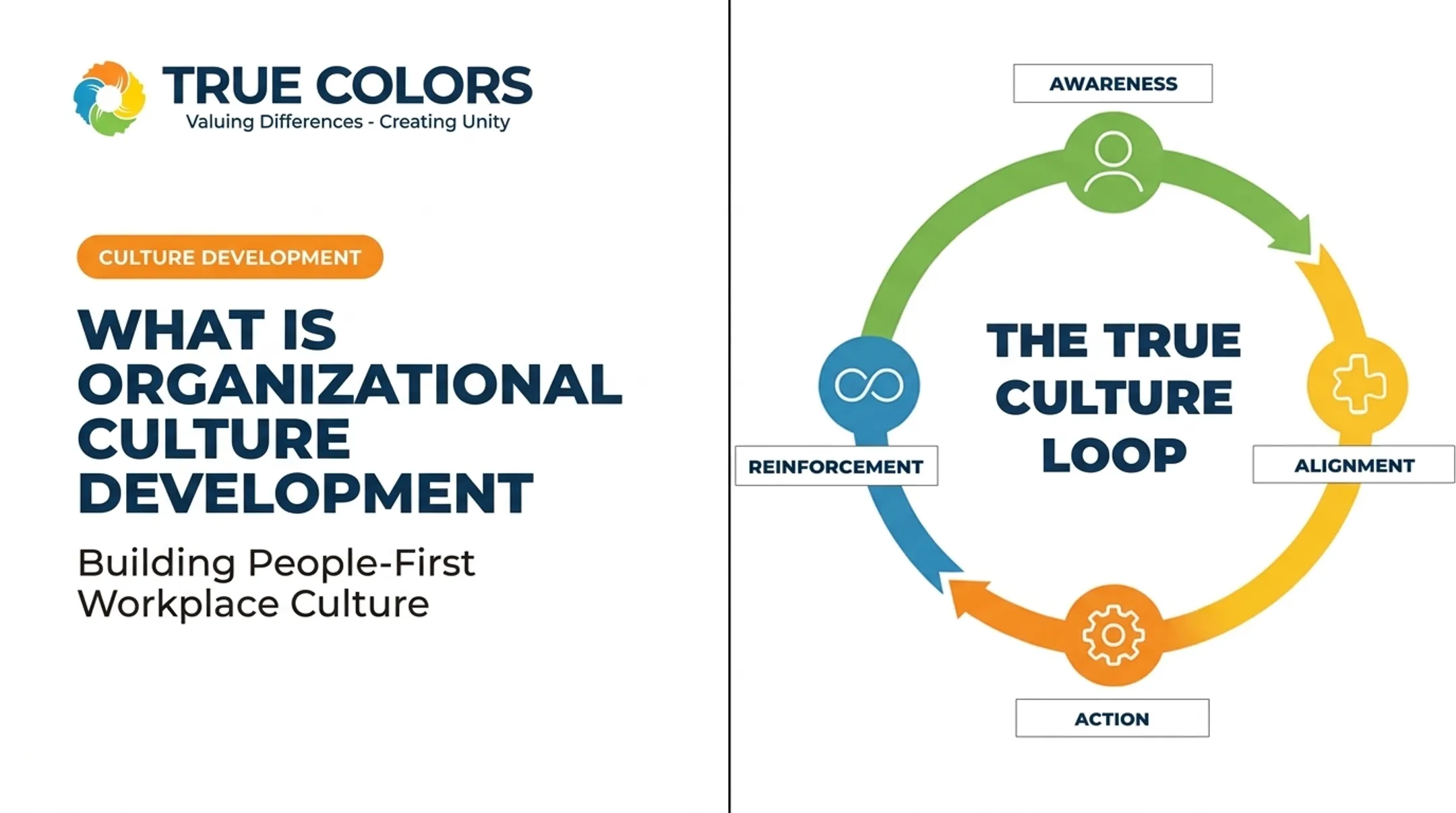
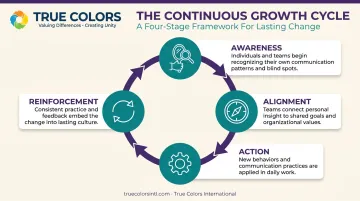
This is the gap True Colors International's methodology was built to close. Rather than treating culture change as a one-off training day, the company's True Culture Loop (Awareness, Alignment, Action, Reinforcement) gives organizations a repeatable system for building self-aware teams:
- Awareness: helping employees understand their own communication and risk tendencies
- Alignment: connecting those individual styles to team and organizational goals
- Action: applying that awareness to real decisions, including how ideas get proposed and tested
- Reinforcement: sustaining the behavior through ongoing practice rather than a single workshop
Organizations working with True Colors International, including Fortune 500 companies, hospital systems, and school districts, use this shared language to reduce the friction that normally kills good ideas before they're heard.
Conclusion
Innovation depends less on a dedicated department, lab, or annual event than on how an organization treats trust, diversity, risk, and communication daily. Get those conditions right, and innovation happens consistently instead of occasionally.
That understanding should shape more than a single training session. It belongs in how leaders are developed, who gets hired, and how teams get structured from day one, ideally around a shared language for talking about differences.
Frequently Asked Questions
What is an innovative organizational culture?
It's an environment that systematically encourages idea generation, risk-taking, and open collaboration across every level of the organization, not just within a dedicated innovation team.
What is the relationship between organizational culture and innovation?
Culture doesn't cause innovation directly. It creates the conditions (safety, diversity, trust) that make consistent innovation possible over time rather than a one-off occurrence.
What are the 4 types of organizational innovation?
Product, process, business model, and organizational/structural innovation. Most mature companies pursue several of these types simultaneously rather than focusing on just one.
What are the 5 C's of innovation?
One widely cited practitioner framework names competition, collaboration, culture, catalysts, and constraints as the five conditions that combine to produce innovation.
How can leaders measure whether their culture supports innovation?
Track employee engagement scores and idea-submission rates, then compare them against psychological safety assessments. A drop in any of these usually signals that ideas are stalling before reaching leadership.
Can a company intentionally build an innovation culture, or does it happen naturally?
Leaders build it intentionally through consistent behavior, structured communication frameworks, and reinforcement systems applied over time. True Colors International's True Culture Loop framework, for example, gives leaders a repeatable process for turning that intention into lasting culture change.