Maria didn't fail because she lacked good intentions. She failed because nobody ever taught her how to structure a feedback conversation. Most professionals learn this skill by trial and error, which means a lot of error.
Tone, timing, and personality differences shape outcomes far more than the actual words used. A comment that lands well with one colleague can shut another one down completely.
This guide breaks down the exact steps for giving feedback that actually works, when to time it, how personal factors change the delivery, and the mistakes that quietly sabotage even well-meaning conversations.
Key Takeaways
- Specific, behavior-based feedback tied to one event beats vague character judgments
- Private, calm, prompt conversations land better than public or delayed ones
- Adapt to the person—one feedback script will not work for everyone
- The "feedback sandwich" and vague absolutes ("always," "never") tend to backfire
- Frameworks like Situation-Behavior-Impact (SBI) simplify planning and delivery
How to Give Feedback to Colleagues at Work
Giving feedback well is a sequence, not a single sentence. Skip a step and the conversation tends to derail, no matter how good your intentions are.
Step 1: Clarify Your Intent and Choose the Right Moment
Before saying anything, ask yourself one question: is this about helping the person improve, or is it about venting frustration? If you're still annoyed about what happened, wait.
Setting and timing both matter:
- Constructive feedback needs privacy: a closed door or a video call, never in a group chat or on the open floor
- Positive feedback works well in public: recognition in front of peers reinforces good work
- Timing counts: pick a moment when neither of you is rushed, distracted, or already frazzled from back-to-back meetings
Skipping this step is how well-meaning feedback turns into public embarrassment.
Step 2: Describe the Specific Situation and Behavior
Vague feedback gives people nothing to act on. "You need to communicate better" tells a colleague almost nothing useful. Reference one concrete event instead, such as a specific email, meeting, or deliverable, and skip words like "always" or "never."
Stick to what you actually observed, not what you assume was going on in their head. Guessing at motive almost always backfires and turns the conversation into a debate about intent instead of behavior.
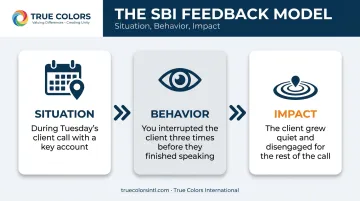
This is where the Situation-Behavior-Impact (SBI) framework helps. Developed and widely used by the Center for Creative Leadership, it separates fact from interpretation in three parts:
- Situation: Name the specific moment, including when and where it happened
- Behavior: Describe the observable action, no opinions or judgments attached
- Impact: State the effect that behavior had
Instead of "you're disorganized," SBI produces something like: "In yesterday's client call [situation], you interrupted the presenter three times [behavior], and I noticed the client seemed confused about who was leading the meeting [impact]."
Step 3: Explain the Impact and Invite Dialogue
Once you've described the behavior, explain how it affected you, the team, or the outcome, using "I" statements rather than blame. "I felt caught off guard when the numbers changed last minute" lands very differently than "you always spring changes on me."
Then stop talking. Ask an open-ended question: "How did you see that situation?" or "What was going on there?"
This pause matters more than most people realize. Active listening turns a one-way critique into a dialogue, and dialogue gets accepted far more often than lectures.
Step 4: Agree on Next Steps and Follow Up
Don't hand someone a fix. Build one together. Ask what they think would help, then shape it into something specific and actionable rather than a vague promise to "do better."
- Set a concrete follow-up point, a date or milestone, so the conversation doesn't evaporate
- Check in on that date, even briefly
- When you see improvement, say so—positive reinforcement is what makes new behavior stick
That reinforcement idea sits at the center of the True Culture Loop framework we use at True Colors International: culture and behavior change stick when they're reinforced consistently, not treated as a one-time event. A single feedback conversation rarely changes a habit. A follow-up conversation, and maybe a third, usually does.
When Should You Give Feedback to a Colleague?
Timing changes how feedback is received almost as much as the words themselves.
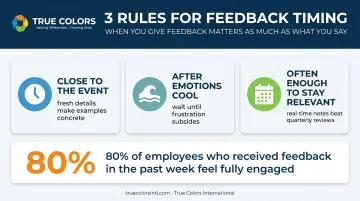
Use these timing rules:
- Close to the event — Fresh details make the example concrete, so your colleague can connect the dots
- After emotions cool — If frustration is high (yours or theirs), wait; even an hour can turn a tense exchange into a useful one
- Often enough to stay relevant — Real-time notes beat a pile of saved comments at the quarterly review
Gallup found that 80% of employees who received meaningful feedback in the past week reported feeling fully engaged at work. Frequent, timely feedback supports that engagement far better than annual catch-ups.
How often you give feedback also shapes the mix people hear. You'll see claims online about an "ideal" positive-to-constructive ratio, often cited as 6:1. Treat those numbers cautiously—the research behind popular ratios has been widely disputed, and no single formula fits every team.
What does hold up: leaning too heavily on criticism, with little positive reinforcement, steadily erodes trust. Aim for a healthy mix rather than an exact count.
What Affects How Your Feedback Is Received
The exact same sentence can land as helpful coaching for one colleague and feel like an attack to another. Understanding the person matters as much as crafting the message.
Communication and Personality Style
Direct, results-focused colleagues often want the impact stated plainly and quickly. Relationship-oriented colleagues usually need more context and reassurance before they can hear the message at all.
This is exactly where personality-based frameworks earn their keep. True Colors International's temperament model breaks communication preferences into four styles:
| Style | What They Listen For | Feedback Preference |
|---|---|---|
| Orange | Impact, relevance, usefulness | Concise, practical, outcome-focused |
| Gold | Details, context | Clear expectations, specific action items |
| Blue | Relationship, alignment | Warmth and rapport before content |
| Green | Logic, problem-solving | Evidence-based, emotion-free, direct |
A Green colleague wants the data and the fix. A Blue colleague needs to feel the relationship is intact before the content even registers. Neither reaction is wrong. They're just different lenses on the same conversation.
Relationship and Trust Level
Identical words from a manager you trust and a colleague you barely know produce very different reactions. People receive feedback far more openly from someone with established rapport. If trust is thin, build some before delivering anything critical.
Timing and Emotional or Personal Context
Stress, workload, and life outside work all shape how people absorb feedback. A quick "is now a good time?" before diving in respects that context and often improves the outcome.
Power Dynamics: Peer vs. Manager
Unsolicited peer-to-peer feedback can feel intrusive unless it was invited. Feedback from a manager carries a different weight since it's part of a defined role. Peers should tread more carefully and check for openness first.
Getting this wrong isn't a minor issue. Grammarly and The Harris Poll estimated that poor workplace communication costs U.S. businesses roughly $1.2 trillion annually, an average of $12,506 per employee per year. Personalized, well-timed feedback is a cost-control measure.
Common Mistakes to Avoid When Giving Feedback
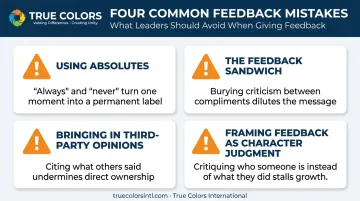
Even well-intentioned feedback fails when it falls into these traps:
- Using absolutes like "always" or "never": Exceptions almost always exist, so colleagues fixate on disproving the absolute instead of hearing your point.
- Relying on the "feedback sandwich": Harvard Business Review notes that cushioning criticism between compliments confuses recipients—confident employees dismiss the critique, while self-critical ones fixate on it.
- Bringing in third-party opinions: "Others have said you're hard to work with" turns one conversation into a vague indictment. Speak only to what you personally observed.
- Framing feedback as a character judgment: "You're careless" attacks identity. "This report had three data errors" addresses one changeable behavior.
Skip these four, and most feedback conversations improve immediately.
Conclusion
Effective feedback comes down to three things: it's specific, it's timely, and it accounts for how the recipient actually processes information. Most feedback conversations fail because the delivery missed the moment or the person, not because anyone meant harm.
Once a team shares a common language for how colleagues prefer to give, receive, and process information, every future feedback conversation gets easier. True Colors International's culture-building programs help organizations build that shared understanding at scale, instead of leaving it to chance one awkward conversation at a time.
Frequently Asked Questions
How do you give good feedback to coworkers?
Good feedback is specific, tied to a recent behavior, and focused on impact rather than judgment. Deliver it privately, and leave room for the other person to respond, not just receive.
What are the 5 R's of feedback?
There's no single, widely verified "5 R's" model for workplace feedback—treat versions you see online as informal mnemonics. For a research-backed alternative, use the 3 C's below: Clarity, Contextual Meaning, and Composure.
What are the 3 C's of feedback?
UNC Executive Development's model includes Clarity (specific, actionable direction), Contextual Meaning (connecting feedback to the person's goals and relationship), and Composure (anticipating and managing emotional reactions).
How often should you give feedback to colleagues?
Frequent, smaller feedback moments tied to real events generally work better than saving everything for a scheduled review. Fresh context makes the conversation more concrete and easier to act on.
Is it okay to give feedback to a peer who didn't ask for it?
Proceed cautiously. Unsolicited feedback between peers can feel intrusive, so check whether the person is open to hearing it before diving in.
What is the difference between feedback and criticism?
Feedback is forward-focused and behavior-based, aimed at helping someone improve a specific action. Criticism tends to be vague, personal, and lacking any actionable next step.