Introduction
Half of all remote-capable managers now lead hybrid teams. Yet 73% feel unprepared to do it, according to Gallup's analysis of the hybrid workplace.
That gap between where leadership sits and where skill exists defines the post-pandemic workplace.
Leading a distributed team isn't the same leadership playbook delivered through a webcam. Trust, communication, and visibility all worked differently when everyone sat in the same building. They have to be rebuilt on purpose now.
This guide covers:
- What virtual leadership means in practice
- A practical framework for running remote and hybrid teams
- The factors that separate strong virtual leaders from struggling ones
- Mistakes that erode team morale before anyone notices
- How to troubleshoot friction points that surface no matter how well you plan
Key Takeaways
- Structured, intentional communication must replace the hallway chats and body language in-person teams rely on
- Trust and visibility, not physical presence, determine whether a hybrid team performs
- Knowing how each team member prefers to communicate reduces friction before it starts
- Micromanagement, proximity bias, and inconsistent messaging cause most virtual leadership failures
- Virtual leadership is a trainable skill anyone can develop with practice
What Is Virtual Leadership?
Virtual leadership is the practice of guiding, motivating, and managing people who work from different locations, mostly through digital tools rather than face-to-face contact. It covers everything a traditional manager does: setting goals, resolving conflict, coaching performance. The difference is how it gets done.
A virtual leader's day typically includes:
- Setting expectations through written documentation instead of hallway conversations
- Coordinating work across multiple channels (chat, video, project boards) instead of one shared physical space
- Coaching and correcting performance without the benefit of in-person body language
These distinctions become clear when placed side by side:
In-Person Leadership vs. Virtual Leadership
| Element | In-Person Leadership | Virtual Leadership |
|---|---|---|
| Communication cues | Tone, body language, facial expression | Written and verbal cues only |
| Interaction style | Spontaneous, hallway-based | Scheduled, deliberate |
| Performance evaluation | Often influenced by visible presence | Based on measurable outcomes |
Spotify's experience with these differences shows what's possible when leadership adapts deliberately. When CHRO Katarina Berg rolled out a Work From Anywhere policy covering roughly 6,500 employees, the company let people choose where they worked, within reasonable limits on time zones and legal entity requirements.
The results were striking: Spotify's Q2 2022 turnover was 15% lower than its pre-pandemic Q2 2019 baseline. That's not a controlled experiment, but it's a strong signal that flexibility paired with intentional leadership retains people.
This matters because hybrid arrangements aren't a temporary accommodation anymore. They're the default operating model for most remote-capable organizations, and leaders who haven't adjusted their approach are managing a workforce that no longer matches their toolkit.
How to Lead Remote and Hybrid Teams: A Practical Framework
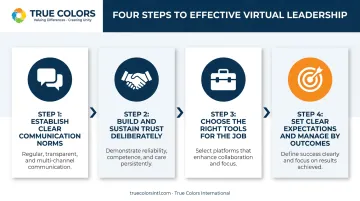
Outcomes in virtual leadership vary based on a handful of decisions leaders make (or fail to make) early on. Here's a four-step framework that covers the fundamentals.
Step 1: Establish Clear Communication Norms
Ambiguity is the enemy of remote teams. Decide upfront:
- Which channel handles what — async updates in project software, real-time discussion on video, quick questions in chat
- Response-time expectations for each channel, so nobody's guessing whether a delay means "busy" or "problem"
- A recurring meeting cadence (daily stand-ups, weekly one-on-ones) that respects everyone's time zone
- A habit of documenting decisions in writing, so team members who missed a call aren't left out
Teams that share a common language for these decisions, such as the frameworks used in True Colors International's communication training, cut the back-and-forth of defining norms from scratch.
Step 2: Build and Sustain Trust Deliberately
Without daily physical contact, virtual teams judge leaders on consistency, not visibility. Follow through on what you say you'll do. That's the baseline.
Avoid proximity bias by giving remote updates the same weight as in-office ones. And create structured moments for informal connection, since the organic "water cooler" conversation doesn't happen on its own. Virtual coffee chats or a non-work Slack channel sound small, but they replace real trust-building infrastructure that used to happen by accident.
Step 3: Choose the Right Tools for the Job
Match the tool to the task:
- Video for sensitive or complex conversations where tone matters
- Chat for quick, low-stakes updates
- Project management software for tracking deliverables and deadlines
Train every team member on the tools you use. A team fluent in three tools outperforms one fumbling through seven.
Step 4: Set Clear Expectations and Manage by Outcomes
Measure results instead of hours logged. Hold regular one-on-ones focused on progress and blockers, keeping the conversation collaborative rather than a surveillance check.
Feedback deserves the same rigor. Employees who receive meaningful weekly feedback are four times as likely to be engaged, according to Gallup's 2025 workplace research. Only 21% of employees currently say they get it.
Key Factors That Determine Virtual Leadership Success
Outcomes hinge on how well leaders manage a short list of variables. Miss one, and the others don't fully compensate.
Communication & Personality Style Awareness
Team members process information differently, and without face-to-face repair, misalignment festers instead of resolving. This is where structured, personality-based frameworks earn their place.
True Colors International's methodology, built around four color-coded spectrums: Orange, Gold, Green, and Blue, gives distributed teams a shared vocabulary for describing how they prefer to communicate. Consider two common styles:
- Gold-dominant team members want structured, detailed updates delivered on a predictable schedule
- Orange-dominant colleagues prefer quick, direct exchanges with minimal preamble
Neither approach is wrong. Knowing the difference up front prevents a lot of unnecessary friction.
Trust & Psychological Safety
Trust has to be earned through consistency and transparency when physical presence isn't an option. Microsoft's survey of over 20,000 knowledge workers found that 49% of hybrid managers struggled to trust employees to do their best work, compared with 36% of in-person managers.
Gallup separately found that having an effective manager matters four times more to engagement than work location itself.
Time Zone & Schedule Management
Unmanaged time zone gaps create a two-tier team: those who get heard live and those who read the recap. Rotate meeting times and document decisions asynchronously so no one is permanently on the losing end of the clock.
Technology Proficiency and Adoption
Tool fatigue causes lost information and slower collaboration. Standardized, well-trained tool usage fixes that. If half your team hasn't opened the shared dashboard in a month, that's not a tools problem, it's a training gap.
Feedback Frequency and Quality
Infrequent feedback leaves remote employees guessing about where they stand. Consistent, specific feedback isn't optional polish; it's one of the strongest engagement levers available to a virtual leader.
Common Mistakes When Leading Virtual Teams
Even well-intentioned leaders fall into predictable traps:
- Micromanaging out of anxiety. Losing visual confirmation of "busy" work triggers a need to check in constantly, which erodes trust and increases burnout risk.
- Proximity bias. Managers favor employees they see in person for opportunities and recognition. Owl Labs found 64% of managers are more likely to seek input from in-person staff.
- Treating virtual leadership as business as usual. Copying in-office habits onto a distributed team without adapting cadence, tools, or support structures sets everyone up for friction.
Troubleshooting Common Challenges in Virtual Teams
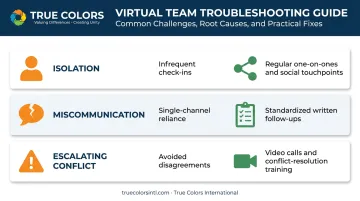
Even a solid virtual leadership approach runs into recurring friction. Here's how to diagnose and fix the most common issues.
Team members feel isolated or disconnected
- Likely cause: Infrequent leader check-ins and no informal interaction
- What to adjust: Schedule regular one-on-ones, create virtual social touchpoints, and encourage peer-to-peer channels outside of formal work threads
Recurring miscommunication or missed expectations
- Likely cause: Over-reliance on a single channel or unclear documentation
- What to adjust: Standardize written follow-ups after every meeting and clarify which channel serves which purpose
Conflict between team members escalates instead of resolving
- Likely cause: Disagreements are harder to spot without in-person cues, so team members avoid rather than address them
- What to adjust: Bring disagreements to a video call quickly, and offer structured conflict-resolution training, such as True Colors' Conflict Navigation certification, to curb repeat conflicts
Frequently Asked Questions
What are the key principles or frameworks of virtual leadership?
Virtual leadership rests on four pillars: intentional communication, deliberately built trust, well-chosen technology, and outcome-based management. Leaders who master these replace the lost in-person cues with structure.
What is an example of virtual leadership experience?
A manager leading a globally dispersed team through structured weekly check-ins, documented async updates, and rotating meeting times to respect every time zone is a common example. Spotify's Work From Anywhere policy is a large-scale version of the same idea.
What is a virtual leadership role?
A virtual leadership role involves managing performance, communication, and team culture primarily through digital tools rather than in-person interaction. Core responsibilities stay the same; the delivery method changes completely.
What skills do you need to lead a remote team effectively?
Strong virtual leaders need clear communication, deliberate trust-building, technology proficiency, emotional intelligence, and comfort managing by outcomes rather than hours. Personality and communication-style awareness rounds out the list.
How is virtual leadership different from traditional in-person leadership?
Virtual leadership relies on written and verbal cues instead of body language. Leaders build trust on purpose rather than assuming it, and they judge performance by outcomes instead of visible presence.
Can virtual leadership skills be developed through training?
Yes. These are learnable, trainable skills rather than fixed traits. Personality-based communication training, including True Colors International's Advanced Certification tracks in Communication and Team Building, builds these capabilities systematically across an organization.