So what actually separates a good team from a high-performing one?
It's rarely raw ability. High-performing teams are built, not assembled. They require intentional structure, self-awareness among team members, and tools that align people around a shared purpose before the real work even starts.
This guide walks through the exact steps to build a high-performing team, the traits that consistently define one, what you need in place before you begin, and the mistakes that quietly derail even the most promising teams.
Key Takeaways
- High-performing teams come from deliberate structure—clear goals, defined roles, trust, and communication—not luck.
- Leaders and employees rate team culture very differently—Dale Carnegie found a 34-point gap on access to learning alone.
- Knowing each teammate’s communication style and temperament builds trust faster and reduces friction.
- Most team failures stem from skipped groundwork—unclear purpose, fuzzy roles, or unresolved tension—not a lack of talent.
How to Build a High-Performing Team: A Step-by-Step Framework
Building a high-performing team follows a logical sequence. Skip a step, and everything downstream gets harder.
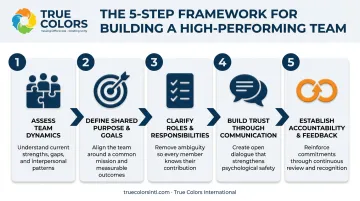
Step 1: Assess Team Dynamics and Individual Styles
Before you set a single goal, understand how your people actually work.
Every team member has a natural pace, communication tone, and decision-making style. Some move fast and want action now. Others slow down to gather information first. Some communicate directly; others prioritize relationship and tone before getting to the point.
Validated personality assessments, like the one used in True Colors International's methodology, map these differences across a four-color temperament spectrum: Orange (action-oriented), Gold (structured), Green (analytical), and Blue (relationship-focused). Nobody gets boxed into one label. Everyone gets a full spectrum showing dominant and secondary tendencies.
Skip this step, and leaders default to building teams on skills alone. That's how you end up with technically qualified people who talk past each other constantly.
This step gives the team a shared vocabulary before anyone talks about goals.
Step 2: Define a Shared Purpose and Clear, Measurable Goals
Once your team understands how they work together, define why they're working together at all.
Document the team's purpose and connect it directly to organizational priorities. This isn't a nice-to-have.
MIT Sloan Management Review found that only 28% of executives and middle managers responsible for executing strategy could name three of their organization's top priorities. If leadership struggles with this, front-line teams have little chance without clear direction.
Goals need to be specific and trackable:
- "Reduce onboarding time by 20% this quarter" (measurable)
- "Improve team collaboration" (vague and unmeasurable)
Write the purpose down. Post it somewhere visible. Revisit it monthly.
Step 3: Clarify Roles and Responsibilities
Ambiguity over "who owns what" is one of the most common sources of internal conflict and duplicated effort. Two people quietly working on the same task, or worse, nobody working on a critical one, is a structural failure, not a personality problem.
A simple role-clarity exercise fixes this fast:
- List every recurring task or deliverable the team handles
- Assign a single owner to each one
- Note who needs to be consulted before decisions are made
- Note who simply needs to stay informed
This is essentially a lightweight RACI exercise (Responsible, Accountable, Consulted, Informed), and it takes less than an hour to run with a team of any size.
Step 4: Build Trust Through Open Communication
Trust doesn't happen because a team spent a Friday afternoon at a retreat. It builds through consistent, transparent interaction over time.
Practical habits that build trust:
- Regular one-on-one and team check-ins, not just status updates
- Active listening: repeating back what you heard before responding
- Transparent information-sharing, even when the news is inconvenient
- Leaders following through on what they say they'll do
That last point carries the most weight. Trust is modeled from the top. A leader who dodges hard conversations or breaks small commitments teaches the whole team that follow-through is optional.
Step 5: Establish Accountability, Feedback, and Recognition Loops
The final step locks the previous four in place. Without ongoing feedback and recognition, even well-structured teams drift back into old habits.
Practices that keep the system running:
- Build two-way feedback so input flows both directions, not just manager to employee
- Recognize progress consistently, not only at annual reviews
- Shift accountability peer-to-peer so it feels like teamwork instead of surveillance
Key Characteristics That Define High-Performing Teams
Every team looks different, but research on team effectiveness, including Google's Project Aristotle study, keeps surfacing the same core traits.
Psychological Safety and Trust
Psychological safety lets people take interpersonal risks, disagree openly, and resolve conflict before it festers.
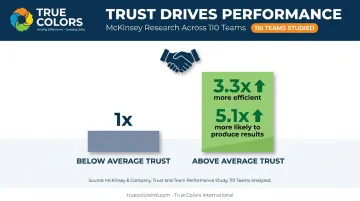
McKinsey's research across 110 teams found that teams scoring above average on trust were 3.3 times as efficient and 5.1 times as likely to produce results as teams scoring below average. Trust is a performance driver, not a soft metric.
Complementary Skills and Personality Awareness
Diverse working styles bring different problem-solving angles to the table. Without mutual understanding, that diversity creates friction instead of value.
Teams that grasp each other's temperament styles (pace, detail orientation, tone, decision-making approach) collaborate with fewer misunderstandings. They make decisions faster because they stop misreading each other's intentions.
Clarity of Roles, Goals, and Expectations
Clarity removes the ambiguity that leads to duplicated work or dropped responsibilities. When individual effort maps directly to team and organizational outcomes, people stop guessing what matters and start executing on it.
Open, Two-Way Communication
Small misunderstandings escalate into larger conflicts when communication only flows one direction, or not at all. Teams with strong two-way dialogue solve problems faster and hand off work more cleanly across departments and functions.
Adaptability and Continuous Improvement
Priorities, tools, and market conditions shift constantly. Teams that can't pivot lose momentum every time something changes.
Business leaders consistently rank speed and adaptability among their top strategic priorities. Teams that build those habits into daily norms keep moving when rigid teams stall.
What You Need Before You Start Building Your Team
Enthusiasm doesn't make team-building efforts stick. Preparation does.
Before launching any team development initiative, get these three elements in place:
- Leadership buy-in and a baseline read on team dynamics. A validated personality or communication-style assessment gives leaders and members a shared vocabulary from day one instead of guessing what drives friction.
- Dedicated, ongoing time. Treat team-building activities, check-ins, and training as a continuing investment—not a once-a-year calendar filler.
- A way to measure progress. Periodic pulse surveys or team health check-ins, such as an Employee Experience Survey, show whether your interventions actually improve trust and performance.
Skipping this preparation phase is why many well-intentioned team-building efforts fizzle out within a few months.
Common Mistakes That Undermine Team-Building Efforts
Even well-resourced teams stumble on the same few mistakes repeatedly.
- Assuming talent equals cohesion. Hiring skilled people doesn't create a cohesive team on its own. Without aligning personalities, goals, and communication styles, talent works at cross-purposes.
- Treating team-building as a one-off event. A single workshop or retreat sparks a short burst of energy. That energy fades within weeks unless you reinforce it with regular check-ins and feedback.
- Avoiding difficult conversations. Role conflict and personality clashes that go unaddressed let small frictions compound into larger dysfunction over months.
Conclusion
High-performing teams don't happen by chance. They're built through deliberate steps: self-awareness, clear goals, trust, and mutual accountability.
Teams rarely fail from a lack of talent. They stall when leaders skip the groundwork, especially how people communicate and work differently.
Organizations that invest in structured, research-backed team development see measurable gains in collaboration, retention, and performance. Personality-based approaches like the True Colors System help those gains compound over time instead of fading after a single workshop.
Frequently Asked Questions
What are the elements of a high-performing team?
The core elements are a shared purpose, clearly defined roles, mutual trust, open two-way communication, and accountability that runs in both directions, not just top-down.
How long does it typically take to build a high-performing team?
Timelines vary by team size and starting point, but meaningful trust and alignment usually take several months of consistent effort. A single workshop won't get you there on its own.
What is a leader's role in building a high-performing team?
Leaders set the vision, model trust and accountability through their own behavior, and create the conditions—time, tools, and feedback loops—for the team to develop itself.
Can remote or hybrid teams become high-performing?
Yes. It takes intentional communication norms, regular check-ins, and tools that replicate the trust-building that happens naturally in person. Distance alone does not block strong performance.
Why do teams with talented individuals still underperform?
Talent alone doesn't guarantee cohesion. Without shared goals, defined roles, and trust, even highly skilled individuals end up working at cross-purposes instead of together.
What tools help assess and improve team performance?
Personality and communication-style assessments, regular feedback or pulse surveys, and structured goal-tracking frameworks are the most practical tools for diagnosing gaps and guiding improvement.