The concept isn't new, but it's getting fresh attention as hybrid and remote work reshape how people collaborate. In Microsoft's 2022 Work Trend Index, 44% of hybrid employees said they didn't feel included in meetings, and only 28% of leaders had created team agreements for hybrid work.
"Working together" sounds simple. In practice, it varies wildly based on team composition, leadership style, communication habits, and how differences get handled. This guide walks through the exact steps to build synergy, what you need before starting, the variables that shape results, common mistakes, and a few alternative approaches worth considering.
Key Takeaways
- Trust, communication, and shared goals combine to create results beyond individual effort
- Personality and communication style awareness is the starting point, not an afterthought
- Building synergy takes continuous practice: assessment, communication norms, trust-building, and recognition, not a single workshop
- Most failures trace back to skipped trust-building, unaddressed behavioral differences, or vague goals
- A validated personality assessment gives teams a shared language that speeds progress
How to Build Team Synergy in the Workplace
Step 1: Assess Team Personalities and Communication Styles
Every synergy effort should start with a simple question: how does each person on this team actually think, communicate, and handle pressure? Guessing wastes time. A validated behavioral assessment answers it directly.
True Colors International's temperament-based assessment sorts communication and decision-making tendencies into four color types — Orange, Gold, Green, and Blue. Rather than assigning one label, it produces a "color spectrum" showing how strongly each trait shows up in a person. The assessment surfaces:
- Communication preferences — how someone prefers to give and receive information
- Decision-making tendencies — fast and intuitive versus methodical and detail-driven
- Stress responses — some people get more direct under pressure, others withdraw, seek structure, or push for faster action
Once you have this data, map it against your project needs. A launch team heavy on detail-oriented Gold types but light on big-picture Orange thinkers has a coverage gap worth addressing before deadlines hit, not after.
The real payoff comes from the shared vocabulary this creates. Instead of labeling a colleague "difficult" or "slow," teams learn to say "that's a very Green response to ambiguity," a neutral, constructive way to name differences that used to cause friction.
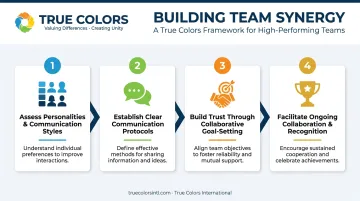
Step 2: Establish Clear Communication Protocols
Assessment data means little without rules for applying it. Communication protocols turn insight into daily behavior.
Start by defining which channel fits which message:
- In-person or video for sensitive feedback and performance conversations
- Chat tools for quick status updates and low-stakes questions
- Email or documentation for decisions that need a paper trail
Write this down. A verbal agreement fades within weeks; a shared document doesn't.
Beyond channels, set explicit norms for active listening and how feedback gets given and received. Teams also need psychological safety, meaning people feel safe disagreeing without penalty.
That doesn't happen by accident. Leaders have to invite dissent out loud, ask "who sees this differently?" in meetings, and visibly reward whoever raises a hard question rather than whoever agrees fastest.
Step 3: Build Trust Through Collaborative Goal-Setting
Trust builds fastest when people help shape the work they're accountable for. Vague, top-down goals do the opposite.
Involve the full team in setting SMART goals (specific, measurable, achievable, relevant, time-bound) and connect each one to a broader organizational objective. When people understand why a goal matters, they stop treating it as busywork.
Just as important: let the team define how the goal gets reached, not only what it is. Shared ownership over the path, not just the destination, is what separates a rubber-stamped objective from one people actually commit to.
Finally, schedule recurring goal reviews. Circumstances shift, priorities change, and a goal set in January can be irrelevant by June. Revisit it on a set cadence instead of waiting for a crisis to force the conversation.
Step 4: Facilitate Ongoing Collaboration and Recognition
Synergy needs repeated reps, not a single kickoff event. Build regular, structured collaboration into the calendar: brainstorms, cross-functional working sessions, or problem-solving huddles where every voice is expected to contribute, not just the loudest one.
Recognition matters just as much as the collaboration itself. Mix up how you acknowledge wins:
- Quick shout-outs in team meetings
- Handwritten or written notes for individual effort
- Formal recognition tied to company-wide programs
And don't let recognition flow only from the top. Build peer-to-peer feedback loops so team members can call out each other's contributions directly. Accountability and appreciation both land harder when they come from a colleague, not just a manager.
What You Need Before Building Team Synergy
Skipping foundational prep is the single biggest reason synergy efforts stall. Before running a workshop or rolling out new protocols, confirm three things are in place.
Leadership and Organizational Buy-In
Leaders have to model the collaborative behavior they're asking for. If a manager preaches open dissent but shuts down disagreement in the next meeting, the message cancels itself out. Real time and real budget need to go toward team development. Treating it as a side project signals it isn't a priority, and teams notice.
Assessment Tools and Frameworks
Establish a baseline before layering on tactics. True Colors International's four-color personality framework is ASI-certified and built on an N=10,000 validation study, meeting EEOC 80% guideline standards for reliability and fairness. Starting with a research-backed tool avoids the guesswork that undermines less structured approaches.
Team Readiness and Psychological Safety
Confirm unresolved interpersonal conflicts are addressed first. Synergy-building exercises can backfire badly in a low-trust environment. Asking people to open up about working styles when there's an unresolved grudge in the room tends to surface tension instead of resolving it.
Key Factors That Affect Team Synergy Results
Even well-designed synergy efforts produce different outcomes depending on how a handful of variables get managed.
Team Composition and Leadership Style
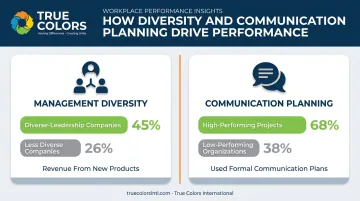
Teams with varied but complementary temperaments generate more creative solutions, but they need more intentional facilitation to get there. Across more than 1,700 companies in eight countries, organizations with above-average management diversity reported 45% of revenue from products launched in the prior three years, versus 26% at less diverse companies.
That 45% reflects facilitated diversity, not diversity that exists on paper alone.
Leaders set the emotional tone for how safe people feel sharing ideas or pushing back. Hands-off or inconsistent leadership stalls synergy even when every other condition looks favorable. True Colors International's personality-based workshops give leaders a shared vocabulary for navigating those differences constructively. Consistency matters more than charisma here.
Communication Norms and Organizational Culture
Clear norms reduce ambiguity, and ambiguity is what erodes trust fastest. High-performing organizations used formal communication plans on 68% of projects, compared with just 38% at low performers. That's not a small gap.
Synergy built at the team level can't survive in a culture that rewards individual competition over collaboration. Company culture has a stronger pull on retention and behavior than most team-level fixes can offset. When the practices your team adopts run against the grain of how the broader company operates, friction is the likely outcome.
A sales team rewarded only for individual quotas will struggle to prioritize shared goals, regardless of how strong its internal dynamics are.
Common Mistakes to Avoid When Building Team Synergy
Most synergy failures follow familiar patterns:
- Skipping trust-building and jumping straight to task assignments, leaving underlying friction to fester and undermine collaboration later
- Ignoring personality and communication differences, which causes team members to misread intentions or assume someone's slower pace means less commitment
- Setting vague or misaligned goals that leave people uncertain about priorities, then never revisiting those goals as work evolves
- Treating synergy as a one-time event, such as a single workshop or retreat, instead of an ongoing, reinforced practice
The one-time-event mistake causes the most damage. A workshop can spark momentum, but that momentum fades fast without follow-up. One True Colors client engagement, a university accounting department, saw a single session surface more issues than it could resolve in one sitting. That gap led directly to requests for advanced follow-up work.
Alternative Approaches to Building Team Synergy
The right approach depends on team size, budget, remote-versus-in-person mix, and how deep a cultural shift needs to go.
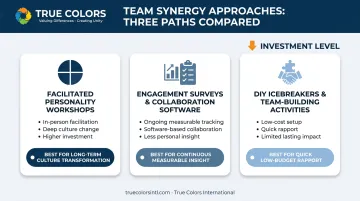
Facilitated Personality-Based Team Workshops
Best for organizations seeking a deep, sustainable culture shift across multiple teams or departments. True Colors' nationwide network of certified facilitators and Master Trainers connects organizations with someone who understands their specific industry context. This route requires more upfront time and budget but tends to produce longer-lasting behavioral change than a one-off activity.
Engagement Surveys and Team Collaboration Software
Useful for distributed teams that need ongoing, measurable tracking of collaboration health. These tools provide data and trend visibility over time. The trade-off: they offer less personal insight into why someone communicates the way they do compared to an assessment-based approach. Without follow-through action, a survey rarely moves the needle on its own.
DIY Icebreakers and Team-Building Activities
A solid quick option for smaller budgets, newly formed teams, or as a supplement to deeper work. These build surface-level rapport quickly and inexpensively. They rarely produce lasting behavioral or communication change by themselves, though, so treat them as a starting point rather than the whole strategy.
Frequently Asked Questions
What is synergy in team building?
Synergy in team building refers to the enhanced performance that results when team members combine diverse strengths, communication styles, and perspectives to produce outcomes greater than what any individual could achieve alone.
What is an example of synergy in team building?
In a cross-functional project team, members bring complementary skills in strategy, communication, and technical execution, and they anticipate each other's needs. This synergy delivers results faster and with fewer errors than people working in isolation.
What are the 5 C's of team building?
Some practitioners describe teamwork through Communication, Collaboration, Coordination, Cohesion, and Commitment as an informal shorthand. It's a useful mnemonic, though not a single universally validated research model, so treat it as a starting framework rather than gospel.
How long does it take to build team synergy?
Timelines vary based on team size, leadership consistency, and how often collaboration gets reinforced. There's no fixed universal benchmark, but most teams need several months of sustained practice before synergy becomes consistent rather than occasional.
How do you measure team synergy in the workplace?
Combine process indicators like information sharing and conflict management with outcome indicators such as delivery speed, quality, engagement scores, and retention. No single "synergy score" captures everything, so look at both.
Can remote or hybrid teams achieve true team synergy?
Yes. A six-month trial of 1,612 employees found hybrid schedules cut quit rates by a third with no measurable performance loss. Intentional communication protocols and regular virtual touchpoints matter more than physical proximity.