That's the leadership skills gap in action. Most professionals climb the ladder because they excelled at their individual work, not because anyone trained them to lead people. A 2023 CMI/YouGov study found that 82% of UK managers stepped into the role without any formal management or leadership training.
The result is predictable: friction on teams, quiet resignations, careers that plateau before they should. This guide breaks down what "honing leadership skills" actually means, the five core skills every leader needs, and the strategies that turn good intentions into measurable growth.
Key Takeaways
- Leadership development is a continuous loop of self-assessment, practice, and feedback.
- Five skills define strong leaders: communication, emotional intelligence, decision-making, adaptability, and accountability.
- Mentorship, feedback, and stretch assignments accelerate growth faster than reading alone.
- Self-awareness is the root skill: leaders who know their own style adapt faster to others.
- Poor communication costs businesses nearly $12,506 per employee annually, according to Grammarly's research.
What Does "Honing Leadership Skills" Mean?
Honing isn't the same as learning from scratch. It means sharpening abilities you already have, pairing the technical expertise that got you promoted with the interpersonal capability to lead the people around you.
The process runs on a repeatable cycle:
- Self-assess: Identify where your current style helps or hurts your team.
- Practice: Apply one specific behavior change in a real meeting or project.
- Gather feedback: Ask a direct report, peer, or mentor how it landed.
- Adjust: Refine the approach and run the cycle again.
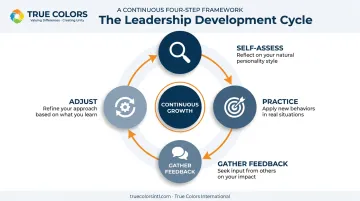
This mirrors what psychologist Carol Dweck calls a growth mindset: the belief that abilities develop through effort and feedback rather than staying fixed. Genuine growth mindset means testing a new approach and adjusting based on honest feedback, not simply praising effort blindly.
This cycle never really ends. A VP with twenty years of experience still needs to hone leadership skills when they inherit a new team, navigate a merger, or lead through a crisis. The skills don't expire. They just need recalibrating.
5 Key Leadership Skills Every Leader Must Master
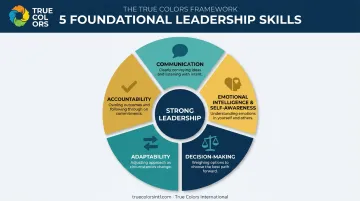
Leadership requirements shift by industry, but decades of organizational research converge on five foundational skills.
Communication
Clear, two-way communication reduces misunderstanding and builds trust between leaders and teams. When it breaks down, the cost is measurable. Grammarly's 2022 research with The Harris Poll estimated poor communication drains 7.47 hours per employee per week, adding up to roughly $12,506 per employee annually.
Strong leaders don't just talk. They:
- Confirm understanding before moving on
- Adjust tone and detail based on the listener
- Create space for questions and pushback
Emotional Intelligence & Self-Awareness
Leaders who understand their own emotional triggers and default communication style can read others' cues more accurately. Personality-based frameworks, such as the ones used in True Colors' leadership workshops, give leaders a shared language for spotting these patterns faster.
This awareness lets them flex their approach, staying direct with one team member and more collaborative with another, instead of leading everyone the same way regardless of fit.
Decision-Making
Effective leaders balance hard data, intuition, and stakeholder input. What separates good leaders from great ones is decisiveness under ambiguity: acting with reasonable confidence when the full picture isn't available, then course-correcting as new information arrives.
Adaptability
Markets shift. Teams change. Crises hit without warning. Leaders who can pivot their strategy and communication style in response keep trust and momentum intact, even when the plan they announced last month no longer fits reality.
Accountability
Owning mistakes, rather than deflecting blame, builds psychological safety. Teams watch how leaders handle their own errors closely, and when a leader models accountability, it gives everyone else permission to do the same.
Proven Strategies to Hone Your Leadership Skills
Knowing the five skills matters less than building a system to actually improve them. These strategies work because they combine practice with structured feedback:
Seek structured feedback. Tools like 360-degree feedback and consistent one-on-ones surface blind spots leaders often can't see in themselves. Feedback works best when it's specific, timely, and tied to concrete goals.
Find a mentor or coach. Mentorship accelerates development through real-world modeling and accountability. Credentialed bodies like the International Coaching Federation (ICF) support these structured relationships, and True Colors International holds its own ICF membership as part of its coaching work.
Practice self-reflection routines. Journaling, after-action reviews, or a quick debrief after a tough meeting help identify patterns before they become habits.
Take on stretch assignments. Volunteering for a project outside your comfort zone builds skills faster than staying in a routine role, provided there's enough support to avoid burnout.
Invest in formal training and assessments. Structured programs and personality assessments give leaders an objective framework instead of guesswork. True Colors' personality-based assessments, for example, turn abstract self-improvement into a concrete map of strengths and blind spots.
Build a personal development plan. Set specific, measurable goals tied to the five core skills above, and revisit progress every quarter rather than once a year.
Why Self-Awareness Is the Foundation of Leadership Growth
Most leadership breakdowns trace back to a lack of self-awareness. A leader who doesn't understand their own communication style will struggle to adjust when it clashes with someone else's. Most people overestimate how self-aware they actually are.
A 2018 Harvard Business Review study found that only 10% to 15% of people meet real self-awareness criteria, despite most believing they qualify. That gap is exactly where personality and temperament frameworks earn their place.
Turning Self-Knowledge Into a Leadership Tool
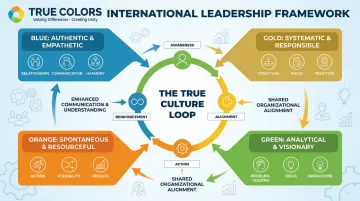
Personality-based frameworks give leaders a shared, practical language for understanding themselves and their teams. True Colors International's ASI-validated methodology, used by organizations including Amazon, Google, and Ford, is built on exactly this premise: once leaders identify their own temperament and recognize others', they can:
- Customize feedback based on what actually motivates each person
- Delegate tasks based on natural strengths rather than assumptions
- Resolve conflict faster by understanding what's driving the friction
A leader who's fact-driven might deliver blunt, data-heavy feedback that lands fine with one team member and completely shuts down another who needs context and reassurance first. Self-awareness is what tells the leader the difference exists in the first place.
Alignment Speeds Up With a Shared Framework
When an entire leadership team adopts a shared self-awareness framework, such as True Colors' True Culture Loop, decisions move faster because everyone understands what principles guide them. Departments collaborate with less friction.
Messaging flows consistently from senior leaders down through managers instead of fragmenting along the way. During periods of change, that consistency is what keeps teams from splintering into confusion.
Common Challenges in Developing Leadership Skills
Even motivated leaders run into predictable obstacles when trying to grow.
The "sink or swim" promotion problem. Professionals promoted for technical excellence often receive zero formal leadership training. DDI's Frontline Leader Project found that new leaders wait an average of four years after entering management before getting any structured training, leaving a skills gap wide open from day one.
Resistance to feedback and blind spots. Many leaders overestimate their own strengths. Without structured external input (a mentor, a 360 review, an honest peer), those blind spots stay invisible far longer than they should.
Time constraints. Leaders at fast-growing or resource-strapped organizations often push their own development to the bottom of the list. Daily operational fires feel more urgent than a leadership book or a coaching session, even though skipping development compounds the problem over time.
Common fixes include:
- Scheduling development time on the calendar like any other meeting
- Pairing new leaders with a mentor within their first 90 days
- Normalizing feedback requests as routine, not a sign of weakness
Frequently Asked Questions
What are 5 key leadership skills?
The five foundational leadership skills are communication, emotional intelligence and self-awareness, decision-making, adaptability, and accountability. Most leadership research converges on these regardless of industry.
What does "honing leadership skills" mean?
It refers to the continuous, deliberate process of refining leadership abilities you already have through consistent practice and honest feedback.
How long does it take to develop strong leadership skills?
There's no fixed timeline since leadership development is ongoing. Consistent practice and feedback typically produce noticeable improvement within a few months.
Can leadership skills be learned, or are they innate?
Some traits come more naturally to certain people, but most leadership skills are learned and strengthened through deliberate practice, feedback, mentorship, and real-world experience over time.
What's the difference between management skills and leadership skills?
Management focuses on processes, planning, operations, and resource allocation. Leadership focuses on setting direction and developing people's capabilities. The two functions complement each other but serve distinct purposes.
How can personality assessments help improve leadership skills?
Personality and temperament assessments give leaders self-awareness and a shared language for understanding their teams. That foundation supports clearer communication and faster conflict resolution.