Remote work gives people flexibility. What it doesn't give them is the culture that used to build itself through shared kitchens, hallway chats, and the general osmosis of sitting near each other every day.
Many organizations still treat culture as something that happens automatically once people are hired. It doesn't. 53% of people who work from home at least some of the time say the arrangement has hurt their connection with coworkers. Left alone, that gap turns into disengagement, quiet isolation, and eventually, resignations.
This guide covers how to build remote culture step by step: what needs to be in place before you start, the factors separating thriving distributed teams from struggling ones, the mistakes that derail most efforts, and how to troubleshoot problems that surface even when you're doing things right.
Key Takeaways
- Remote culture needs deliberate design, not casual hallway chats or lunch breaks.
- Trust, clear communication norms, recognition, and measurement matter more than tools or perks.
- Most failures trace to skipped groundwork: fuzzy values, undefined norms, and unknown working styles.
- A shared framework for personality and communication differences builds trust and reduces misreadings.
How to Build a Strong Culture for Remote Teams
Building remote culture takes four connected steps that reinforce each other over time.
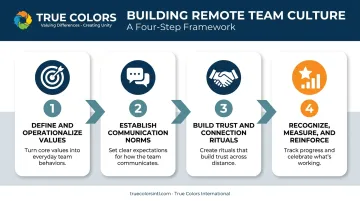
Step 1: Define and Operationalize Values for Distributed Work
Start by auditing your existing values. Some will translate fine to remote work. Others were written for an office that no longer exists for half your team.
Ask honestly: does "open-door policy" mean anything when there's no door? Does "collaboration" still work as a value if it was really just code for "we sit near each other"?
Once you've weeded out the office-only relics, get specific. Vague values don't guide behavior. Specific, observable ones do.
| Vague value | Observable remote behavior |
|---|---|
| Transparency | We document decisions in a shared doc within 24 hours |
| Collaboration | We tag relevant stakeholders in async threads before meetings |
| Accountability | We update project status boards daily, not just when asked |
Then embed these behaviors everywhere:
- Onboarding materials: new hires see the behavior, not just the buzzword
- Project kickoffs: teams agree on how the value shows up in this specific project
- Recognition criteria: people get praised for demonstrating the behavior, not just hitting a number
Values that only live in a slide deck fade fast. Values that show up in daily workflows stick.
Step 2: Establish Clear Communication Norms and Channels
Distributed teams drown in tools but starve for clarity. The fix requires clearer rules about which tool does what.
A working structure looks something like this:
- Video calls for nuance, sensitive feedback, or anything with emotional weight
- Chat for quick updates, questions, and time-sensitive pings
- Async docs for decisions, proposals, and anything future team members will need to reference
Response-time expectations matter just as much as tool selection. Set defaults (same-day for chat, 24 hours for docs) and default to asynchronous communication wherever you can. It respects time zones and protects focus time, which remote employees consistently name as their biggest productivity advantage.
Write it all down in a "how we work" guide. Not because your current team needs it memorized, but because your next new hire won't have three months of osmosis to figure it out. They'll have a document instead of guesswork.
Step 3: Build Structured Trust and Connection Rituals
Office culture runs on spontaneous interaction: the hallway catch-up, the coffee-machine conversation. Remote teams need to schedule what used to happen by accident.
That means:
- Weekly team syncs focused on work
- Monthly all-hands for company-wide context
- Informal virtual social time with no agenda
- Quarterly virtual retreats for deeper, unstructured connection
Consistency matters more than frequency. A team that reliably meets every Tuesday at 10am builds more predictability than one that meets constantly but erratically. Predictability is how trust gets built when you can't read body language across a desk.
The harder problem is depth. Even with regular touchpoints, distributed colleagues rarely get natural exposure to how teammates think, decide, or handle stress.
That's where a shared personality and communication framework earns its keep. At True Colors International, teams use a temperament-based methodology, built around four color-coded styles, to give distributed teammates a common vocabulary for describing how they communicate, make decisions, and prefer feedback. Instead of guessing for months why a colleague seems terse in chat, teams learn it's a communication preference, not a personal slight.
Finally, pair new hires with a buddy in their time zone. This simple practice shortens the isolation window most remote hires experience in their first few weeks.
Step 4: Recognize, Measure, and Reinforce Culture Continuously
Unreinforced culture fades fast. Two systems keep it alive: recognition and measurement.
Recognition needs to work without physical presence carrying the weight. Build a system that includes:
- Peer-to-peer shoutouts tied to specific values
- Manager-led recognition in team channels, not just private DMs
- Values-based criteria, so recognition reinforces the behaviors from Step 1
Measurement should be lightweight and frequent, not annual and exhausting. Short pulse surveys (two to five questions, sent monthly or biweekly) catch problems while they're still small. Annual engagement surveys catch them after they've already cost you a resignation letter.
The step most companies skip: closing the loop. Harvard Business Review's research on employee feedback links visibly acting on employee input to stronger retention, innovation, and talent attraction. The mechanism is simple: people who see their feedback change something keep giving feedback, while those who don't eventually stop.
What You Need Before Building Remote Team Culture
Skipping preparation is the single biggest reason remote culture initiatives fail to stick. Before you touch Step 1, three things need to be in place.
Leadership Commitment and Sponsorship
Approving a budget isn't sponsorship. Leaders need to model the behaviors themselves. They should respond async instead of demanding instant replies and show real vulnerability on video calls. Living the values they ask of others matters just as much as stating them.
Communication and Collaboration Infrastructure
Baseline tools need to exist before norms can govern them:
- Video conferencing that works across time zones
- A persistent chat platform (not email threads pretending to be chat)
- A shared documentation system everyone can access, regardless of location
Understanding of Team Composition and Working Styles
You can't set communication norms for people you don't understand. Establish a baseline for how each person communicates, processes information, and prefers feedback before you write a single policy. A validated personality assessment, such as True Colors' framework, shortcuts months of trial-and-error guessing into a shared reference point everyone can use from day one.

Key Factors That Affect Remote Culture Success
Outcomes vary widely depending on how organizations manage a handful of controllable variables.
Trust and Psychological Safety
Why it matters: Without physical cues like tone and body language, trust has to be built deliberately, through reliability, consistency, and follow-through, not proximity.
Impact on outcomes: Research on virtual teams consistently links higher intrateam trust to stronger team effectiveness. Teams that never build that trust see it show up as reduced collaboration and higher attrition.
Communication Clarity and Cadence
Why it matters: Written and asynchronous communication strips away tone. A short chat message that reads as blunt in person can read as hostile on a screen.
Impact on outcomes: Inconsistent communication norms, with no shared agreement on tools, response times, or channels, are a leading driver of the disconnection remote employees report.
Visibility and Recognition
Why it matters: Remote workers face what's called proximity bias — the tendency to see people who are physically present as more productive, regardless of actual output.
Impact on outcomes: The effect shows up in advancement data. One 2023 analysis of 2 million white-collar workers, reported by The Wall Street Journal, found remote employees were promoted at 3.9%, compared to 5.6% for office-based or hybrid peers (a 31% gap). Recognition systems that rely on who's 'seen' the most will always disadvantage distributed staff.
Shared Language for Individual Differences
Why it matters: Distributed teams rarely get natural exposure to how colleagues think, decide, and communicate differently. In an office, you pick this up by accident. Remotely, you have to build it on purpose.
Impact on outcomes: Teams trained on temperament-based frameworks, such as True Colors' methodology, tend to resolve conflict faster. Disagreements get framed as style differences instead of personal conflicts, a meaningful shift for teams working across cultures and time zones.
Common Mistakes and How to Troubleshoot Remote Culture Challenges
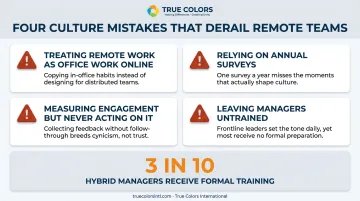
Most remote culture failures come from a small set of repeated, avoidable errors:
- Treating remote work as "office work, just online" instead of redesigning norms from scratch
- Relying on annual surveys instead of continuous, lightweight measurement
- Measuring engagement but never acting on it, which is the fastest way to make people stop responding to surveys
- Leaving managers untrained. Gallup found only three in 10 hybrid managers had received any formal training on leading hybrid teams. Most are leading distributed teams on instinct alone
Troubleshooting Problem: Team Feels Disconnected Despite Frequent Meetings
Likely cause: Meetings are transactional status updates, not relationship-building moments. The content of those meetings, not their frequency, is what's missing.
What to adjust: Separate work syncs from connection-focused rituals entirely. Rotate meeting times across time zones so the same people aren't always sacrificing their evenings.
Troubleshooting Problem: High Performers Feel Overlooked
Likely cause: Recognition and visibility systems favor employees who are physically observed or naturally vocal in meetings, not necessarily the ones doing the best work.
What to adjust: Implement structured, data-informed recognition tied to documented contributions (project logs, shared docs, completed deliverables) rather than subjective manager impressions.
Conclusion
Thriving remote culture comes from deliberate systems: clear values, explicit communication norms, structured trust rituals, and continuous measurement. Without shared physical space, teams can't rely on hallway chats or accidental proximity to build culture on their own.
Most failures trace back to skipped preparation or inconsistent follow-through, not a lack of good intentions. Teams that invest in structured frameworks, including communication-style tools such as True Colors' personality-based framework, consistently outperform those relying on ad hoc effort and good vibes.
Frequently Asked Questions
What is remote team culture?
Remote team culture is the shared values, communication norms, and behaviors that guide a distributed workforce. Unlike office culture, it has to be built intentionally rather than absorbed through daily proximity.
How is building culture for remote teams different from in-office culture?
Remote culture relies on deliberate rituals, written documentation, and asynchronous communication instead of spontaneous hallway interactions. What happens by accident in an office has to happen on purpose remotely.
How long does it take to build a strong remote culture?
Foundational elements (values, communication norms, basic rituals) can be established in a few weeks. A genuine cultural shift, where people actually feel it, typically takes several months of consistent reinforcement.
What tools help build remote team culture?
Core categories include video conferencing, async collaboration platforms, pulse survey tools, and personality or communication-style assessments. Tools matter less than the norms governing how they're used.
How do you measure remote team culture?
Use pulse surveys, participation rates, and behavioral indicators like recognition frequency. Engagement metrics matter too, but only if you're tracking them often enough to catch problems early.
Can personality assessments improve remote team culture?
Yes. Validated assessments, such as True Colors International's methodology, give distributed teams a shared language for communication styles. That shared vocabulary accelerates trust and reduces the misunderstandings that pile up when teams never meet face-to-face.