Introduction
Picture two companies with the exact same PTO policy, the same open-door management philosophy on paper, and nearly identical org charts.
Walk into one and you feel energized, heard, part of something. Walk into the other and you feel like you're being watched, judged, and quietly discouraged from speaking up.
That felt difference is organizational climate.
Many leaders confuse climate with culture, treating them as interchangeable buzzwords, but they're not the same thing. This article defines organizational climate, breaks down its core dimensions, and explains why it matters to your bottom line.
The stakes are real. A 2026 study of 210 emergency medical staff found organizational climate correlated with employees' intent to stay at r = 0.42, a strong association in behavioral research terms.
Climate isn't a soft HR concept; it's a measurable predictor of who stays and who walks.
Key Takeaways
- Organizational climate is employees' shared, day-to-day perception of workplace practices
- Climate changes faster than culture, making it HR's smartest near-term lever
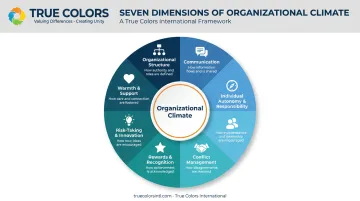
- Seven core dimensions (structure, communication, autonomy, conflict, rewards, risk-taking, warmth) shape climate
- Departments often show different climate styles, with sales, legal, and creative teams varying most
- Regular measurement and behavior-focused leadership development speed up improvement
What is Organizational Climate?
Organizational climate is the shared, relatively stable perception employees develop about the policies, practices, and atmosphere of their workplace. The employee handbook spells out policy on paper. Organizational climate is how that policy actually plays out day to day, shaped by countless small interactions between people.
Researchers distinguish this everyday, collective experience from psychological climate, which is an individual's personal read on their environment. James and James's foundational work showed that psychological climate becomes organizational climate only when enough employees within a team or unit share a similar perception. One person's frustration is an opinion. Twenty people's shared frustration is a climate signal.
What Shapes Climate Over Time
Climate builds gradually, through repeated small interactions rather than one big event. The everyday experiences that shape it include:
- How much trust and autonomy employees are given
- How managers and peers treat one another under pressure
- Whether growth and advancement opportunities feel real or theoretical
- How conflict gets handled: openly or swept under the rug
- Whether incentive structures feel fair or arbitrary
Because climate is built through behavior rather than policy documents, leaders can shape it intentionally. Everyday leadership actions carry far more weight than any mission statement.
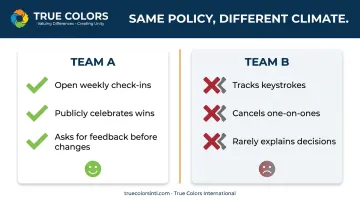
Consider two teams with identical remote-work policies. Team A's manager holds open weekly check-ins, celebrates wins publicly, and asks for feedback before rolling out changes. Team B's manager tracks keystrokes, cancels one-on-ones, and rarely explains decisions. Same policy, wildly different climate.
Organizational Climate vs. Organizational Culture
Culture and climate get lumped together constantly, but they operate at different levels.
Culture is the macro-level set of values, beliefs, and identity that define "who we are" as an organization. It's deep, often unspoken, and shaped over years. Climate is the micro-level, day-to-day perception of that culture in action, meaning it's what employees actually feel when they show up to work.
| Aspect | Organizational Culture | Organizational Climate |
|---|---|---|
| Depth | Deep assumptions and values | Surface-level perceptions of practices |
| Speed of change | Slow, often years | Faster, can shift in months |
| Measurability | Harder to assess consistently | Easier to survey and track |
| Focus | The "why" behind decisions | The daily "feel" of the workplace |
This is exactly why HR teams get quicker wins by focusing on climate. You can't rewrite a company's core values overnight, but you can change how a manager runs meetings within a quarter.
Here's the catch: a strong culture can still produce a poor climate. A company can have genuinely good values on paper, but if managers don't translate "we value transparency" into actually sharing information, employees experience the disconnect as broken trust, not aspiration.
The 7 Key Dimensions of Organizational Climate
Building on the foundational work of Litwin and Stringer, researchers have grouped organizational climate into structural, interactive, and perceptual factors. Modern synthesis of that research points to seven dimensions that consistently show up across industries and instruments.
These dimensions include:
- Organizational Structure: Decentralized structures push decision-making closer to the people doing the work, boosting engagement and speed; centralized authority leaves employees with little say.
- Communication: Open, transparent systems let employees raise concerns without fear of retaliation, while guarded communication filtered through approval layers lets good ideas die quietly.
- Individual Autonomy & Responsibility: Higher autonomy reduces manager workload and builds ownership; low autonomy breeds frustration as employees feel like they're just executing tasks.
- Conflict Management: Teams that address disagreements openly build trust and cooperation, while those that avoid conflict let resentment fester.
- Rewards & Recognition: Fair, performance-based rewards create healthy competition, but perceived bias in who gets recognized tanks morale fast, regardless of budget.
- Risk-Taking & Innovation: Climates that tolerate calculated risk foster creativity and experimentation, while those that punish mistakes harshly stifle the innovation leadership often claims to want.
- Warmth & Support: Mutual support among peers and managers gives employees the confidence to share ideas without fear of ridicule, shaping whether people speak up in meetings.
Types of Organizational Climate
Most organizations show a blend of climate types, usually with one dominant pattern. Based on the well-validated Competing Values framework, four commonly recognized types emerge:
- People-oriented – Prioritizes employee wellbeing, support, and involvement over rigid process
- Rule-oriented – Prioritizes structure, formalization, and compliance with established procedures
- Innovation-oriented – Prioritizes creativity, flexibility, and outward-looking experimentation
- Goal-oriented – Prioritizes clear targets, efficiency, and performance feedback
The "right" type often depends on function:
| Function | Best-Fit Climate | Why It Works |
|---|---|---|
| Sales floor | Goal-oriented | Clear metrics and targets drive daily performance |
| Finance or legal department | Rule-oriented | Precision and compliance carry real risk |
Neither approach is wrong. Mismatched climate to function is the actual problem.
The Impact of Organizational Climate on Business Performance
Climate acts as a behavioral constraint system. It signals, often more loudly than any policy manual, what actions get rewarded and what gets discouraged.
Leadership efficacy is central here. Managers shape climate more than any other single factor, and that climate then shapes how customers experience the business. Research across 134 bank branches found that HR practices like training and managerial support built a stronger service climate, which then predicted better customer perceptions the following quarter.
The link to engagement and performance is well documented too. Across multiple large-scale studies, the pattern holds: climate quality predicts commitment, innovation, and productivity months or years later.
| Study | Sample | Key Finding |
|---|---|---|
| CIPD evidence review | 89 studies, 53,000+ participants | Climate correlated with commitment at r = 0.54 |
| UK manufacturing study | 55 organizations | Open Systems climate → innovation: r = 0.36; Human Relations climate → productivity: r = 0.29 |
Translation: how people feel treated today predicts what they produce tomorrow.
This is where interpersonal and communication dimensions matter most, and where the work gets practical, not theoretical. True Colors International has spent more than 45 years helping organizations, including Google, Ford, and Marriott, strengthen exactly these dimensions through personality-based awareness training.
The logic is straightforward: when employees understand their own communication style and their colleagues' styles, the warmth, communication, and conflict-management dimensions of climate improve because people stop misreading each other's intentions.
A university accounting department that ran a True Colors Personal Success Workshop saw a direct example of this. Staff communication improved, conflict dropped, and the shift carried through to better retention and customer service, showing how communication-focused interventions ripple into broader performance outcomes.
How to Measure and Improve Your Organizational Climate
You can't improve what you don't measure, and climate is measurable if you use the right approach.
Start with Honest Data
Run regular climate surveys or pulse checks, but pair them with psychologically safe team discussions. Surveys alone can miss nuance. A quick pulse check followed by an open conversation surfaces what numbers alone won't show.
Turn Values into Daily Behavior
Employees don't experience mission statements. They experience what their manager does in a Tuesday morning meeting. Translate stated values into specific, observable leadership behaviors:
- Define what information gets shared and how often for the value "transparency"
- Establish what cross-team check-ins actually look like for "collaboration"
- Outline concrete development conversations, not just an annual review, for "growth"
Focus on What's in HR's Control
Four levers consistently move climate faster than anything else:
- Leadership development – Train managers on communication and emotional intelligence, not just deliverables
- Autonomy – Give teams real decision-making room, not just delegated tasks
- Recognition – Make rewards visible, consistent, and tied to actual performance
- Inclusion – Ensure every voice, not just the loudest one, gets heard in decisions
True Colors International structures this work through what it calls the True Culture Loop, a four-stage framework:
- Awareness – Helping teams understand their own and each other's communication styles
- Alignment – Building shared practices around that awareness
- Action – Embedding new behaviors into daily routines
- Reinforcement – Sustaining the habit long after initial training ends
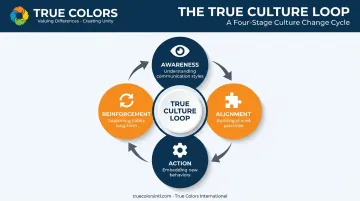
This structure gives organizations a clear starting point when they know climate needs to shift but lack a plan for how.
Frequently Asked Questions
What is meant by organizational climate?
Organizational climate is employees' shared perception of their workplace's policies, practices, and daily atmosphere. It's distinct from culture, which refers to the deeper values and beliefs behind those practices.
What are the 7 dimensions of organizational climate?
The seven commonly cited dimensions are structure, communication, autonomy, conflict management, rewards and recognition, risk-taking, and warmth/support. These dimensions often overlap and reinforce one another in practice.
What is the difference between organizational climate and organizational culture?
Culture is the deep, stable set of values and assumptions that define why an organization operates the way it does. Climate is the changeable, day-to-day feel employees experience as those values get applied.
How can organizations measure their organizational climate?
Regular climate surveys and pulse checks, combined with one-on-one or team feedback sessions, give the clearest read. Consistency matters more than frequency, since tracking change over time reveals real patterns.
What are the main types of organizational climate?
The four main types are people-oriented (focused on employee wellbeing), rule-oriented (built on structure), innovation-oriented (driven by creativity), and goal-oriented (centered on results). Most organizations show a blend, with one type typically dominant.
How quickly can organizational climate be improved?
Unlike culture, which takes years to shift, climate can improve within months through consistent leadership behavior change, better recognition practices, and clearer communication. The key is sustained effort, not a one-time training session.