The problem usually isn't strategy. It's that leaders treat transformation like a bigger version of ordinary change management, then wonder why culture pushes back. They roll out new systems while ignoring the human side, and the initiative stalls before it ever takes hold.
This guide breaks down what organizational transformation actually means, how it differs from routine change, the main types you'll encounter, what triggers it, and a practical framework for executing it without losing your workforce along the way.
Key Takeaways
- Transformation reshapes structure, culture, and operations, not just a software rollout
- Success depends on aligning leadership vision, culture, and execution, not new tools
- Most transformations blend digital, cultural, structural, and business-model shifts at once
- A phased, culture-first approach greatly improves the odds of lasting change
- Employee resistance is predictable; make communication your strongest lever for buy-in
What Is Organizational Transformation?
Organizational transformation is the fundamental reconfiguration of how a company creates value: its structure, culture, operations, and strategy, in response to major internal or external shifts. Rather than a single project with a finish line, it's an ongoing realignment of the business.
Think of it like renovating a house. Ordinary change is repainting a room or swapping the countertops. Transformation means tearing out load-bearing walls and rebuilding the foundation, sometimes while people are still living in the house.
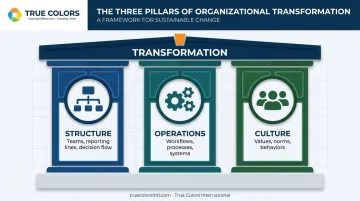
Three pillars hold up any transformation effort:
- Structure: how teams are organized, who reports to whom, and how decisions flow
- Operations: the workflows, processes, and systems that get work done
- Culture: the values, norms, and behaviors that determine whether any of it sticks
Culture is the least tangible of the three, and it's usually the one that decides success or failure. You can redesign an org chart in a weekend. Changing how 5,000 people actually behave takes months, sometimes years.
Increasingly, companies are treating transformation as a permanent capability rather than a one-off initiative, a muscle kept in constant use instead of a program that gets wrapped up and filed away. Organizations that build this muscle tend to sustain their competitive edge longer than those that launch isolated programs every few years and call it done.
Organizational Transformation vs. Organizational Change
Here's the distinction that trips up most leaders: change asks "how can we do this better?" Transformation asks "should we be doing this at all?"
| Factor | Change | Transformation |
|---|---|---|
| Scope | Specific process or team | Entire operating model |
| Timeline | Weeks to months | 18 months to several years |
| Risk | Low to moderate | High, enterprise-wide |
| Question asked | How do we improve this? | Should this exist in its current form? |
The most common pitfall? Applying change-management tactics like a memo, a training session, or a new dashboard to a problem that actually requires rethinking the business model. It's why success rates have barely moved despite the money poured into these efforts. McKinsey has found that transformation success has hovered around 30% for years, a figure that "hasn't budged" even as investment in these programs keeps climbing, according to McKinsey's research on successful transformations.
Types & Real-World Examples of Organizational Transformation
Most transformations aren't neatly categorized. A company chasing digital modernization often ends up rewriting its culture and org chart along the way. Understanding the individual types still helps leaders figure out where to focus first.
Digital Transformation This is about rethinking how technology enables every part of the business, not bolting on new software. Spend is climbing fast, but results lag: Gartner found that only 48% of digital initiatives met their business-outcome targets, while a smaller "Digital Vanguard" group hit 71%.
Cultural Transformation Culture tends to be the biggest enabler or blocker of any other transformation type. New reporting lines mean nothing if people don't trust each other enough to collaborate under them.
A shared communication language, like the personality-spectrum workshops True Colors International builds for teams, reduces this friction. Teams stop guessing at each other's motives and start recognizing behavioral patterns instead.
Business Model Transformation Business model transformation changes how value is created and captured: shifting from one-time product sales to subscriptions or platform-based revenue.
Operational/Structural Transformation Operational transformation redesigns workflows, governance, and reporting lines to remove friction and speed up decisions.
A Real-World Case: Microsoft
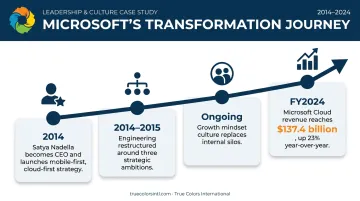
When Satya Nadella took over as CEO in 2014, he repositioned Microsoft around a "mobile-first, cloud-first" strategy, a hard pivot after the company recorded roughly $7.5 billion in impairment charges tied to its struggling phone business. He restructured engineering around three strategic ambitions and pushed a "growth mindset" culture to replace internal silos.
By fiscal 2024, Microsoft Cloud revenue alone reached $137.4 billion, up 23% year-over-year. The numbers don't prove causation on their own. But the sequence tells the real story: leadership reset first, structural realignment next, then cultural shift. That order is a textbook illustration of transformation in motion.
What Drives Organizational Transformation
Three forces typically push companies past the point where incremental change is enough.
External market pressure and competitive disruption: When competitors fundamentally change how an industry operates, playing catch-up with small tweaks doesn't work. Kearney's 2025 study found market disruption was the top-cited trigger, named by 63% of transformation leaders, ahead of new technology (51%) and financial underperformance (45%).
Technological disruption: AI and automation are forcing companies to rethink how people work alongside new tools, not just which tools to buy. McKinsey's 2025 research found 92% of companies planned to increase AI investment, yet only 1% of executives called their generative-AI deployment mature. Employees, meanwhile, reported using AI roughly three times more than executives assumed.
Internal performance gaps: Persistent underperformance and disengagement signal that the current model has hit its ceiling. Gallup's most recent data shows only 23% of employees worldwide are engaged, while 62% are simply going through the motions. Gallup estimates this costs the global economy $8.9 trillion annually — roughly 9% of global GDP.
How to Execute Organizational Transformation: A Step-by-Step Framework
Transformation doesn't happen in one leap. It moves through phases, and skipping any one of them is usually where things fall apart.
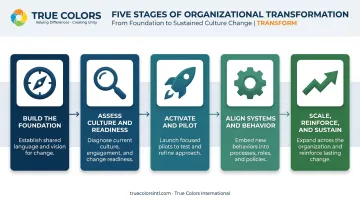
Build the Foundation: Articulate a clear vision, get leadership genuinely aligned (not just nodding in meetings), and build urgency using real data and a narrative people can repeat in their own words.
Assess Culture and Readiness: Evaluate leadership alignment, cultural openness, and governance maturity before launching anything. Validated personality assessments, like the ASI-certified tools True Colors International uses, reveal team communication patterns and flag resistance points before they become roadblocks.
Activate and Pilot: Roll out pilot initiatives in a contained group, build the new capabilities you'll need at scale, and generate early wins visible enough to build momentum elsewhere in the organization.
Align Systems and Behavior: Embed new processes into HR systems, performance reviews, and daily habits so the change doesn't rely entirely on leadership enforcement. A shared organizational language, such as True Colors' personality-spectrum framework, helps translate strategic intent into everyday behavior, whether that's how a manager delivers feedback or a sales team handles objections.
Scale, Reinforce, and Sustain: Track progress against defined KPIs and keep reinforcing new behaviors. This maps closely to what True Colors calls the True Culture Loop: a continuous cycle of Awareness, Alignment, Action, and Reinforcement that treats culture change as ongoing work rather than a finished project.
Coherence matters more than speed here. Strategy, structure, culture, and incentives all need to point the same direction, even if they move on different timelines. A brilliant new org chart paired with an unchanged bonus structure just creates confusion.
Common Challenges and How to Overcome Them
Resistance to Change
Skepticism is normal, not a red flag, and it's usually rooted in unclear communication rather than stubbornness. Transparent, two-way dialogue, not top-down mandates, is what actually moves people.
McKinsey research points to two clear multipliers for success:
- Transformation success is 5.8 times more likely when CEOs tell a compelling change story
- Success jumps to 8 times more likely when senior managers keep communicating openly as the work unfolds
Cultural Misalignment
Transformations that skip line managers and frontline employees succeed only about 3% of the time, according to McKinsey's research. Genuinely engaging those groups lifts that number to roughly 26-28%.
Building a shared communication framework helps close that gap. True Colors International's ASI-certified, personality-based assessments give leaders and teams a common language, reducing behavioral friction faster than generic training alone.
Loss of Momentum
Transformations lose steam without visible wins and consistent reinforcement from leadership. Embedding feedback loops and recognition systems, such as celebrating the pilot team that hit its numbers, keeps engagement alive well past the initial launch excitement.
Frequently Asked Questions
What is organizational transformation?
It's a fundamental realignment of a company's structure, culture, and operations to adapt to major internal or external shifts. Unlike routine change, it questions whether current ways of working should exist at all.
What is an example of organizational transformation?
Microsoft's shift under Satya Nadella is a well-documented case: a leadership reset paired with restructured engineering divisions, all anchored by a push toward a "growth mindset" culture as the company moved to cloud-first operations.
What is the difference between organizational change and organizational transformation?
Change is incremental and targets specific pain points quickly. Transformation reshapes the entire operating model over a longer horizon, often years rather than weeks.
How long does organizational transformation typically take?
Most major transformation initiatives run 18 to 36 months for full execution, though organizations often realize half their targeted value within the first 18 months. Scope and company size shift the timeline.
Why do most organizational transformation efforts fail?
McKinsey research shows large-scale transformations fail roughly 70% of the time, frequently due to weak employee engagement and cultural resistance rather than flawed strategy.
Who should lead an organizational transformation?
It requires senior leadership sponsorship paired with cross-functional ownership. No single department, including HR or IT, can carry a transformation alone.