That distinction matters more than most leaders realize. Gallup's latest Q12 meta-analysis, which tracked 183,806 business and work units across 90 countries, found that teams in the top quartile for engagement saw up to 51% lower turnover and 18% higher productivity than bottom-quartile teams — all within the same organization, often under the same HR policies and the same mission statement (Gallup Q12 Meta-Analysis, 2024).
In other words: the team is the unit that actually experiences culture, not the org chart.
Leaders often pour energy into polished culture decks while the day-to-day dynamics on individual teams go unmanaged. This article covers five practical, research-backed ways to fix that, including one factor most teams overlook entirely: personality awareness.
Key Takeaways
- Daily behavior, not mission statements, builds team culture and shapes retention and output.
- Strong cultures need shared values, personality awareness, honest feedback, visible leadership, and recognition.
- Culture work never finishes. It needs regular measurement and reinforcement to stick.
- Understanding communication styles builds trust faster than most team-building exercises alone.
What Is Team Culture and Why Does It Matter?
Team culture is the specific set of shared values, unwritten rules, and daily behaviors within one working group. It's narrower than organizational culture, which spans the entire company.
Harvard Business Review has noted that a single organization can contain multiple subcultures. Two teams at the same company, working under identical policies, can feel completely different to work on.
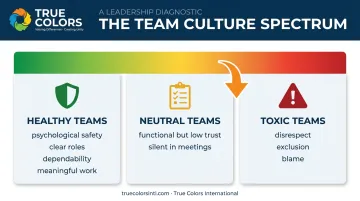
That culture typically falls somewhere on a spectrum:
- Healthy teams show psychological safety, clear roles, dependability, and a sense that the work matters. Google's Project Aristotle research, which studied 180 internal teams, found these traits mattered more than seniority, team size, or even individual talent.
- Neutral teams function fine on paper but lack real trust. People do their jobs, but nobody speaks up in meetings or flags problems early.
- Toxic teams feature disrespect, exclusion, and blame. Left unchecked, this dynamic spreads fast and drives people out the door.
The business case is hard to argue with.
Teams in Gallup's top-quartile engagement group posted 23% higher profitability and 78% lower absenteeism than bottom-quartile units.
Culture isn't a soft metric anymore. It shows up directly on the P&L.
5 Tips for Building a Strong Team Culture
Tip 1: Define Clear, Shared Team Values and Purpose
Most teams assume everyone already knows "how we work here." They don't. Unspoken values create inconsistent expectations, and inconsistent expectations create friction.
Team-level values need to be discussed out loud and written down, not implied.
Actionable step: Run a 60-90 minute workshop where the team co-creates 3-5 values together. Skip the top-down memo. When people help write the rules, they actually follow them.
A few guardrails:
- Keep the list short — five values max, or nobody remembers them
- Tie each value to a specific behavior ("we share bad news early," not "we value transparency")
- Make sure team values ladder up to the broader company mission, not compete with it
Tip 2: Build Self-Awareness Around Personality and Communication Styles
Here's an uncomfortable truth: most team friction has nothing to do with effort or skill. It comes from people misreading each other's communication and work styles.
A detail-focused teammate who wants agendas and deadlines can come across as rigid to a colleague who prefers spontaneous, big-picture conversations. Neither is wrong. They're just wired differently.
Validated personality assessments, including DISC, MBTI, and True Colors, give teams a shared, judgment-free vocabulary for talking about these differences. That's the whole point: not to label people, but to explain them.
True Colors International's methodology sorts communication and work-style tendencies into four categories: Orange, Gold, Green, and Blue, each representing a different temperament pattern. An Orange team member who thrives on spontaneity and a Gold supervisor who wants structure and follow-through aren't destined for conflict once both understand why the other operates the way they do.
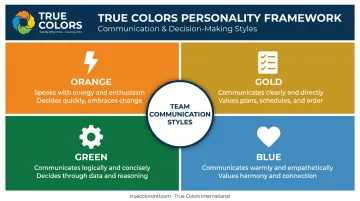
Actionable step: Run a personality-mapping session where the team maps out how each person prefers to communicate, make decisions, and receive feedback.
One True Colors client, the University of Texas Permian Basin's accounting department, used this exact exercise to help staff, in their own words, "acknowledge the team's different personalities and how our various personality colors can benefit the team."
The session doesn't need to be elaborate. Even a half-day workshop, the format True Colors used with MetroStar Systems for onboarding, can shift how a team talks to each other for months afterward.
Tip 3: Foster Open Communication and Continuous Feedback
Amy Edmondson's foundational research on 51 manufacturing teams defined psychological safety as a shared belief that the team is safe for interpersonal risk-taking.
Google's later Project Aristotle study confirmed it: psychological safety ranked as the single strongest predictor of team effectiveness, ahead of dependability, structure, and even the meaningfulness of the work itself.
Without it, people stay quiet. Problems fester. Good ideas never surface.
Actionable step: Replace vague "my door is open" policies with structured touchpoints:
- Weekly 1:1s that cover more than task status
- Short pulse surveys (2-3 questions, sent monthly)
- Team retros that ask what's working and what's not
Leaders should also flip the script occasionally and ask for feedback on team dynamics, not just deliver it. A simple "what's one thing slowing this team down?" at the end of a meeting opens more doors than any formal review ever will.
Tip 4: Lead by Example and Model the Behaviors You Want
Gallup's research is blunt about this one: managers account for at least 70% of the variance in team engagement scores across business units, based on data spanning 27 million employees (Gallup, "Managers Account for 70% of Variance in Employee Engagement"). A written values statement doesn't stand a chance against a manager who ignores it.
Team culture is caught more than it's taught.
Actionable step: Leaders should visibly own their mistakes and demonstrate the collaborative behaviors they're asking others to adopt. Say "I got that wrong" out loud in a meeting. Ask a junior teammate for input before deciding something big.
One caveat worth repeating: consistency matters more than grand gestures. A single instance of a leader skipping a stated value (say, promising transparency and then quietly excluding someone from a key decision) can undo months of trust-building in an afternoon.
Tip 5: Recognize Contributions and Reinforce Positive Habits
Recognition isn't a nice-to-have. Gallup's longitudinal study of nearly 3,500 employees from 2022 to 2024 found that people who felt well recognized were 45% less likely to have left their organization two years later (Gallup, "Employee Retention Depends on Getting Recognition Right").
Gallup ties strong recognition to five qualities: it's fulfilling, authentic, personalized, equitable, and embedded into daily culture, not saved for annual awards ceremonies.
Actionable step: Build lightweight recognition rituals that don't require a budget:
- A weekly "wins roundup" in a team channel
- Peer-to-peer shoutouts at the start of standups
- A rotating "who helped you this week?" prompt
One nuance that gets missed: recognize the behavior, not just the outcome. Praising someone for hitting a deadline is fine. Praising them for helping a teammate hit theirs reinforces the actual culture you're trying to build.
How to Measure and Sustain a Strong Team Culture Over Time
Culture work doesn't end after one workshop. It fades without upkeep, the same way fitness fades without training.
Sustaining it takes a mix of hard and soft signals:
- Quantitative: engagement surveys, retention data, absenteeism trends
- Qualitative: meeting participation, willingness to disagree openly, how often people volunteer for shared work
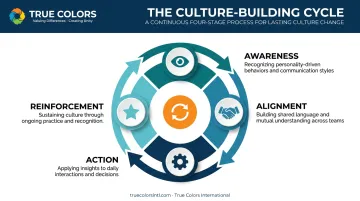
True Colors International frames this as a continuous cycle rather than a one-time fix — its True Culture Loop moves through four repeating stages: Awareness, Alignment, Action, and Reinforcement. Instead of a single training day, teams revisit each stage as new members join or priorities shift.
Most internal teams don't have the bandwidth to run this loop alone. That's why many organizations partner with certified facilitators to keep the work moving. True Colors currently supports a growing network of certified facilitators and Master Trainers worldwide, matched by industry so a hospital team and a sales team aren't getting the same generic playbook.
The pattern holds across sectors: culture built once and left alone reverts to old habits. Culture measured and revisited regularly compounds.
Frequently Asked Questions
How do you build a good team culture?
Start with clear, co-created values, then build mutual understanding of communication styles across the team. Add regular feedback loops and consistent leadership modeling, and reinforce all of it over time rather than treating it as a one-time fix.
What is an example of a good team culture?
A team that communicates openly, resolves disagreements without lingering resentment, and actively recognizes individual differences and contributions. Members feel comfortable flagging problems early rather than waiting for things to blow up.
How do you describe team culture at work?
Team culture is the shared values, communication norms, and daily behaviors that shape how a specific group collaborates. It's distinct from company-wide culture because it plays out in real interactions, not policy documents.
What are the 5 C's of teamwork?
There's no single, universally validated "5 C's" model — it varies by source. A more research-backed framework comes from Tannenbaum and Salas, who identify seven evidence-based drivers: capability, cooperation, coordination, communication, cognition, coaching, and conditions.
How long does it take to build a strong team culture?
Early signs of change can appear within a few months of consistent effort. Meaningfully embedding new norms so they stick without constant reminders usually takes sustained work over 6-12 months or longer.
How does personality awareness improve team culture?
Understanding how teammates prefer to communicate and make decisions reduces the misunderstandings that cause most day-to-day friction. It builds empathy for different working styles, which is the core idea behind frameworks like True Colors International's methodology.