Misread tone. A blunt piece of feedback that lands as an insult. Silence that gets mistaken for disengagement instead of respect. These moments don't always cause a blowup, but they chip away at trust and slow decisions down.
The stakes are real: PMI's research found that one in five projects fails specifically because of ineffective communication, with 56% of at-risk project budgets tied directly to communication breakdowns. This post breaks down what cross-cultural communication training actually involves, its core building blocks, and how organizations can implement it in a way that sticks.
Key Takeaways
- Cross-cultural training addresses how people build trust and interpret behavior across cultures
- Personality-based frameworks give teams a shared language that works regardless of nationality
- Culturally fluent teams see measurable gains in innovation, retention, and profitability
- Effective programs combine assessment, customized content, and ongoing reinforcement
What Is Cross-Cultural Communication Training?
Cross-cultural communication training is a structured process that builds the awareness, knowledge, and skills people need to communicate, collaborate, and lead across cultural lines. It's not a crash course in customs or a list of dos and don'ts for your next business trip to Tokyo.
That's the common misconception. Etiquette guides tell you not to hand someone a business card with one hand in certain cultures. They don't tell you why your direct feedback style might be read as disrespectful, or why a colleague's silence in a meeting doesn't mean agreement.
Cultural knowledge alone is incomplete. Knowing that a country values collectivism doesn't tell you how the specific person on your team processes conflict, receives feedback, or prefers to make decisions. That's where personality and temperament-based frameworks come in.
True Colors International's methodology, for instance, uses a four-color system to identify core temperament patterns that show up consistently across nationalities. Someone with a Gold temperament values structure and clear expectations whether they grew up in Seoul or Sacramento.
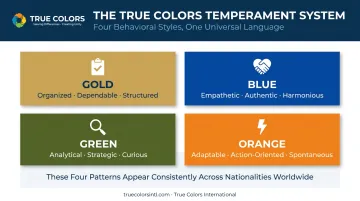
This gives teams a common language that transcends where someone is from and focuses on how they actually communicate. True Colors has applied this approach for over 45 years across organizations including Amazon, Ford, and Marriott, building shared communication frameworks at scale.
What This Training Actually Teaches Employees
Solid programs cover four core skill areas:
- High-context vs. low-context communication — recognizing when meaning depends on shared context and relationships versus explicit words
- Direct vs. indirect feedback — learning to decode softened criticism or read between the lines of a diplomatic email
- Nonverbal cues — interpreting silence, eye contact, and gestures without assuming they mean what they'd mean back home
- Assuming intent vs. seeking clarity — pausing to ask a clarifying question instead of filling in gaps with your own cultural assumptions
Key Elements of Cross-Cultural Communication and Cultural Competence
Cultural competence combines five interconnected capabilities, and most training programs miss at least one.
Self-awareness comes first. Before anyone can adapt to another culture, they need to recognize their own conditioning. A manager raised in a low-context culture might not realize their feedback style feels harsh to someone else until it's pointed out.
Cultural knowledge matters too, but frameworks like Hofstede's dimensions (individualism versus collectivism, power distance) describe tendencies across societies, not rules for predicting any one person's behavior. Treating them as absolutes backfires quickly.
Other essential pieces include:
- Verbal and nonverbal skills: adjusting tone, pacing, and feedback delivery based on context
- Behavioral adaptability: flexing communication style without losing authenticity (sometimes called "global dexterity")
- Empathy and emotional intelligence: the interpersonal sensitivity that helps teams navigate ambiguity without escalating conflict
The research backs this up. A meta-analysis of 37 independent samples found a significant, medium positive relationship between cross-cultural training and cultural adjustment, along with smaller gains in cultural intelligence and job performance. Notably, the delivery method mattered—generic, one-off sessions produced weaker results than sustained, varied approaches.
Why Cross-Cultural Communication Training Matters for the Modern Workplace
The business case isn't theoretical anymore. Recent research links diversity directly to profitability and innovation:
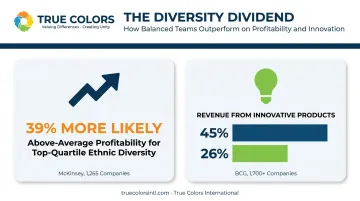
- McKinsey's analysis of 1,265 companies across 23 countries found that top-quartile companies for ethnic representation on executive teams were 39% more likely to show above-average profitability than bottom-quartile companies
- BCG's survey of over 1,700 companies found a similar pattern for innovation: companies with above-average management diversity reported 45% of revenue from innovative products, versus 26% for less diverse companies
But diversity alone doesn't guarantee those results. Harvard Business Review research notes that cultural diversity can actually suppress creativity when conflicting norms go unmanaged. The difference between teams that thrive and teams that stall often comes down to whether they've built the skills to navigate friction constructively.
This same dynamic shows up in retention. Multicultural work groups depend heavily on cultural intelligence to keep people engaged; studies link higher CQ to stronger work engagement and lower withdrawal intentions. Culturally competent leaders build trust faster with multicultural teams, which translates directly into retention and engagement outcomes leadership actually tracks.
Real-World Examples of Cross-Cultural Training in Action
Training theory is one thing. Here's what it looks like on the ground.
Feedback style adjustments. An American manager giving feedback to a team member from Japan learns to soften direct criticism, layering in context and relationship-preserving language rather than leading with the problem. Research from INSEAD notes that American managers already tend to cushion critique with positive framing. Even that softened version can still land as blunt in a culture where feedback is typically far more indirect.
Cross-time-zone norms. Global sales teams facing five or more time zones often rotate inconvenient meeting slots rather than always burdening the same office. HBR documented one team that built explicit communication routines and used shared tech tools to keep distributed members genuinely connected, not just scheduled.
Negotiation role-play. Training simulations let employees practice negotiating with counterparts from task-focused cultures like Germany, where competence and moving quickly to substance matter most, versus relationship-driven cultures like Brazil, where trust gets built before business gets discussed. Neither approach is wrong—but assuming everyone negotiates the same way is where deals stall.
How to Get Cross-Cultural Communication Training Right
Getting this right takes more than scheduling a workshop. Here's a practical sequence:
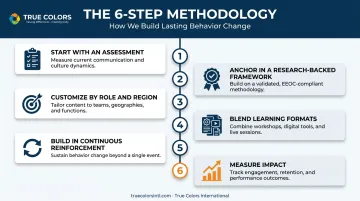
- Start with an assessment. Audit current friction points through surveys, interviews, or a validated behavioral assessment before designing anything.
- Anchor training in a research-backed framework. Look for methodologies validated against recognized standards. True Colors' assessment, for example, is ASI-certified through 2027 and tested against EEOC 80% Guideline standards using a 10,000-participant validation study.
- Customize by role and region. Executives, frontline managers, and customer-facing teams each need tailored content.
- Blend learning formats. Combine live workshops, e-learning, role-play simulations, and manager toolkits so concepts get reinforced from multiple angles.
- Build in continuous reinforcement. A one-time session fades fast. True Colors structures this as a cyclical process (Awareness, Alignment, Action, Reinforcement) that keeps learning compounding over time.
- Measure impact. Track pre/post assessment scores, behavior-based KPIs, or collaboration and retention metrics to prove ROI to leadership.
One caution: The Kirkpatrick model reminds us that positive reaction scores after a workshop don't equal behavior change on the job. If you're only measuring "did people like it," you're missing the real signal.
Common Challenges in Cross-Cultural Training (and How to Overcome Them)
Even well-designed programs run into predictable roadblocks.
- Language barriers. Multilingual materials, captioning, and bilingual facilitators help non-native speakers engage fully instead of missing nuance.
- Generic, one-size-fits-all content. Fix this by customizing case studies and scenarios by region, function, and seniority level rather than reusing the same deck for every audience.
- Low engagement or resistance. Passive lecture-style training rarely lands. Interactive formats (simulations, storytelling, peer discussion) paired with visible leadership buy-in reframe training as a business advantage, not a compliance checkbox.
These fixes aren't just intuitive. A systematic review of 27 studies found generally positive effects on cultural competence, particularly for programs using varied activities and mixed delivery formats. Programs that skip variety and reinforcement tend to see effects fade quickly.
Frequently Asked Questions
What is cross-cultural communication training?
It's structured training that builds the awareness and skills needed to communicate and collaborate effectively across cultural differences. It goes beyond etiquette to address communication styles, feedback interpretation, and behavior.
What are the key elements of cross-cultural communication and cultural competence?
The core pillars are self-awareness, cultural knowledge, verbal and nonverbal communication skills, behavioral adaptability, and empathy. Each one builds on the others rather than working in isolation.
What is an example of cross-cultural training?
A common example is role-play exercises where employees practice adapting feedback delivery or negotiation approaches for different cultural contexts. This might mean softening direct criticism for one culture or shifting to a relationship-first approach in negotiations for another.
Who needs cross-cultural communication training?
Any organization with distributed teams, international clients, or a culturally diverse workforce benefits: corporate enterprises, healthcare systems, government agencies, and educational institutions alike.
How is cross-cultural training different from general diversity training?
Diversity training typically focuses on broad inclusion and bias awareness. Cross-cultural training zeroes in specifically on communication styles, behavior, and collaboration within particular cultural contexts.
How long does it take to see results from cross-cultural communication training?
Initial awareness shifts can show up within weeks. Measurable behavior change and stronger team cohesion typically build over several months through consistent reinforcement and practice.