But pricing an engagement survey isn't straightforward. Costs range from a free DIY form builder to six-figure enterprise consulting programs. The right price depends on your headcount, how deep you want the reporting to go, and whether you need outside help turning results into action.
This guide breaks down the pricing tiers, the factors that push costs up or down, a full cost breakdown by category, and how to budget an amount that actually fits your organization.
TL;DR
- Full-service engagement surveys typically run $3,000–$30,000; software tools bill per employee per month.
- Length, headcount, reporting depth, and consultants raise prices; templates and smaller teams lower them.
- Small businesses running a simple pulse check land at the low end; enterprises needing benchmarking pay far more.
- A bigger budget only pays off when the data drives real follow-through, not a report nobody acts on.
How Much Does an Employee Engagement Survey Cost? (Pricing Overview)
There's no single price tag here. Engagement survey costs scale with three things: how deep the survey goes, who runs it, and how many people you're surveying. A 40-person startup and a 4,000-person manufacturer are simply buying different products, even if both call it an "engagement survey."
A few mistakes tend to inflate costs after the fact:
- Underbudgeting for follow-up action: the survey itself is often the cheapest part of the whole initiative
- Picking a tool with shallow reporting: you pay again later to upgrade for cross-tabs or benchmarking
- Getting surprised by per-employee or per-response fees: costs that weren't obvious at signup
Typical Cost Range
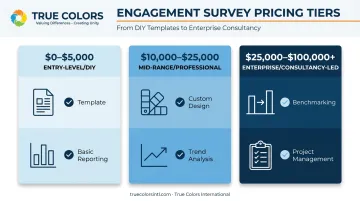
| Tier | Price Range | What You're Paying For |
|---|---|---|
| Entry-level / DIY | $0–$5,000 | Free form builders, basic survey software, templates |
| Mid-range / professional | $10,000–$25,000 | Custom design, enhanced reporting, some consultation |
| Enterprise / consultancy-led | $25,000–$100,000+ | Full benchmarking, cross-tabs, dedicated project management |
Drive Research, a market research firm, reports that outsourced employee survey projects typically fall in the $3,000 to $30,000 range, depending on survey length, response volume, and reporting depth. That band matches what most mid-sized organizations pay for a professionally designed, mid-range program.
Entry-level / DIY Tier
Best for small businesses running a quick pulse check. You get pre-built templates, a limited question set, basic summary reporting, and minimal support. Fine for a gut-check, but don't expect segmentation or trend analysis.
Mid-range / Professional Tier
This is where most growing companies land. Expect tailored questions, anonymous distribution, trend analysis over time, and some consultant involvement in interpreting results, without paying full consultancy rates.
Enterprise / Consultancy-led Tier
Built for large or complex organizations that need compliance-grade data. This tier typically includes multi-survey strategy, predictive analytics, custom action plans, and ongoing consultation plus manager training to sustain the work.
Key Factors That Affect the Cost of an Employee Engagement Survey
Price depends on survey design complexity, how many people you survey, reporting depth, customization, and how much support you need to turn results into action.
Survey Length and Complexity
Longer surveys cost more to design and analyze. Qualtrics recommends 30–50 employee experience questions as a rule of thumb, while Culture Amp's standard engagement template runs 57 questions and still finishes in under 10 minutes. Every additional question adds design time, analysis complexity, and respondent fatigue risk.
Number of Participants and Company Size
More employees means more data to collect and process, which raises costs. Response rates also vary by company size. Culture Amp's benchmarks show organizations under 50 employees often see 80-90% participation, while companies over 1,000 typically land between 65-80%. Higher headcount plus strong participation means more responses to process, clean, and report on.
Reporting Depth and Cross-Tabulation
Basic summary reports are inexpensive. Advanced reporting with demographic cross-tabs (by department, tenure, or gender) costs more because it needs statistical rigor and often a higher software tier. SurveyMonkey, for example, gates crosstabs behind its premium plan rather than its basic one.
Level of Customization
Off-the-shelf templates are fast and inexpensive. Custom-written questions designed by specialists to avoid leading or biased phrasing take longer to build but produce better data. You're paying for question quality, not just question quantity.
Provider Reputation, Consultation, and Delivery Method
Established providers that bundle strategic consultation, action-planning support, and hands-on project management charge more than a bare-bones software subscription. Delivery method shifts price too: outsourced, third-party administration usually costs more but improves data trustworthiness.
Cost Breakdown of an Employee Engagement Survey
The sticker price is only part of the investment. Engagement surveys carry both one-time and recurring costs, and organizations that only budget for the first survey often get blindsided later.
| Cost Category | One-Time or Recurring | What It Covers |
|---|---|---|
| Survey design & licensing | One-time (or annual license) | Question development, platform setup, branding |
| Distribution & data collection | One-time per cycle | Email, mobile, Slack/Teams deployment |
| Reporting & analysis | One-time per cycle (recurring for pulses) | Dashboards, benchmarking, cross-tab reports |
| Follow-up action planning & training | Recurring | Manager training, workshops, consultation |
That last line item is where most organizations under-invest. It's also where the real return on investment lives.
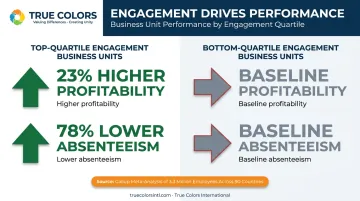
Gallup's 11th Q12 meta-analysis, covering more than 3.3 million employees across 90 countries, found that top-quartile engagement units saw 23% higher profitability and 78% lower absenteeism than bottom-quartile units. Acting on the findings is what produces those gains.
How to Estimate the Right Budget for Your Organization
The "right" cost isn't the lowest quote. It's the number that fits how your organization operates and what you plan to do with the results.
Consider these factors before you commit to a budget:
- Company size and expected response volume — larger headcounts mean more data processing
- Survey frequency — an annual deep-dive costs more per cycle, but continuous pulse checks add up over a year
- Whether you need compliance-grade or benchmarked data — this pushes you toward mid-range or enterprise tiers
- In-house HR capacity vs. the need for outsourced expertise — internal teams save money upfront but may lack bandwidth or objectivity
The most common mistake? Fixating on the survey price tag while ignoring the budget needed to act on results. A report full of insights does nothing sitting in a shared drive.
This is where pairing survey data with a structured framework matters. True Colors International's True Culture Loop (Awareness, Alignment, Action, Reinforcement) is built for that gap.
Survey data feeds the Awareness stage and shows where culture gaps exist. That insight then drives Alignment and Action, while Reinforcement keeps changes from fading after the initial report. The goal is direct: turn the survey investment into lasting engagement improvement, not a one-time snapshot that gathers dust.
Conclusion
Employee engagement survey costs vary widely, from a few hundred dollars for a DIY tool to six figures for enterprise, consultancy-led programs. Scope, headcount, and reporting depth are the main drivers.
The smarter approach balances upfront cost against the resources needed to act on what you find. A survey without follow-through rarely improves engagement, no matter how much you spent on it.
Organizations serious about lasting culture change tend to pair survey data with a proven methodology rather than treating measurement as the finish line. True Colors International has spent more than 45 years helping organizations move from insight to action, so survey results feed real culture change instead of sitting in a report.
Frequently Asked Questions
Are employee engagement surveys worth it?
Yes, but only when paired with follow-up action. Gallup's research links top-quartile engagement to 23% higher profitability and significantly lower turnover, benefits that only materialize when leaders act on findings.
What is a good participation rate for an employee engagement survey?
Culture Amp's benchmarks put healthy participation between 65% and 90%, depending on company size. Smaller companies (under 50 employees) tend to see 80-90%, while larger ones see 65-80%. Unusually low rates often signal distrust or survey fatigue.
What are the 5 C's of employee engagement?
One commonly referenced framework groups engagement drivers into Career, Competence, Care, Connect, and Congratulate. These roughly map to what most engagement surveys measure: growth opportunities, skill development, support, relationships, and recognition.
How much does an employee engagement survey cost per employee?
Software tools often charge $4–$5 per employee per month, based on published pricing from vendors like Officevibe and ThriveSparrow. Full-service consultancy surveys are usually quoted as a flat project fee instead.
Is it cheaper to run engagement surveys in-house or outsource them?
In-house tools cost less upfront but can suffer from lower trust, since employees may worry HR can identify their responses. Outsourcing costs more but tends to improve confidentiality and data quality through independent administration.
Does survey frequency affect overall cost?
Frequent pulse surveys often cost less per cycle but add up over a year of repeated cycles. A single annual survey has a higher one-time cost but lower cumulative spend across twelve months.