Introduction
Most leadership development plans fail before they start. Why? Because goals like "become a better leader" or "communicate more effectively" sound nice but give leaders nothing to act on.
The gap is real. According to Gallup's research on employee development barriers, 59% of CHROs say employee development is among the toughest employee-experience challenges they face, up sharply from the year before.
The SMART framework, Specific, Measurable, Achievable, Relevant, and Time-bound, fixes this by turning vague aspirations into trackable action. This guide walks through 10 ready-to-use SMART goal examples for leadership development, plus how to build your own and stay accountable along the way.
Key Takeaways
- SMART goals convert vague traits like "better communicator" into trackable actions
- 10 goal examples inside cover communication, emotional intelligence, delegation, and more
- Self-awareness, often built through a personality assessment, comes before goal-setting
- Regular check-ins and an accountability partner boost your follow-through odds
What Are SMART Goals and Why They Matter for Leadership Development
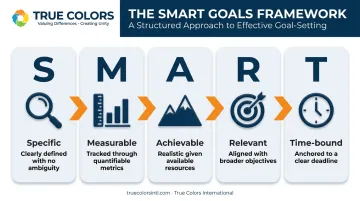
SMART is a five-part filter for turning intentions into action:
- Specific: Names the exact skill or behavior, not a general trait
- Measurable: Includes a number, percentage, or observable milestone
- Achievable: Stretches the leader without setting them up to fail
- Relevant: Ties directly to their role, team, or business priority
- Time-bound: Has a clear start and end date
A four-week Dominican University study of 149 adults found that people who wrote their goals down achieved a mean progress score of 6.44, compared to 4.28 for those who only thought about them.
Those who wrote weekly progress reports scored even higher, at 7.6, according to the Dominican University goals research summary. Specificity and tracking drive that difference.
SMART Goals vs. OKRs
People often confuse the two. An OKR pairs a big-picture Objective with several measurable Key Results, and it's typically used to align teams around organizational priorities. A SMART goal, by contrast, tests whether a single goal is well-formed: is it specific enough, measurable enough, realistic, relevant, and time-bound?
SMART goals are the quality check on an individual development target, while OKRs are the alignment structure for a whole team's priorities. A leader can (and should) write SMART goals whether or not their organization uses OKRs.
How to Set SMART Goals for Leadership Development
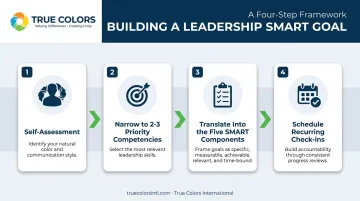
Setting a SMART goal without doing the groundwork first is like packing for a trip without knowing the destination. Follow these four steps.
Start with self-assessment. Before picking a goal, understand your natural communication and leadership style. A validated assessment, such as the True Colors personality assessment, surfaces blind spots you can't see on your own. Without that awareness, you can't tell whether your instinct is to over-control or over-delegate.
Narrow to 2 to 3 priority competencies. Trying to fix everything at once guarantees you'll fix nothing well. Pick the two or three growth areas that will move the needle most for your current role and team.
Translate each priority into the five SMART components. Use a simple worksheet: write the competency, then fill in what specific behavior you'll change, how you'll measure it, why it's achievable, why it's relevant now, and your deadline.
Schedule recurring check-ins. Monthly or quarterly reviews keep goals alive. Circumstances change, teams shift, and priorities evolve, so your goals should flex with them rather than sit untouched in a document until year-end.
10 SMART Goals for Leadership Development (With Examples)
Each example below can be scaled up or down depending on your role, industry, and current skill level. Treat them as templates, not scripts.
Goal 1: Improve Communication Skills
Example: "I will complete one communication-focused course or workshop per month for six months and collect peer feedback each quarter to track improvement."
- Specific: Focused on communication skill-building through structured courses
- Measurable: Six monthly courses, quarterly peer feedback scores
- Achievable: One short course monthly is realistic alongside a full workload
- Relevant: Communication consistently ranks among the leadership skills organizations invest in most heavily
- Time-bound: Six-month window with quarterly checkpoints
Goal 2: Build Emotional Intelligence and Self-Awareness
Example: "I will complete a certified personality assessment within 30 days and apply the insights to adapt my communication style with at least three different personality types over the following quarter."
- Specific: Complete an assessment, then apply insights to real interactions
- Measurable: Three distinct personality types, tracked over one quarter
- Achievable: A single assessment plus deliberate practice fits most schedules
- Relevant: Leaders with stronger emotional intelligence build more trust with their teams, which reduces friction and conflict
- Time-bound: 30 days to complete, 90 days to apply
For this goal, the assessment itself matters. Tools like the True Colors online personality assessment give leaders a research-backed starting point rather than a guessing game. It's ASI-certified, validated against a 10,000-person study, and compliant with EEOC 80% guidelines.
Goal 3: Learn to Give and Receive Constructive Feedback
Example: "I will deliver structured feedback to each direct report at least once monthly and actively request feedback on my own performance from three peers per quarter."
- Specific: Both giving and receiving feedback, tracked separately
- Measurable: Monthly delivery, quarterly requests from three peers
- Achievable: Fits within existing one-on-one cadences
- Relevant: Builds a culture of accountability and continuous improvement across the team
- Time-bound: One full quarter
Goal 4: Strengthen Relationships With Team Members
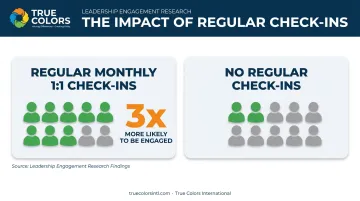
Example: "I will hold monthly one-on-one check-ins with every direct report for the next six months, focused on their goals, blockers, and career interests."
- Specific: Structured monthly one-on-ones with a defined agenda
- Measurable: One meeting per report, per month
- Achievable: Requires calendar discipline, not new resources
- Relevant: Employees whose managers meet with them regularly are nearly 3x as likely to be engaged, according to Gallup's research on manager relationships
- Time-bound: Six months, reviewed at month three
Goal 5: Increase Adaptability to Change
Example: "I will complete a change management course within 60 days and document at least five adaptive responses to unplanned shifts during the six months after."
- Specific: Formal training plus real-world application
- Measurable: Five documented adaptive responses
- Achievable: Most change courses run a few weeks
- Relevant: Adaptability keeps teams functional during disruption and market shifts
- Time-bound: 60-day training window, six-month tracking period
Goal 6: Run More Effective Meetings
Example: "I will implement a standardized meeting agenda template and reduce total weekly meeting time by 20% over two months."
- Specific: Standardized agenda, measurable time reduction
- Measurable: 20% reduction, tracked weekly
- Achievable: Cutting unnecessary meetings is often just a habit change
- Relevant: Poorly run meetings drain productivity and focus across the entire team
- Time-bound: Two-month window
Goal 7: Develop Internal Talent Through Mentorship
Example: "I will launch a structured mentorship program with bi-monthly sessions, running for one year, and track mentee participation and satisfaction quarterly."
- Specific: Defined program structure and cadence
- Measurable: Bi-monthly sessions, quarterly participation tracking
- Achievable: Doesn't require new headcount, just scheduling and structure
- Relevant: Supports retention and builds a pipeline of future leaders
- Time-bound: Full 12-month program
Goal 8: Improve Delegation Skills
Example: "I will delegate at least 30% of my current recurring tasks within six months and survey my team quarterly on their confidence handling new responsibilities."
- Specific: A defined percentage of tasks, tracked survey feedback
- Measurable: 30% delegation target, quarterly confidence surveys
- Achievable: Gradual delegation over six months, not overnight
- Relevant: Poor delegation is strongly linked to leader burnout, and empowering teams builds their capability
- Time-bound: Six months
Goal 9: Show Consistent Appreciation and Recognition
Example: "I will host one team recognition activity monthly for six months and collect brief feedback after each session to refine the approach."
- Specific: Monthly recognition activity with a feedback loop
- Measurable: Six sessions, feedback collected each time
- Achievable: Low-cost, low-effort, high-frequency habit
- Relevant: Consistent recognition is tied to stronger morale and lower turnover
- Time-bound: Six-month cycle
Goal 10: Enhance Conflict Resolution and Decision-Making Skills
Example: "I will complete conflict-resolution training within 90 days and apply a structured resolution process to at least six team conflicts throughout the next year."
- Specific: Training plus a repeatable resolution framework
- Measurable: Six documented conflict resolutions
- Achievable: Most conflicts already surface naturally within a year
- Relevant: Better conflict resolution improves team cohesion and business outcomes
- Time-bound: 90 days to train, 12 months to apply
Tips to Successfully Achieve Your Leadership SMART Goals
Writing a SMART goal is the easy part. Sticking with it is where most leaders stumble.
- Track progress visibly. Use a spreadsheet or project management tool to log milestones against each goal. Seeing a half-finished progress bar is surprisingly motivating.
- Bring in outside accountability. Partner with a certified coach or facilitator, such as a True Colors Master Trainer, for objective feedback you won't get from self-review alone.
- Revisit goals quarterly. Timelines shift. Priorities change. A quarterly check-in lets you recalibrate deadlines without abandoning the goal entirely.
- Celebrate completed milestones. Don't wait until the finish line to acknowledge progress. Small wins sustain motivation over long time horizons.
Frequently Asked Questions
What is an example of a SMART goal for leadership?
"I will delegate 30% of my recurring tasks within six months and survey my team quarterly on their confidence handling new responsibilities." This covers all five SMART elements: specific action, measurable target, realistic scope, clear relevance, and a firm deadline.
What are 5 SMART goals examples?
Five common themes include improving communication through monthly courses, building emotional intelligence via a personality assessment, strengthening delegation, refining feedback exchange, and increasing adaptability to change through structured training.
How do I write a SMART goal for leadership development?
Start with a self-assessment to identify blind spots, narrow to 2-3 priority competencies, translate each into the five SMART components, and schedule recurring check-ins to track progress and adjust as needed.
How many SMART goals should a leader focus on at once?
Stick to 2 to 3 goals at a time. Spreading focus across more than that usually stalls meaningful progress on every goal at once.
What is the difference between a SMART goal and a general leadership competency?
A competency is a broad skill area, like "communication" or "delegation." A SMART goal is the specific, time-bound action a leader takes to build that competency in practice.
How often should leadership development goals be reviewed?
Monthly or quarterly reviews work best for most leaders. This cadence is frequent enough to catch problems early, but not so frequent that it feels like busywork.