Here's the common trap: most organizations say they value their people. Mission statements mention it. Onboarding decks highlight it. But the daily experience of employees rarely matches the language on the wall, and that gap breeds quiet disengagement.
This article defines what an employee-first culture actually looks like and walks through a practical 13-step framework, drawing on decades of organizational development research and personality-based communication science to help leaders build something that sticks.
Key Takeaways
- Global engagement sits at just 20%, making people-first practices a competitive necessity
- Well-recognized employees are 45% less likely to leave within two years
- Culture change requires a repeatable system, not a single initiative or annual event
- Shared language and personality awareness reduce friction faster than policy alone
- EVP strength depends directly on how genuinely employee-first the daily culture feels
What Is an Employee-First Culture?
An employee-first culture treats employee well-being, voice, and growth as core drivers of business results, not a secondary concern behind quarterly profit. This philosophy shapes how leaders make decisions every day.
This idea isn't new. HCLTech dates its own "Employees First" journey to 2005, and the concept went mainstream after Vineet Nayar published Employees First, Customers Second in 2010, alongside his Harvard Business Review article making the same case.
Nayar's model inverted the traditional pyramid so leadership became accountable to the frontline employees creating customer value, not the other way around. What started as a bold management theory is now considered baseline good practice.
Six characteristics define an employee-first workplace:
- Trust: leaders share real information, not filtered updates
- Inclusion: diverse perspectives shape decisions, not just headcount
- Transparency: decisions and their reasoning are visible, not hidden
- Empowerment: employees have real authority over their work
- Recognition: contributions get acknowledged specifically and often
- Development: growth paths exist beyond the current role
Notice none of these show up in a policy binder. They show up in Tuesday afternoon meetings, in how a manager responds to a mistake, in whether feedback actually changes anything. An employee-first culture requires weekly reinforcement, not an annual appreciation lunch.
The 4 Types of Workplace Culture
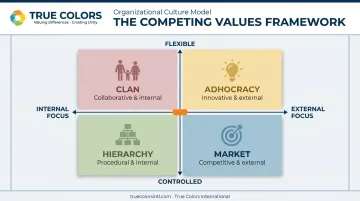
Before applying any framework, it helps to know what culture you're actually working with. The Competing Values Framework identifies four types:
| Culture Type | Focus | Defining Trait |
|---|---|---|
| Clan | Internal, flexible | Family-like, collaborative, employee development |
| Adhocracy | External, flexible | Entrepreneurial, innovative, adaptive |
| Market | External, controlled | Competitive, results-driven, goal-focused |
| Hierarchy | Internal, controlled | Structured, procedural, consistent |
Employee-first organizations typically blend Clan and Adhocracy traits: collaborative but adaptive. That said, no quadrant is inherently better. A hospital's ICU may lean Hierarchy for good reason. The real work is diagnosing where your organization sits today before layering on the steps below.
Why Employee-First Culture Matters
The business case isn't theoretical anymore. Gallup's meta-analysis of over 2.7 million employees found that top-quartile engaged business units outperform bottom-quartile units by:
- 23% in profitability
- 18% in sales productivity
- 14% in production output
These are associations drawn from business-unit comparisons, not a guarantee, but the pattern is consistent across industries.
Retention tells a similar story. A two-year Gallup and Workhuman study tracking nearly 3,500 employees found that those who felt well recognized in 2022 were 45% less likely to have left their jobs two years later.
Recruiting is affected too. In a multi-country Glassdoor survey of over 5,000 adults, 77% said they'd consider culture before applying to a job, and 73% wouldn't apply at all unless a company's values matched their own.
Culture now functions as a filter candidates apply before they ever submit a resume.
Ignore this shift, and the costs show up as absenteeism, quiet quitting, and the kind of toxic dynamics that push your best people out the door, one resignation at a time.
13 Steps to Creating a People-Focused Organization
These steps move from foundational awareness to daily reinforcement. They work for a 20-person startup and a 20,000-person enterprise alike; only the scale of execution changes.
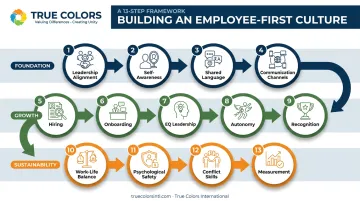
Step 1: Align Leadership and Mission Around People-First Values
Culture change starts at the top, visibly. If leaders talk about empowerment in a town hall but micromanage in practice, employees notice the gap immediately. Every major decision should be checked against the mission statement, not just referenced during onboarding.
Step 2: Build Self-Awareness Through Personality and Temperament Insights
Teams communicate better once they understand how individuals differ, not just what they disagree about. Validated personality assessment methodologies, like the one used across True Colors International's programs, help employees and managers recognize behavioral patterns that would otherwise cause friction.
Step 3: Create a Shared Organizational Language
A common vocabulary for discussing differences saves time and reduces defensiveness. Instead of vague labels like "difficult" or "disengaged," teams can describe someone's working style in specific, neutral terms that everyone in the building understands the same way.
Step 4: Establish Two-Way Communication Channels
One annual survey doesn't cut it anymore. Build ongoing dialogue through:
- Regular town halls with real Q&A, not scripted updates
- Pulse surveys sent quarterly or monthly
- Genuinely open-door policies, not just the phrase itself
- Digital feedback platforms employees actually use
Step 5: Hire for Cultural and Values Alignment
Every new hire either reinforces your culture or dilutes it. Incorporating culture-fit assessments into recruiting, alongside skills evaluation, helps hiring teams spot candidates who will thrive in your specific environment, not just candidates who look good on paper.
Step 6: Design an Onboarding Experience That Welcomes, Not Overwhelms
Early exits are common: BambooHR found that 31% of employees leave a job within six months, often citing unclear responsibilities and weak training as top reasons. Structured checklists and mentor pairing during the first 90 days address both problems directly.
Step 7: Develop Emotionally Intelligent Leaders
Managers set the emotional temperature of their teams. Training them in empathy, active listening, and self-regulation has a direct line to trust and retention. Coaching and workshop-based EQ development work better than a one-time seminar.
Step 8: Empower Employees With Autonomy and Growth Paths
Micromanagement kills initiative. Give employees real decision-making authority within their role, paired with individualized development plans and mentorship. People stay where they can see a future, not just a paycheck.
Step 9: Recognize and Celebrate Contributions Consistently
Frequent, specific recognition beats a generic annual award every time. A manager thanking someone by name for a specific contribution, the same week it happened, does more for motivation than a year-end plaque ever will.
Step 10: Support Genuine Work-Life Balance
Flexible scheduling and remote options only count if off-hours boundaries are actually respected. If leadership sends emails at 11 p.m. and expects fast replies, the flexibility policy is just decoration.
Step 11: Build Psychological Safety and Trust
Employees need to voice concerns or admit mistakes without fear of retaliation. Protecting that kind of honesty is what innovation depends on. Teams that hide problems can't fix them.
Step 12: Equip Teams With Conflict Navigation Skills
Unresolved conflict doesn't disappear. It festers, and it erodes trust over time. Formal conflict-resolution training, like the Advanced Certification tracks True Colors International offers to facilitators, gives teams tools to disagree productively instead of avoiding hard conversations altogether.
Step 13: Measure, Reinforce, and Continuously Evolve the Culture
Close the loop with real metrics: engagement scores, retention rates, recognition frequency. Review them quarterly, not annually. Metrics you track regularly stay reinforced. Ignore them, and the culture behind them fades fast.
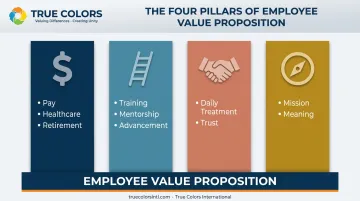
The 4 Pillars of Employee Value Proposition (EVP)
EVP is the full package an employee receives in exchange for their skills and effort, not just their paycheck. HR authorities like SHRM and Gartner describe it broadly, but four categories capture the practical essentials:
- Compensation & Benefits: pay, healthcare, retirement, and perks
- Career Development: training, mentorship, and advancement opportunities
- Work Environment/Culture: how people are treated day to day
- Purpose/Values Alignment: whether the mission means something real
Here's the connection: a genuine employee-first culture directly strengthens the third and fourth pillars. You can't fix compensation with culture work, but you absolutely can fix whether people feel their work matters and whether their environment respects them. The 13 steps above are, in effect, an EVP-building exercise disguised as culture work.
How True Colors International Helps Build Employee-First Cultures
Building this kind of culture from scratch is hard without a shared framework. True Colors International has spent over 45 years helping organizations do exactly that, using an ASI-certified personality assessment methodology built around four color-coded temperament types: Orange, Gold, Green, and Blue.
The system gives teams the shared vocabulary described in Step 3, the self-awareness foundation in Step 2, and the conflict navigation tools in Step 12, all rooted in the same underlying assessment.
Master Trainers guide this work across sectors, from Fortune 500 companies to healthcare systems and government agencies:
- Dr. Bill Behrens, President of True Colors International, brings 33 years of public education leadership experience
- David Eng, a Master Instructor since 2008, has trained teams at organizations including Amazon, Google, Ford, and Salesforce
If your organization is ready to move past mission statements and into daily practice, exploring True Colors International's assessments and certification programs is a practical next step toward putting these 13 steps into action.
Frequently Asked Questions
What is employee-first culture?
Employee-first culture is an organizational approach that prioritizes employee well-being, voice, and growth as central drivers of business success, not secondary concerns behind profit. It shows up in daily decisions, not just policy documents.
What are the 4 types of workplace culture?
The Competing Values Framework identifies Clan (collaborative), Adhocracy (innovative), Market (competitive), and Hierarchy (structured) as the four core types. Most organizations blend traits from more than one.
What are the 4 pillars of EVP?
Compensation & Benefits, Career Development, Work Environment/Culture, and Purpose/Values Alignment make up the four commonly cited pillars of Employee Value Proposition. Together, they define the full exchange between employer and employee.
How long does it take to build an employee-first culture?
Culture change is ongoing rather than a fixed timeline. Most organizations see measurable shifts within one to three years, depending on company size, leadership consistency, and how deeply the changes get reinforced.
Is an employee-first culture the same as a customer-first culture?
No, but they aren't in conflict either. An employee-first approach improves customer experience indirectly, since engaged, well-supported employees deliver better service than burned-out ones.
What role does personality awareness play in building a strong workplace culture?
Understanding communication and temperament differences, often mapped through frameworks like True Colors' personality-color system, helps employees interpret each other's behavior more charitably instead of personally. That shared understanding reduces friction and builds empathy across teams and leadership levels alike.