Seven in 10 U.S. employees say their organization experienced disruptive change in the last year, according to Gallup's 2024 workplace disruption research. Leaders and managers are 56% more likely than individual contributors to feel that disruption acutely.
Siloed teams. Miscommunication. Disengaged employees. Change initiatives that stall before they start. These aren't isolated problems — they're symptoms of organizations that haven't invested in the systems that hold people together.
Organizational coaching is the strategic response. This guide covers what it is, why it works, the four types of engagements, who needs it most, and how to choose a program that fits.
Key Takeaways
- Organizational coaching targets systemic, company-wide change, not just individual leaders
- Communication breakdowns and weak middle-management support drive most failed culture initiatives
- Coaching cultures correlate with higher engagement, stronger retention, and better financial performance
- Effective programs follow a cyclical process: assess, align, act, and reinforce
- The right program fits your organization's size, culture, and goals, backed by verifiable credentials
What is Organizational Coaching?
Organizational coaching is a strategic, systemic process. It partners with leaders, teams, and stakeholders to align individual and team performance with company-wide objectives.
That's a meaningfully different animal than executive or life coaching. Those disciplines work one-on-one, focused on a single person's growth. Organizational coaching, by contrast, targets scalable, enterprise-wide change — how departments communicate, how teams collaborate, and how culture actually functions day to day.
This work sits at the intersection of three disciplines:
- Human resources, which manages the people systems
- Organizational development (OD), which diagnoses systemic issues
- Leadership development, which builds capability at the top
Most engagements start with diagnostic tools: personality or behavioral assessments designed to surface root-cause issues before anyone tries to fix them.
True Colors International's Approach in Practice
True Colors International has spent more than 45 years building this exact communication foundation for organizations. Its ASI-certified personality assessment gives leadership teams a shared language for understanding behavioral differences, which becomes the bedrock that broader coaching initiatives rely on.
Clients ranging from Amazon and Ford to Oracle and Marriott have used this approach to move from what the company calls "culture confusion" to "culture confidence."
Organizational coaching functions as an ongoing, cyclical discipline embedded into how a company operates day to day, not a single workshop or one-time event.
Key Benefits of Organizational Coaching
The pain points are familiar. The benefits, when coaching is done well, are measurable.
Improved cross-team communication. Nearly half of professionals surveyed by SHRM's 2023 Fishbowl study didn't understand their own employer's hybrid-work plan. That gap reflects a communication failure happening at scale across thousands of organizations.
Stronger collaboration across departments. Teams with different priorities and working styles often talk past each other. Coaching gives them a shared framework, such as True Colors' personality-based communication model, so a detail-oriented team and a big-picture team can actually understand each other's intent.
Reduced turnover through culture alignment. Employees who feel disconnected from their organization's culture leave. Coaching that reinforces alignment reduces that exit risk.
More self-aware, emotionally intelligent leaders. Leaders who understand their own tendencies, and how those tendencies land on others, navigate change with far less friction.
Measurable engagement gains. Organizations with strong coaching cultures see real, quantifiable differences:
- 65% of employees in strong-coaching-culture organizations report high engagement, compared to just 52% elsewhere
- 60% of these organizations reported revenue above their peer group, compared to 41% of others
- Employees are 4.3 times more likely to stay engaged when leaders communicate well during disruption, according to Gallup
- Employees are 65% less likely to feel burned out under the same conditions
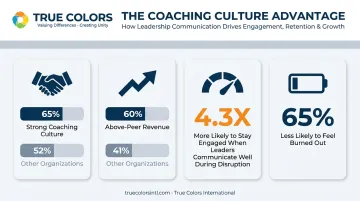
That data on engagement and revenue comes from an ICF/HCI study of more than 500 professionals. It shows association, not causation, but the pattern has held for years. Communication is a retention strategy with measurable ROI.
How Organizational Coaching Works: The Process
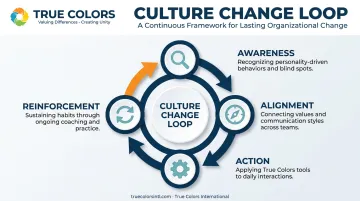
Most engagements don't follow a one-time fix. They run on a structured, cyclical framework: assessment, alignment, action, and reinforcement, repeated as the organization evolves.
Phase 1: Assessment
Coaches evaluate leadership capability, team dynamics, and existing culture before recommending anything. This typically involves validated assessments, such as personality or temperament tools like True Colors' ASI-certified assessment, that establish a baseline of self-awareness.
Skipping this step is the most common mistake organizations make. You can't align a team around goals if nobody understands how they actually operate day to day.
Phase 2: Alignment
Once the baseline is set, coaches work with leadership to establish:
- Shared goals across departments
- Clear expectations for behavior and communication
- Success metrics everyone agrees on
This phase matters because it's where most initiatives fail: leadership assumes alignment exists when it doesn't.
Phase 3: Action and Implementation
This is where insight becomes behavior. Workshops, training sessions, and ongoing coaching conversations translate the diagnostic work into daily practice.
Facilitator-led programs, whether delivered by a certified facilitator or a Master Trainer, work well here because they adapt content to real team dynamics rather than delivering a generic script.
Phase 4: Evaluation and Reinforcement
Lasting change requires measurement and reinforcement, not a single training day. This mirrors what True Colors calls its True Culture Loop: Awareness, Alignment, Action, and Reinforcement, cycling continuously rather than running in a straight line.
Culture change has no finish line. It operates as a loop that keeps running as your organization grows.
Who Needs Organizational Coaching?
Different levels of an organization need coaching for different reasons.
Top leaders and executives. Coaching helps them model the behaviors and culture they want cascading through the organization. If leadership doesn't visibly live the values, nobody else will either.
Middle management. This is the level most culture initiatives forget — and where they fail as a result. Middle managers translate strategy into daily practice. Yet McKinsey's global survey of 706 middle managers found only 20% strongly agreed their organization helped them succeed as people managers.
That gap has real financial consequences. McKinsey's analysis of 50 companies found organizations with top-performing middle managers produced 3 to 21 times greater five-year shareholder returns than those with average managers.
Functional teams and high-potential employees. Coaching here improves day-to-day collaboration and prepares tomorrow's leaders. It applies across industries:
- Corporate and technology teams navigating rapid growth
- Healthcare teams where communication failures affect patient outcomes
- Education institutions building staff and faculty collaboration
- Government and nonprofit organizations managing limited resources with high stakes
How to Choose the Right Organizational Coaching Program
Not every program is built the same way, and picking the wrong one wastes budget and goodwill.
Look for tailored, not generic. A program that applies the same framework to a 50-person nonprofit and a 5,000-person hospital system probably isn't accounting for your specific culture, size, or goals.
Verify credentials and track record. This matters more than most buyers realize. Check for:
- ICF membership or affiliation
- SHRM or HRCI accreditation
- Third-party validated assessments with documented reliability data
True Colors International, for example, holds ICF membership, SHRM and HRCI accreditation, and an ASI-certified assessment valid through 2027, built on a validation study of 10,000 respondents.
It also maintains a global network of certified Master Trainers and facilitators across the U.S., including a small Elite Facilitator tier of just 11 professionals trained to adapt program depth for advanced teams.
Confirm scalability and success metrics. Ask upfront how the program measures progress and whether it can grow alongside your organization — from a single department pilot to a company-wide rollout.
Frequently Asked Questions
What does an organizational coach do?
An organizational coach partners with leaders and teams at every level to identify performance gaps, facilitate better communication, and guide implementation of sustainable, strategic change across the organization.
What are the four types of coaching?
Common categories include executive coaching for senior leaders, team coaching for collective goals, leadership development coaching for building manager capability, and internal versus external coaching based on who delivers it. No single universal standard defines these as an official list.
What are the 5 C's of coaching?
Various sources reference Clarity, Communication, Connection, Commitment, and Confidence as core coaching pillars. The ICF itself doesn't use a "5 C's" model; it defines eight core competencies instead.
How is organizational coaching different from executive coaching?
Executive coaching targets one senior leader's individual growth. Organizational coaching addresses systemic, company-wide culture and performance alignment across teams and departments.
How long does an organizational coaching engagement typically last?
Engagements vary widely: a few months for a focused team intervention, multi-year partnerships for full culture transformation. One documented healthcare case expanded from a five-month program to ten months as scope grew.
What industries can benefit from organizational coaching?
It applies broadly across corporate, healthcare, education, government, nonprofit, and military sectors, anywhere teams need stronger alignment and communication to function well together.