This happens constantly. The skills that make someone a closing machine rarely translate to leading a room full of closing machines with different personalities, motivations, and stress responses.
The stakes are real. Firms with strong sales coaching see annual revenue growth 16.7% higher than firms offering no coaching at all, according to research from the Sales Management Association. Leadership isn't a soft skill here. It's a revenue driver.
This article breaks down the six essential skills every sales leader needs, why they matter more now than ever, and how to build them systematically across your team.
Key Takeaways
- Sales leadership centers on people, not pipeline management
- Six core skills: emotional intelligence, communication, coaching, hiring, accountability, adaptability
- Leadership sets vision and culture; management drives daily execution
- EQ and communication develop through personality-based frameworks and practice
Why Sales Leadership Skills Matter More Than Ever
Sales teams look nothing like they did five years ago. Hybrid work, compressed buying cycles, and rising rep turnover have changed what "good leadership" requires. Enforcing quotas isn't enough anymore; leaders now need to retain talent, motivate remote reps, and keep morale steady through constant change.
Turnover is the clearest warning sign: sales organizations saw voluntary turnover jump 58% higher in 2021 compared to the year before, according to Xactly's survey of 400+ sales leaders. That's not a one-time blip — it reflects a talent market where reps leave managers, not just companies.
Replacing them isn't cheap, either. General hiring benchmarks from SHRM put average cost-per-hire near $4,700, with total replacement costs ranging from 50% to 200% of salary depending on role complexity. For a sales team losing multiple reps a year, that adds up fast.
The upside is just as compelling:
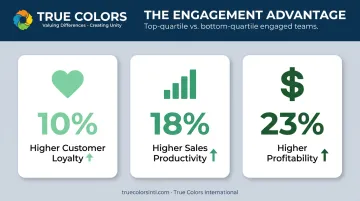
- Teams in the top quartile of engagement show 10% higher customer loyalty
- The same teams post 18% higher sales productivity
- Profitability runs 23% higher than bottom-quartile teams
These numbers come from Gallup's Q12 meta-analysis, one of the largest workplace studies ever conducted. People-first leadership isn't a nice-to-have: it shows up directly in the numbers finance teams care about.
6 Essential Sales Leadership Skills for Success
These six skills show up again and again across research on high-performing sales organizations and the leaders who run them. None of them require a personality transplant. All of them can be built with intention.
Emotional Intelligence and Self-Awareness
Emotional intelligence is the ability to recognize and manage your own reactions while reading what's happening on your team. It matters most in the moments that make or break morale: end-of-quarter crunches, missed targets, sudden pipeline gaps.
A leader who snaps under pressure sets the tone for the whole floor. One who stays steady, even while pushing hard, keeps reps engaged instead of anxious.
Temperament plays a bigger role here than most leaders realize. A rep who thrives on direct, fast feedback might shut down if a manager is too soft. Another rep might need more encouragement and less bluntness to stay motivated.
This is exactly the gap that personality-based frameworks like True Colors International's training were built to close, giving leaders a common language for understanding why reps respond so differently to the same pressure.
Clear, Transparent Communication
Reps don't just want instructions. They want the "why behind the what." Sharing context for a new quota structure or territory change increases buy-in and cuts down on quiet resistance.
Strong communicators also listen more than they talk. That means asking discovery-style questions instead of dictating:
- "What's blocking this deal from moving forward?"
- "What would make this quarter easier for you?"
- "Where do you feel unclear on expectations?"
Consistent messaging around goals matters just as much, especially during uncertainty. Teams that hear the same priorities repeated stay aligned. Teams that get mixed signals start guessing, and guessing kills momentum.
Coaching and Mentoring for Growth
Managing checks on outcomes. Coaching diagnoses the skill gap behind the outcome and builds capability to fix it.
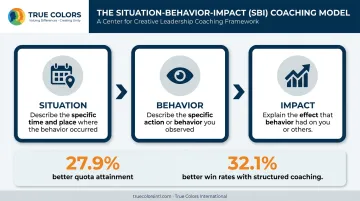
Structured feedback makes coaching stick. The Situation-Behavior-Impact model, developed by the Center for Creative Leadership, gives leaders a repeatable format:
- Situation: name when and where it happened
- Behavior: describe the observable action, not assumed motives
- Impact: explain the effect it had
The payoff is measurable. Dynamic, adaptive coaching produces 27.9% better quota attainment and 32.1% better win rates than random, unstructured coaching, according to CSO Insights' sales enablement research. Coaching that's tailored to each rep's communication style and strengths consistently outperforms one-size-fits-all training sessions.
Strategic Hiring and Talent Development
A sales leader is only as strong as the team they build. That makes coachability and cultural fit just as important as a polished resume, if not more so.
Structured interviews help here more than most leaders assume. Adding structure to the hiring process (consistent questions, clear scoring criteria) improves reliability and reduces the odds of a bad hire. SHRM cites Brandon Hall Group research showing organizations without standardized interviewing were five times more likely to make a bad hire.
Understanding a candidate's motivations and communication style during the interview process also predicts retention better than experience alone. This is where assessment-based hiring tools add value: they give leaders a structured way to evaluate fit against the team's existing dynamics, not just the job description.
Accountability Paired With Trust
Holding reps to commitments and building a fear-based culture are two very different things. The best leaders do the first without falling into the second.
Practical ways to strike that balance:
- Set SMART goals (specific, measurable, assignable, realistic, time-related), the original 1981 framework from George Doran, still relevant today
- Recognize wins publicly, not just in a private Slack message
- Build psychological safety so reps raise problems before they become crises
That last point isn't fluff. Amy Edmondson's research across 51 work teams found psychological safety directly linked to learning behavior, which in turn predicted team performance. Google's Project Aristotle study reached a similar conclusion, naming psychological safety the single most important factor in team effectiveness.
Reps who trust their leader flag issues early. Reps who don't, hide them until it's too late.
Adaptability and Resilience Through Change
Markets shift. Buyer behavior shifts. Internal strategy shifts. Leaders who can't guide a team through change lose momentum right when they need it most.
The building-controls company Syserco offers a useful example. When COVID-19 disrupted its usual sales channels, the company redirected its sales team toward biotech and high-tech clients and replaced passive lead generation with direct, personal outreach.
The result was 21% revenue growth in 2020, even as most competitors struggled, according to Harvard Business Review's reporting on the pivot.
A simple, repeatable narrative makes change easier to absorb: explain the why, name the next step, and set clear expectations. Skip any of those three, and reps fill the gap with anxiety instead of action.
Sales Leadership vs. Sales Management: What's the Difference?
The terms get used interchangeably, but they describe different jobs. Harvard Business School researcher John Kotter drew the clearest line: management copes with complexity: planning, staffing, tracking, problem-solving. Leadership copes with change: setting direction, motivating people, and aligning them around where things are headed.
| Sales Leadership | Sales Management |
|---|---|
| Sets vision and coaching philosophy | Runs pipeline reviews |
| Builds culture and team trust | Enforces CRM process and reporting |
| Guides teams through change | Delivers predictable, day-to-day execution |
Most effective sales organizations need both functions. In smaller teams, one person often wears both hats.
A leader who sets direction but never checks the CRM loses visibility into the pipeline. A manager who tracks numbers without leading through change risks burning out the team the moment the market shifts.
How to Develop These Skills in Your Sales Team
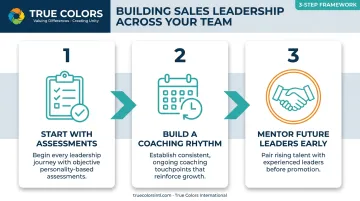
Building these six skills requires an ongoing system, not a single training event.
- Start with assessments. Self- and team-assessments reveal current strengths and gaps in communication style and leadership readiness before you build a development plan. Structured personality and communication assessments give leaders a shared language for understanding team dynamics. True Colors International, for example, builds its workshops around this kind of assessment-driven framework.
- Build a coaching rhythm. Weekly or biweekly one-on-ones beat occasional training days every time, because consistency is what makes coaching stick.
- Mentor future leaders early. Give high-potential reps stretch assignments and expose them to leadership decisions before they're formally promoted. That's how you avoid the "Sarah problem" from the introduction.
None of this requires a complete overhaul; small, consistent habits compound faster than sweeping initiatives that fizzle out after month two.
Frequently Asked Questions
What are the skills of a sales leader?
The core skills are emotional intelligence, clear communication, coaching, strategic hiring, accountability paired with trust, and adaptability. These apply across industries and team sizes, from a five-person startup team to an enterprise sales floor.
What are the 5 C's of sales?
Definitions vary across sources, but one common framework centers on character, competence, compassion, communication, and collaboration. Together they describe how salespeople and leaders build trust with both customers and teams.
What are the 7 golden rules of sales?
There's no single universally accepted list. Commonly cited principles include knowing your customer, listening more than talking, focusing on value over price, following up, building trust, and asking strong questions.
What's the difference between sales leadership and sales management?
Leadership shapes vision, culture, and people development, while management handles daily processes, targets, and operational execution. Strong sales organizations need both working in sync.
How can sales leaders improve their emotional intelligence?
Practice active listening, ask trusted colleagues for feedback on blind spots, and use personality or temperament assessments to understand how you and your team react under pressure. Awareness is the first step toward better control.
How do personality assessments help sales leaders build stronger teams?
Tools like the True Colors assessment give teams a shared vocabulary for discussing communication and motivation differences. That shared language reduces friction between mismatched styles and helps leaders tailor coaching to what actually works for each rep.