The numbers back this up, and they're not encouraging. Global employee engagement dropped to 21% in 2024, down from 23% the year before, according to Gallup's State of the Global Workplace data. Only 33% of employees reported thriving in their overall lives, the lowest mark since 2021.
Many organizations still treat employee experience as a perks problem or a technology purchase. They miss the human element entirely: people communicate, process feedback, and handle stress differently. This article breaks down what employee experience actually means, how it drives culture, and what the research says about building a workplace where people feel understood, not just managed.
Key Takeaways
- Global engagement sits at just 21%, making employee experience business-critical
- Employee experience is the full journey; engagement is one outcome of that journey
- Managers drive up to 70% of the variance in team engagement
- Recognition and psychological safety cut turnover risk dramatically
- Understanding personality and communication differences reduces friction across teams
What Is Employee Experience, and How Does It Shape Workplace Culture?
Employee experience (EX) is the sum of everything an employee encounters, sees, and feels from the moment they apply to the moment they leave. It includes the obvious things, like pay and benefits, but also the subtler ones: how a manager delivers criticism, whether meetings start on time, or how it feels to ask for help.
Culture and experience are related but not identical. Culture is the shared environment and values an organization holds. Employee experience is how each person actually lives and perceives that environment day to day. Two employees can work in the same "culture" and have completely different experiences of it, depending on their team, manager, or even communication style.
The Three Pillars of Employee Experience
Most frameworks describe employee experience across three interacting environments:
- Cultural: Leadership style, manager quality, and team relationships
- Physical: Workspace design, hybrid or on-site conditions, and comfort
- Digital: The tools, systems, and platforms employees rely on to get work done
When these three pillars are misaligned, employees notice fast. A culture that preaches collaboration but hands employees clunky, disconnected tools sends a mixed message, and that mismatch chips away at trust over time.
The Employee Lifecycle and Culture Touchpoints
Gallup maps the employee journey across seven stages: Attract, Hire, Onboard, Engage, Perform, Develop, and Depart. Each stage is a moment where culture either strengthens or erodes.
- Recruitment and onboarding set expectations before day one
- Performance and development signal whether growth is real or just a talking point
- Exit shapes what departing employees say publicly about the organization
Treat any single stage as an afterthought, and the rest of the lifecycle suffers.
Employee Experience vs. Employee Engagement vs. Workplace Culture: What's the Difference?
These three terms get used interchangeably, but they're not the same thing.
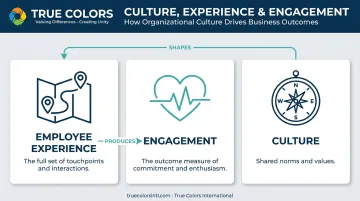
- Employee experience is the broad set of interactions and touchpoints an employee has with the organization
- Engagement is the narrower, outcome-based measure of commitment and enthusiasm that results from that experience
- Culture is the shared context, the norms and values, that shapes which behaviors get rewarded
You'll also hear employee experience called the "employee journey" or "workplace experience." In HR conversations, these terms are generally interchangeable.
Here's why the distinction matters: 52% of employees globally were watching for or actively seeking a new job in 2024, according to Gallup's employee retention data.
That's over half the workforce, and it's not just people who feel disengaged. Many score fine on engagement surveys yet are still quietly job hunting. Engagement metrics alone won't catch that. You need the full experience to see it.
Why a Great Employee Experience Is the Foundation of a Strong Workplace Culture
Turnover is expensive, and the cost isn't abstract. Gallup has estimated that replacing a single employee can run 0.5 to 2 times their annual salary, once you account for recruiting, onboarding, and lost productivity. For a mid-sized company losing a handful of people each quarter, that adds up fast.
The business case goes beyond retention, too. Gallup's Q12 meta-analysis, drawing on data from over 3.3 million employees across 90 countries, found that top-quartile engagement business units outperformed bottom-quartile units by:
- 23% in profitability
- 18% in sales productivity
- 10% in customer loyalty and engagement
Employee experience shapes how people perceive your company before they ever apply, and how long they stay once they're in the door.
| Stage | Stat | What It Means |
|---|---|---|
| Hiring | 83% of job seekers research company reviews before applying, per Glassdoor's employer branding research | A poor employee experience shows up on Glassdoor and LinkedIn before you ever see a resume |
| Day-to-day | 70% of team engagement variance traces back to managers | Miscommunication and unclear expectations under weak management drive disengagement |
That's precisely where communication training earns its keep: it gives managers and teams a shared language for feedback, before small misunderstandings become turnover statistics.
Key Drivers of a Positive Employee Experience and Strong Culture
A handful of factors consistently separate strong cultures from struggling ones.
Leadership communication and manager training. Among 717 U.S. employees who voluntarily left their jobs in 2024, 45% said no manager had discussed their satisfaction or performance in the final three months. Active listening and manager coaching aren't soft skills. They're retention tools.
Team dynamics and psychological safety. Google's own Project Aristotle study of 180 internal teams identified psychological safety, the shared belief that it's safe to take interpersonal risks, as the single most important factor in team effectiveness.
Recognition and belonging. In a longitudinal study tracking roughly 3,500 employees from 2022 to 2024, well-recognized employees were 45% less likely to have left two years later. Yet only 22% said they received the right amount of recognition. That's a wide, fixable gap.
Personality and temperament awareness. This is the piece most organizations skip entirely. Two employees can receive the exact same feedback and interpret it completely differently: one hears coaching, the other hears criticism. That's not a character flaw. It's a communication style mismatch.
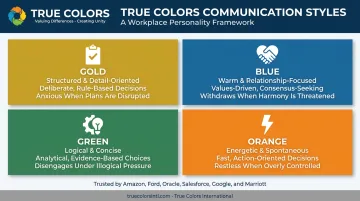
True Colors International has spent over 45 years addressing exactly this gap, using a personality-spectrum methodology adopted by organizations including Google, Amazon, and Ford. The approach teaches teams a shared vocabulary, built around four color-based personality types, for recognizing how colleagues naturally communicate, make decisions, and handle stress.
Instead of treating a blunt communicator or a detail-obsessed teammate as "difficult," teams learn to see those traits as differences worth understanding rather than friction to manage around.
Growth and development opportunities. Employees who see a real path forward, not just a title change, are more likely to stay and invest fully in their work. That path typically includes:
- Mentorship or coaching from someone more experienced
- Stretch assignments that build new skills
- Clear, transparent criteria for promotions and raises
Practical Strategies to Build a Thriving Workplace Culture Through Employee Experience
Turning these drivers into daily practice takes structure, not a single training day.
- Build a lifecycle-based EX framework. Map out "moments that matter", onboarding, first performance review, promotion, exit, and design intentional touchpoints for each one.
- Listen continuously, not annually. Short pulse surveys, run monthly or quarterly, catch problems before they show up in exit interviews. Gallup recommends a simple cycle: communicate findings, assign ownership, act, and update employees on progress.
- Close the feedback loop visibly. Mercer's research is blunt on this point: you don't need to act on every suggestion, but employees need proof their input mattered. Silence after a survey does more damage than the survey itself.
- Use a repeatable culture framework, not one-off events. True Colors International's True Culture Loop moves through four stages: Awareness, Alignment, Action, and Reinforcement. It treats culture-building as a continuous cycle, giving teams a repeatable model instead of a single workshop that's quickly forgotten.
The common thread: culture-building has to be systematic and revisited, not a slide deck people forget by Friday.
Who Owns Employee Experience?
HR typically coordinates the employee lifecycle, running onboarding systems, benefits administration, and development programs. But HR alone can't carry culture.
Ownership is genuinely collective:
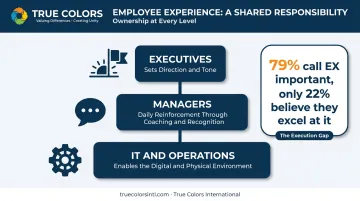
- Executives set the tone and decide whether EX is a real business priority or a talking point
- Managers reinforce culture daily through how they communicate, coach, and recognize their teams
- IT and operations enable (or quietly sabotage) the digital and physical environments employees rely on
Deloitte found that 79% of executives call employee experience important or very important, yet only 22% believe their organization actually excels at it. That gap is the real opportunity: closing it requires every layer of the organization pulling in the same direction, not just an HR initiative running in isolation.
Frequently Asked Questions
What is meant by employee experience?
Employee experience is the cumulative set of interactions, perceptions, and touchpoints an employee has with an organization, from their first job application through their final day. It covers culture, physical workspace, and digital tools alike.
Who owns employee experience?
HR typically coordinates core systems like onboarding and development, but ownership is shared. Executives set direction, managers deliver the daily experience, and IT enables the tools people depend on.
What's another word for employee experience?
Common alternatives include "employee journey" and "workplace experience." In most HR contexts, these terms are used interchangeably with employee experience.
How is employee experience different from employee engagement?
Engagement is a narrower measure of commitment and enthusiasm at a given moment. Employee experience is the broader, cumulative set of interactions across the entire employment relationship that produces that engagement level.
What are the three pillars of employee experience?
The three pillars are cultural (leadership and relationships), physical (workspace conditions), and digital (tools and systems). All three interact constantly to shape how work actually feels day to day.
How can understanding personality differences improve workplace culture?
Personality-based training, such as True Colors' color-spectrum framework, helps employees and leaders recognize different communication and behavioral styles, reducing the friction caused by misread intentions. This shared understanding strengthens trust and team cohesion across diverse groups.