Yet many leaders still struggle to define what "positive" actually looks like day to day. They know culture matters. They just can't pin down the specific behaviors, policies, and leadership habits that separate a thriving workplace from one that quietly bleeds talent.
That confusion gets expensive fast. In this article, we'll break down the core characteristics of a positive workplace culture, show what those traits look like in daily employee behavior, make the business case with real data, and walk through practical steps for building a culture that sticks.
Key Takeaways
- Trust, open communication, recognition, and respect—not perks—drive positive culture
- Culture-forward organizations see lower turnover, higher engagement, and stronger results
- Daily habits—collaboration, accountability, peer recognition—sustain culture between formal programs
- Culture is built through intentional leadership and steady reinforcement, not one-off training
What Is a Positive Workplace Culture?
A positive workplace culture is the set of shared beliefs, expectations, and everyday behaviors that shape how people treat each other and make decisions at work. Mission statements on the wall matter far less than what actually happens when a deadline slips, a mistake gets made, or a new idea gets pitched in a meeting.
Culture is built through leadership modeling and daily interactions, not policy documents. A company can have a beautifully written values statement and still operate with a toxic culture if leaders don't model those values consistently. Culture also isn't static. It shifts with every hire, every promotion, and every moment leadership chooses to address (or ignore) bad behavior.
The cost of getting this wrong is significant. According to SHRM's research on toxic workplace cultures, roughly 1 in 5 Americans left a job within a five-year period specifically because of bad company culture. That figure is a direct signal that culture fit influences retention as much as compensation does.
Core Characteristics of a Positive Workplace Culture
Every organization looks different on the surface, but workplace research consistently points to a handful of traits shared by companies where people actually want to stay.
Trust and Psychological Safety
Employees in psychologically safe environments voice opinions, admit mistakes, and raise concerns without fearing retaliation. This isn't a soft skill nicety.
A peer-reviewed meta-analysis covering more than 22,000 individuals found that psychological safety correlates strongly with performance, with a corrected correlation of .43 for individual task performance and .29 for group performance.
Teams that feel safe speak up sooner, catch errors earlier, and take more creative risks.
Open and Transparent Communication
Positive cultures run on two-way communication. Leadership shares information honestly instead of filtering everything through carefully-worded memos, and employees have real channels to respond.
Practical examples include:
- Monthly all-hands town halls where leaders answer unscripted questions
- Open Q&A sessions after major company announcements
- Regular pulse surveys that feed directly into visible action, not a black hole
Respect for Individual and Personality Differences
Positive cultures don't expect every employee to communicate or work the same way. They actively value different working styles, paces, and temperaments.
This is where structured personality frameworks earn their keep. True Colors International, for instance, uses a four-color personality spectrum to help teams understand communication preferences:
- Orange — action-oriented, wants concise and practical information
- Gold — organized, needs direct exchanges and clear expectations
- Green — analytical, prefers logical, no-nonsense communication
- Blue — relationship-oriented, needs rapport before content lands
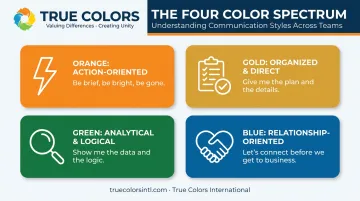
Every person carries traits from all four colors in varying degrees, so the goal isn't boxing people in. It's giving teams a shared vocabulary for why a Gold manager wants a five-step plan while a Blue teammate wants to talk through feelings first. That shared language cuts down on the kind of friction that erodes trust over months.
Recognition and Appreciation
Recognition works best when it's frequent and specific, not reserved for annual reviews. A 2024 Gallup-Workhuman survey found that employees receiving weekly manager feedback and recognition were engaged at a rate of 61%, compared to just 38% among those who got weekly feedback without regular recognition.
Weekly feedback alone is not enough—recognition frequency is what moves the engagement needle.
Shared Purpose and Values Alignment
Employees in positive cultures see a clear line between their daily tasks and the organization's bigger mission. McKinsey has reported that employees who feel they live their purpose at work are roughly six times more likely to want to stay at their company than those who don't feel that connection.
Purpose isn't abstract to employees. It's the difference between "I process invoices" and "I keep the lights on for a company doing work I believe in."
Growth and Development Opportunities
Access to training, mentorship, and clear career pathing signals long-term investment in people rather than short-term utility. Employees who see a future at a company tend to stick around and put in more effort while they're there.
Growth shows up in concrete ways:
- Mentorship pairings and stretch assignments tied to real projects
- Skill training that maps to the next role, not generic courses
- Transparent promotion criteria so people know what "ready" looks like
Fair and Consistent Leadership
Policies and consequences applied unevenly across teams or levels breed cynicism fast. Fair leadership means the same rules apply whether you're a new hire or a ten-year veteran, and consequences for poor behavior don't disappear just because someone is a high performer. When top producers get a free pass on missed deadlines or disrespectful behavior, the rest of the team notices—and trust drops faster than any policy memo can repair.
5 Examples of Positive Work Behaviors
Characteristics like trust and recognition only matter if they show up in how people actually act. Here's what that looks like on an average Tuesday.
Collaborative Teamwork
Employees proactively help teammates, share knowledge without being asked, and step outside their formal role to support shared goals. Nobody says "that's not my job" when a deadline is at risk.
Constructive Feedback and Active Listening
Giving feedback respectfully—and genuinely listening instead of waiting for your turn to talk—builds trust over time. Teams that practice this improve. Teams that don't stay stuck.
Taking Ownership and Accountability
Employees who own mistakes, follow through on commitments, and skip the blame game make teams more resilient. Accountability at the individual level is what makes trust at the organizational level possible.
Adaptability and Openness to Change
When priorities shift or a new process rolls out, adaptable employees adjust and keep work moving. One person digging in their heels can stall an entire rollout.
Recognizing and Celebrating Others
Peer-to-peer recognition (a shout-out in a team meeting, a quick "great catch on that report" message) reinforces culture from the ground up. It doesn't have to come from the top to count.
Why a Positive Workplace Culture Matters
The business case for culture isn't theoretical anymore. Gallup's 2024 Q12 meta-analysis drew on more than 3.3 million employee responses across 90 countries. It found that top-quartile engagement business units saw between 21% and 51% less turnover than bottom-quartile units, depending on baseline turnover rates.
The same analysis found:
- 14% higher productivity, measured through production records and evaluations
- 23% higher profitability compared to bottom-quartile units
- 18% higher sales productivity in sales-focused roles
Wellbeing tracks with those same results. Employees who describe their workplace as toxic report far worse mental health outcomes than those who don't, according to APA's Work in America survey. Stress compounds fast. A team under constant tension loses focus, energy, and output.
How to Build and Sustain a Positive Workplace Culture
Culture doesn't build itself. It takes deliberate leadership behavior and systems that keep values alive after the initial excitement fades.
- Start with leadership commitment. Employees follow what leaders do, not what policies say. A manager who publicly stresses work-life balance while emailing at midnight sends a louder message than any handbook.
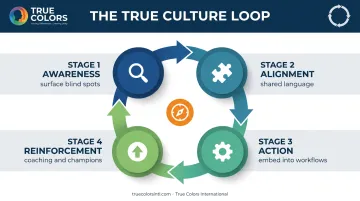
- Use a structured framework to move from awareness to action. True Colors International's True Culture Loop offers one proven model built around four stages:
- Awareness: surface blind spots through tools like Employee Experience Surveys
- Alignment: build a shared language across teams
- Action: embed values into daily workflows
- Reinforcement: sustain habits through coaching and internal culture champions
- Embed shared values into hiring, performance, and promotion decisions. Tools like Talent Selection Assessments help hiring teams evaluate cultural fit alongside qualifications, while Career Compass assessments support promotion decisions based on role alignment rather than tenure alone.
- Measure culture regularly, not once a year. Employee Experience Surveys and pulse checks catch problems while they're still fixable. Waiting for exit interviews means you're diagnosing the disease after the patient has already left.
Companies like Google and Marriott have put practices like these to work across industries as different as enterprise tech and hospitality.
Frequently Asked Questions
What are the characteristics of a positive workplace culture?
The core traits are trust, transparent communication, respect for individual differences, consistent recognition, and a clear connection between daily work and company purpose. Fair leadership ties all of these together.
What are 5 examples of positive work behaviors?
Collaborative teamwork, constructive feedback and active listening, taking ownership of mistakes, adaptability to change, and peer-to-peer recognition. These behaviors turn stated values into daily reality.
How can leaders create a positive workplace culture?
Leaders need to model the values they want to see, communicate consistently, and embed culture into everyday processes like hiring and performance reviews. Culture spreads through behavior, not memos.
What is the difference between a positive and a toxic workplace culture?
Positive cultures run on trust, support, and consistency. Toxic cultures run on fear, gossip, and inconsistent application of rules and consequences. Employees can usually tell within their first few weeks which one they've joined.
How does understanding personality differences improve workplace culture?
Personality awareness helps teams recognize why colleagues communicate or make decisions differently, which reduces miscommunication and builds mutual respect. Frameworks like True Colors’ four-color model give teams a shared language for these differences instead of relying on guesswork.
Why does workplace culture matter for employee retention?
Employees stay far longer when they feel valued, trusted, and connected to a purpose bigger than their task list. Many exits tied to culture are common—and largely preventable.