The science backs this up. Stress research shows that the hormones released during high-pressure moments measurably change how the brain accesses working memory, shifting control away from careful reasoning and toward faster, more reflexive responses. That's not a soft-skill footnote. It's an organizational performance issue.
Most leadership training still focuses on frameworks: decision trees, cost-benefit models, SWOT analysis. What it skips is how pressure itself rewires thinking, triggers emotional reactions, and pulls leaders toward default behavioral patterns they may not even notice.
This guide breaks down what actually happens when leaders decide under pressure: the psychological stages, the regulation skills that separate composed leaders from reactive ones, and how personality shapes the whole process.
Key Takeaways
- Pressure decisions follow a sequence: trigger recognition, rapid assessment, emotional regulation, then action
- Self-control and mindfulness separate leaders who decide well from those who react on impulse
- Sustained pressure narrows thinking, pushing leaders toward fewer options and short-term fixes
- Temperament shapes instinctive reactions under stress, and awareness of that pattern is learnable
- Teams led by pressure-ready leaders report stronger trust and long-term decision quality
What Is Decision-Making Under Pressure?
Decision-making under pressure means evaluating options and choosing a course of action within a compressed timeframe, often with incomplete information and high emotional or organizational stakes. It differs from calm-conditions decision-making because two usual supports disappear at once: time and composure.
Standard frameworks assume both. Sit down, gather data, weigh pros and cons, consult stakeholders. Pressure removes that runway. Leaders end up relying on instinct, prior training, and emotional regulation all at once, sometimes within the same sixty seconds.
Moving fast is not the same as deciding well. A leader can act quickly and still make a poor call if pressure hijacks their judgment. Some of the best pressure decisions are slower than expected, because the leader took ten extra seconds to regulate before responding.
That pause matters because data and tools only go so far. Human judgment still carries the weight when the call involves people, ethics, or ambiguity. No algorithm can read a room mid-layoff announcement or decide how to break bad news to a grieving family.
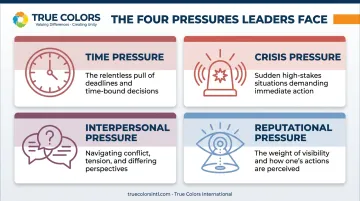
Pressure itself isn't one thing. It shows up differently depending on the trigger, and leaders often respond differently to each type:
- Time pressure: a shrinking deadline with no flexibility
- Crisis pressure: sudden, high-stakes disruption such as a safety incident or system outage
- Interpersonal pressure: disagreement, confrontation, or team friction
- Reputational pressure: public scrutiny where the outcome affects how others view the leader or organization
A plant manager who calmly handles quarterly output pressure might freeze the moment a safety incident forces an immediate evacuation call. Same person, different pressure type, different response. Recognizing which kind of pressure is active is the first step toward responding well instead of reacting.
How Do Leaders Make Decisions Under Pressure?
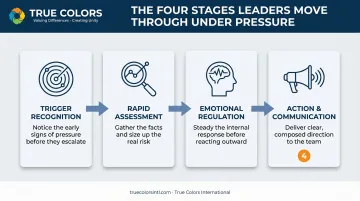
Even leaders who've never studied psychology move through the same rough sequence once pressure hits. They rarely narrate it consciously, since it happens in seconds, but breaking it down shows exactly where things go right or wrong.
Trigger Recognition (Initiation)
The first step is noticing a situation has crossed into "pressure moment" territory. Sometimes this is instant, like a crisis alert. Other times it's gradual, like a deadline that quietly tightens over several days until it's suddenly unavoidable.
Delayed recognition is the most common bottleneck. Leaders who don't clock the shift early lose response time they can't recover. The faster a leader names what's happening, the more room they have to think instead of just react.
Rapid Assessment (Core Operation)
Once pressure is recognized, leaders scan available information, weigh risks, and narrow options, usually without complete data. This is where experience separates people fast.
The Army's Recognition-Primed Decision model shows how experienced leaders work. They match the situation to patterns they've seen before, form an expectation, then mentally test a course of action before committing. Less experienced leaders lack that pattern library, so they tend to freeze or lean too hard on whatever partial data sits in front of them.
Emotional Regulation (Control Stage)
Self-control and mindfulness decide whether a leader stays rational or slides into reactivity.
Skip this stage and calls get impulsive and anxiety-driven. Regulate well and you keep access to logic and perspective, even with the clock running.
Action and Communication (Output)
The final stage produces two outputs: the decision itself, and how that decision reaches the team. Communication is the part teams underrate.
What lands in the room:
- Tone — calm enough to steady people, firm enough to direct them
- Clarity — what we're doing, who's doing it, and by when
- Consistency — the message matches the behavior under stress
Teams take behavioral cues from leaders in stressful moments. A calm, clear message can steady a room faster than the "right" answer delivered badly.
How Personality and Temperament Shape Decisions Under Pressure
Beyond emotional intelligence, a leader's core temperament strongly shapes their default reaction when pressure hits. Most decision-making frameworks barely account for it.
At True Colors International, we've spent over 45 years mapping this through a four-color temperament model: Orange, Gold, Green, and Blue. Each type brings a different instinct to a high-stakes moment.
| Temperament | Default instinct under pressure | Risk at the extreme |
|---|---|---|
| Orange (action-oriented) | Moves fast, adapts on the fly, pushes for immediate action | Acts before thinking it through |
| Gold (organized) | Looks for structure, precedent, or a clear process | Freezes without a rulebook |
| Green (analytical) | Wants more data and logic before committing | Stalls into analysis paralysis |
| Blue (relationship-oriented) | Weighs impact on people and team harmony first | Delays hard calls to avoid conflict |
Each instinct has a real strength and a clear failure mode. An Orange leader's speed helps until it skips a critical safety check. A Green leader's caution helps until the window for action closes.
Picture a leadership team responding to a sudden product recall. The Orange VP wants to announce a fix within the hour. The Green director wants another day to verify the root cause. Neither instinct is bad, but without a shared vocabulary for it, the disagreement reads as personal friction instead of two valid temperaments solving the same problem differently.
Self-awareness turns instinct into a choice. A leader who defaults to gathering more data under stress can set a hard data-collection deadline instead of drifting into paralysis. A Blue-leaning leader who avoids conflict can name that tendency before a hard conversation, rather than letting it steer the outcome.
Organizations that use validated temperament assessments give leaders a shared color language to spot these patterns in the moment—before pressure forces the issue—instead of leaving self-awareness to trial and error.
Where This Shows Up: Real-World Contexts and Examples
Pressure-driven decisions surface constantly, across every industry:
- Crisis management: safety incidents, product recalls, PR fallout
- Rapid market shifts: sudden downturns, competitor moves, supply disruptions
- Resource-constrained decisions: staffing shortages, budget cuts, tight deadlines
- Interpersonal escalations: team conflict, difficult conversations, morale crises
Here’s how those pressures show up in real roles:
- A hospital administrator facing an overnight staffing shortage has minutes to reallocate nurses, knowing patient safety hangs on the call.
- A plant manager in a safety incident must halt the line or attempt a quick fix, with production quotas and worker safety in direct conflict.
- An executive in a sudden market downturn may have one trading day to reassure investors, cut costs, or both—and how open to be with employees.
Industries with constant high-stakes exposure—healthcare, military, and emergency response—often build formal pressure-decision training into leadership development. Aviation has Crew Resource Management. Healthcare has TeamSTEPPS.
Lower-pressure industries rarely build this muscle on purpose. Their leaders often learn it the hard way, mid-crisis, instead of ahead of time.
Building Pressure-Ready Leaders: Practical Takeaways
Pairing emotional intelligence training with temperament awareness gives leaders two essentials: how to regulate emotion, and why they default to certain reactions under stress.
A 2024 meta-analysis of 50 workplace training interventions found that programs targeting emotional intelligence and emotion regulation produced consistent, moderate improvements in participants' skills. Training works, but it has to stick.
Practical habits worth building into any leadership team:
- Protect reflection time before high-stakes calls. Even sixty seconds of pause cuts the odds of a purely reactive decision.
- Run pre-mortems on foreseeable pressure points. Think through the crisis before you're in it.
- Build psychological safety. Leaders need honest input in a crisis, not a sanitized version of events.
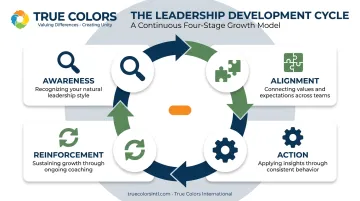
Decision-making under pressure is a trainable skill. Programs like True Colors' Connected Leadership Program build it through a continuous loop:
- Awareness — leaders map their own pressure patterns
- Alignment — teams agree on shared decision-making expectations
- Action — habits get used in real situations
- Reinforcement — ongoing coaching keeps those habits sharp when stakes are highest
Frequently Asked Questions
How does leadership affect decision-making?
A leader's emotional state, tone, and behavior under pressure directly shape how confidently their team processes uncertainty. When a leader stays composed, teams make faster, clearer downstream decisions instead of freezing or over-checking.
What are some examples of decision-making under pressure?
Common examples include a crisis response team deciding on an evacuation plan, a manager handling a sudden staffing shortage, and a leader resolving a heated conflict between team members in real time.
What are the top 3 leadership challenges under pressure?
The most common challenges are staying emotionally regulated, processing incomplete information quickly, and communicating clearly enough to prevent panic from spreading through the team.
What are the five C's of leadership?
The concept is commonly described as Character, Competence, Commitment, Communication, and Courage. Under pressure, they show up as ethical judgment, skill to execute, follow-through, clear messaging, and the willingness to act.
Can decision-making under pressure be improved with training?
Yes. Emotional intelligence and temperament-based leadership training help leaders spot their default stress patterns and build regulation skills through repeated practice—not overnight.
What's the difference between being decisive and being impulsive under pressure?
Decisiveness means making a quick judgment based on available information, with regulation still intact. Impulsiveness skips that regulation step and often ignores likely consequences.