Here's the common trap: leaders assume that writing a mission statement or hosting an occasional all-hands meeting counts as "leading" culture. It doesn't. That gap between having a culture and actively leading one is exactly where disengagement, silos, and turnover take root.
This guide breaks down what organizational culture and leadership actually mean, the five elements that make up culture, the four dominant culture types, and how leadership and culture shape each other. We'll close with a practical framework for building culture on purpose, not by accident.
Key Takeaways
- Culture is the shared values and norms guiding behavior; leadership deliberately shapes and reinforces them
- Five core elements—values, norms, symbols, language, and underlying assumptions—require active leadership attention
- Four culture types (Clan, Adhocracy, Market, Hierarchy) each demand a distinct leadership style
- Leaders shape culture through daily actions, but culture also limits or enables what leaders can do
What Is Organizational Culture and Leadership?
Organizational culture is the collection of shared values, beliefs, assumptions, and norms that guide how people communicate, make decisions, and treat one another across a company. It's not written on a poster in the break room. It's what actually happens when a deadline is missed or a customer complains.
Organizational leadership is the intentional process of guiding, modeling, and reinforcing behaviors that align employees toward a shared mission. According to the Center for Creative Leadership, leadership is a social process that produces direction, alignment, and commitment. It has little to do with titles or positions on an org chart.
Here's the relationship that most leaders miss: culture and leadership aren't separate topics. Leaders don't just "have" a culture sitting in the background. They create it, communicate it, and sustain it through consistent action.
If leaders don't intentionally shape culture, one forms anyway. It just tends to form around whatever behavior goes unaddressed:
- The manager who's rewarded for hitting numbers regardless of how the team feels afterward
- The unofficial rule that speaking up in meetings gets you labeled "difficult"
- The assumption that mistakes get hidden rather than reported
None of that gets written into a policy manual. It gets absorbed by employees within their first few weeks on the job, which is exactly why passive leadership is never neutral.
The 5 Elements of Organizational Culture
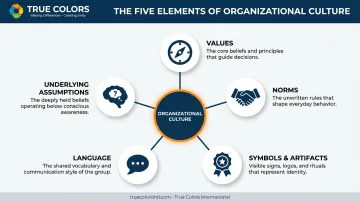
Culture researchers don't agree on one universal checklist, but five elements consistently show up across the evidence, aligning with Edgar Schein's foundational work on artifacts, values, and assumptions.
| Element | What It Looks Like |
|---|---|
| Values | Core beliefs (innovation, fairness, quality) that guide decisions at every level |
| Norms | Unwritten rules of behavior, often more influential than the official handbook |
| Symbols & Artifacts | Office design, dress code, rituals, and recognition programs |
| Language | Shared vocabulary and communication tone that unify or divide teams |
| Underlying Assumptions | Unconscious mindsets shaping how employees interpret events |
Why Language Breaks Teams Faster Than People Expect
Of the five, language and communication style causes the most friction on teams. Two people can hear the exact same feedback and walk away with opposite reactions, depending on how they process information.
A direct, results-focused communicator might see a detail-oriented colleague's questions as stalling. That colleague might see the direct communicator as dismissive. Neither is wrong. They're just wired differently.
This is precisely the gap True Colors International's methodology targets. By giving teams a shared vocabulary for four personality types (Orange, Gold, Green, and Blue), leaders and employees stop mistaking a communication style difference for a character flaw.
A workshop testimonial from the University of Texas Permian Basin's accounting department illustrates this shift. Staff who once talked past each other began acknowledging their teammates' different styles, which rebuilt relationships that had grown strained.
The 4 Types of Organizational Culture
Researchers Kim Cameron and Robert Quinn developed the Competing Values Framework, plotting culture along two axes:
- Flexibility vs. control: does the organization prize adaptability or stability?
- Internal vs. external focus: does it prioritize internal cohesion or external competitiveness?
These two axes produce four culture orientations. Most real organizations blend all four to varying degrees, but one usually dominates.
Clan Culture
Collaborative and family-like. Leaders act as mentors, coaches, and facilitators rather than commanders. Employee development and internal cohesion matter more than external competition. Community organizations and cooperative, team-based businesses often lean this direction.
Adhocracy Culture
Entrepreneurial and risk-tolerant. Leaders behave like visionaries, pushing innovation and experimentation even when it means tolerating failure along the way. Startups and product-innovation units are classic examples, where speed and adaptability beat process every time.
Market Culture
Competitive and results-driven. Leaders act as hard-driving competitors focused on targets, market share, and customer wins. Sales-heavy organizations and customer-facing business units typically gravitate here, prizing external performance over internal harmony.
Hierarchy Culture
Structured and control-focused. Leaders act as coordinators and organizers, prioritizing consistency and predictable, repeatable outcomes. Regulated industries and high-compliance operations tend to run this way out of necessity, not preference.
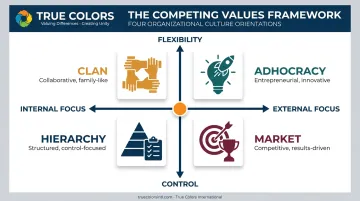
The real skill lies in recognizing your organization's dominant orientation and adjusting your leadership approach accordingly. A leader with a naturally flexible, big-picture style may struggle inside a rigid Hierarchy culture unless they understand why the friction exists.
Personality-based tools like the True Colors System help leaders see their own tendencies clearly enough to adapt, rather than assuming one default style will work everywhere.
How Leadership Shapes (and Is Shaped By) Organizational Culture
Mission statements don't set the tone. Behavior does. How a leader reacts when a deadline slips, a mistake surfaces, or two employees clash tells the team far more about "real" values than any framed poster ever will.
Communication style is the mechanism. Gallup found that 80% of employees who received meaningful feedback in the previous week were fully engaged, based on a survey of over 13,000 full-time employees. Feedback quality tracks closely with trust and psychological safety, though this shows correlation, not proof that feedback alone drives engagement.
Here's the part leaders often overlook: culture shapes leadership just as much as leadership shapes culture. A rigid Hierarchy culture can suppress even the most innovative leader's ideas if the surrounding systems reward compliance over initiative. Existing norms decide which leadership behaviors get accepted, rewarded, or quietly resisted.
Watch for Culture Collisions
Gartner describes the mismatch between stated values and daily behavior as a "culture collision"—when official policy says one thing and the process, incentive structure, or manager behavior says another. Warning signs include:
- Rising turnover in specific teams, not company-wide
- Departments operating in silos with inconsistent norms
- Values applied selectively depending on who's involved
Sustainable change requires more than an announcement. Leaders need to consistently define, teach, model, and reward the specific behaviors they want repeated, not just talk about them once at a kickoff meeting.
This mirrors the True Culture Loop framework used by True Colors International: awareness, alignment, action, and reinforcement, applied as a continuous cycle rather than a one-time announcement.
Building a Sustainable Culture-Leadership Strategy
Sustaining culture is harder than defining it for most organizations. A values statement without a reinforcement system fades within months, and teams quietly revert to old habits.
McKinsey's research on organizational transformations found that efforts using all four building blocks of change (understanding, formal reinforcement, skill-building, and role modeling) were nearly 8 times more likely to succeed than efforts relying on just one. Skipping reinforcement is the most common reason culture initiatives fail within a year.
This is the logic behind True Colors International's True Culture Loop, a four-stage cycle leaders return to as teams grow and shift:
- Awareness: Team members learn their own communication style and how it affects others
- Alignment: Leaders connect personality insights to team goals and expectations
- Action: Teams apply shared language to real workplace situations and conflicts
- Reinforcement: Leaders revisit the framework regularly instead of treating it as a one-time event
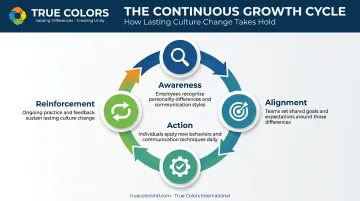
Rather than a single training event, the loop functions as an ongoing practice built into daily team operations.
Personality-based tools play a direct role here. True Colors' assessment methodology, refined over 45+ years and used across corporate, education, healthcare, and government organizations, gives leaders a shared language for aligning communication styles across a team. When people understand why a colleague processes decisions differently, friction drops and reinforcement becomes far less exhausting.
Frequently Asked Questions
What is organizational culture and leadership?
Organizational culture is the shared values, norms, and beliefs guiding behavior across a company. Leadership is the deliberate process of modeling and reinforcing those values. The two constantly reinforce each other in daily interactions.
What are the 4 types of organizational culture?
Clan (collaborative, family-like), Adhocracy (entrepreneurial, innovation-driven), Market (competitive, results-focused), and Hierarchy (structured, process-driven). Most organizations blend elements of all four.
How does organizational culture affect leadership?
Existing culture determines which leadership behaviors employees accept, reward, or resist. A rigid, control-focused culture can limit even a highly innovative leader's ability to introduce change.
What are the five elements of organizational culture?
Values, norms, symbols/artifacts, language, and underlying assumptions. Together they shape how employees interpret events and make everyday decisions, often more powerfully than official policy.
How can leaders actively improve a weak or toxic organizational culture?
Consistently model the values you want to see, communicate transparently, and reinforce them systematically, as with True Colors International's Awareness-Alignment-Action-Reinforcement cycle. Behavior change sticks when it's taught, modeled, and rewarded repeatedly.
What is the difference between organizational culture and leadership style?
Leadership style is one person's personal approach to guiding others. Culture is the collective outcome shaped by many leaders' consistent behaviors over time, across an entire organization.