Sound familiar? Miscommunication like this doesn't just cause friction. It's expensive. Grammarly and The Harris Poll estimated that poor workplace communication costs U.S. businesses $1.2 trillion annually, or roughly $12,506 per employee every year in lost time and productivity.
This article breaks down what workplace communication actually means, why it matters more than most leaders realize, the 7 C's framework for stronger messaging, the barriers that quietly sabotage teams, and practical steps to fix it.
Key Takeaways
- Poor communication drains an estimated $12,506 per employee annually in lost productivity
- Strong communicators report 47% higher shareholder returns over five years than weak ones
- The 7 C's framework gives teams a fast, practical editing checklist
- Personality differences are one of the most overlooked communication barriers
- Active listening and channel selection are two of the fastest wins for any team
What Is Workplace Communication?
Workplace communication is the exchange of information, ideas, and feedback between employees, managers, and teams. It happens constantly, whether people notice it or not.
It includes formal exchanges, such as:
- Scheduled meetings and status reports
- Performance reviews
- Official memos and policy announcements
It also includes informal moments that often carry just as much weight:
- Hallway or break-room conversations
- Slack messages and quick check-ins
- Casual feedback between colleagues
Both types shape how work gets done. A well-run meeting can be undone by a dismissive comment in the hallway five minutes later.
The 4 Types of Communication in the Workplace
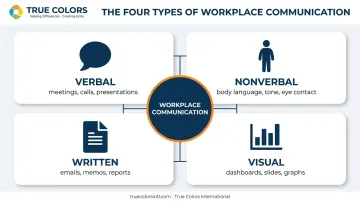
Most workplace interactions fall into four categories. Employees use all four daily, often without realizing it.
- Verbal – Spoken exchanges in meetings, phone calls, and presentations. This is where tone and pacing carry as much meaning as the words themselves.
- Nonverbal – Body language, facial expressions, eye contact, and posture. A crossed-arm stance in a meeting can undercut an otherwise reassuring message.
- Written – Emails, memos, reports, and chat platforms. Written communication leaves a record, but it also strips out tone, which is why misreads happen so easily.
- Visual – Charts, graphs, dashboards, and slide decks. Visuals simplify complexity, especially for data-heavy updates that would take paragraphs to explain otherwise.
No single type works alone. A leader announcing a reorg might use a written memo (facts), a verbal town hall (context and tone), and a visual org chart (clarity). Mastering all four types, rather than defaulting to one, is what lets you adapt your message to any audience or situation.
Why Workplace Communication Matters
Communication isn't a soft skill tucked into HR training. It shows up directly in business performance.
Towers Watson found that companies rated highly effective at communication delivered 47% higher total shareholder returns over five years than companies rated least effective. That's not a coincidence. Clear communication reduces the guesswork that slows teams down and causes costly errors.
Clarity Reduces Errors and Confusion
When employees know exactly what's expected of them, they make fewer mistakes. Gallup's engagement research found that teams with clear expectations saw 32% fewer quality defects and dramatically fewer safety incidents than teams without that clarity. Ambiguity is expensive, and clarity functions as operational insurance for the business.
Psychological Safety Encourages Honesty
Google's internal study of 180 teams identified psychological safety, the belief that it's safe to speak up, ask questions, or admit a mistake, as the single most important factor in team effectiveness. Without it, employees stay quiet about problems until those problems become expensive.
Poor Communication Drives Turnover
Gallup found that 42% of employees who voluntarily quit believed their departure was preventable, and 36% said no one had a real conversation with them before they left. The data suggests silence, not the job itself, drives most of these departures.
It Builds (or Breaks) Leadership Trust
Only 13% of employees strongly agree that leadership communicates effectively across their organization, according to Gallup. During periods of change, that gap becomes a liability.
A shared organizational vocabulary, one that helps people across departments describe how they work and what they need, closes that gap faster than another all-hands meeting ever could. This is the exact problem True Colors International was built to solve: giving teams a common language, built around four color-coded personality types, so communication styles stop feeling like a mystery.
The 7 C's of Effective Workplace Communication
The 7 C's framework is a long-standing checklist in business writing, used to tighten any message before it goes out.
| The C | What It Means |
|---|---|
| Clear | The purpose and meaning are easy to understand |
| Concise | No unnecessary words, repetition, or tangents |
| Concrete | Specific facts and examples replace vague language |
| Correct | Grammar, facts, names, and numbers are accurate |
| Coherent | Ideas follow a logical, connected order |
| Complete | The reader has everything they need to act |
| Courteous | Tone is respectful and audience-focused |
Here's the framework in action:
Vague: "Let's touch base soon about the thing we discussed." Improved: "Can we meet Thursday at 2 PM to finalize the Q3 budget? I'll bring the updated numbers."
Same intent. Completely different clarity. That's the entire point of running messages through this checklist before hitting send.
Common Barriers to Effective Workplace Communication
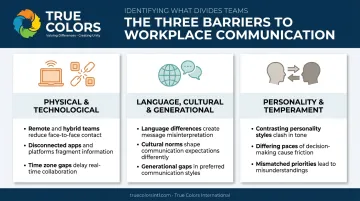
Even well-intentioned teams run into walls. Most barriers fall into three categories.
Physical and technological barriers. Remote and hybrid setups create real friction. In Buffer's 2023 survey of 3,000 remote workers, 23% cited loneliness as their biggest struggle, a clear signal that collaboration is breaking down. Disconnected tools make it worse: one team lives in email, another in Slack, another still exports PDFs.
Language, cultural, and generational differences. Research covering more than 10,000 teams found that cultural diversity can boost creativity, but it can also increase task conflict without shared norms in place. Generational labels get overused too; Pew Research has stopped defaulting to strict generational categories because the boundaries are arbitrary and unreliable for predicting behavior.
Personality and temperament differences. This is the barrier most companies never name, let alone address. Two employees can hear identical instructions and process them completely differently: one wants the data and logic before committing, while another wants to talk it through out loud.
Neither approach is wrong. But without a shared way to recognize those differences, well-meaning messages get misread constantly, making this the natural entry point for personality-based communication training.
Best Practices for Improving Workplace Communication
Improving communication takes consistent daily habits, not a single training event.
Practice Active Listening
Research on paraphrasing found that people who reflect back what they heard are perceived as better listeners and more socially attractive to work with. Try this:
- Listen without drafting your response while the other person talks
- Paraphrase what you heard before responding
- Ask a clarifying question instead of assuming
- Hold judgment until they've fully finished
Choose the Right Channel
Choosing the right channel for each message prevents wasted time and confusion. Media Richness Theory offers a useful rule: complex or emotionally loaded topics need rich, interactive channels like a call or face-to-face conversation. Routine updates belong in written form, where people can review them at their own pace.
Build Psychological Safety Deliberately
This doesn't happen by accident. It requires:
- Regular one-on-ones where employees can raise concerns without penalty
- Feedback loops that actually get acted on, not just collected
- Recognition that people process and share information differently
Use Personality-Based Communication Training
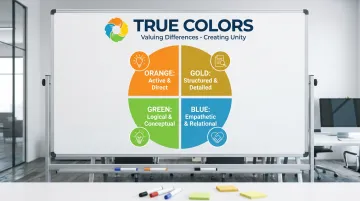
This is where True Colors International's methodology comes in. The approach is built around four color-coded personality types, Orange, Gold, Green, and Blue, that give teams a shared vocabulary for how people naturally communicate, make decisions, and handle stress. Gold personalities, for instance, tend to communicate best with clear structure and defined timelines. Green personalities respond to logic and data over emotional appeals.
Organizations like Amazon, Google, and Ford use this framework to help employees stop guessing at each other's intentions and start recognizing genuine communication differences instead of assuming someone is being difficult.
Invest in Ongoing Skill Development
A single workshop rarely sticks. True Colors offers certified facilitator training so organizations can build internal capability rather than relying on a one-time outside session. Advanced tracks covering communication, conflict navigation, and team building extend the shared language over time instead of letting it fade after month one.
Have Leaders Model Two-Way Communication
Edelman's trust research found that 82% of employees consider the ability to give input to management a strong expectation, sometimes a dealbreaker. Leaders who ask for feedback publicly, and actually respond to it, set the tone for everyone below them.
Frequently Asked Questions
What do you mean by workplace communication?
Workplace communication is the exchange of information, ideas, and feedback among employees, managers, and teams. It happens through verbal, nonverbal, written, and visual channels, both formally and informally.
What are the 4 types of communication in the workplace?
The four types are verbal (spoken), nonverbal (body language and tone), written (emails and reports), and visual (charts and presentations). Most employees use a blend of all four every day.
What are the 7 C's of communication in the workplace?
The 7 C's are Clear, Concise, Concrete, Correct, Coherent, Complete, and Courteous. They act as a checklist for tightening any message before it's sent or spoken.
What is the biggest barrier to effective workplace communication?
Unrecognized personality and communication-style differences are often the most overlooked barrier. Two people can receive the same message and interpret it completely differently based on how they naturally process information.
How do personality differences affect workplace communication?
People with different temperaments express and process information in distinct ways: some favor logic and data, while others favor structure or big-picture thinking. Awareness of these differences, often through personality assessments, reduces friction and misread intentions.
How can I improve my communication skills at work?
Start with active listening, paraphrase what you hear, and adapt your message style to your audience rather than defaulting to your own preference. Structured communication training, including personality-based approaches, accelerates the process.