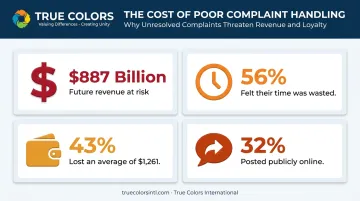
This scene plays out thousands of times a day across contact centers, retail counters, and support chats. Mishandled conflict does not just end one bad call. It costs businesses through lost customers, negative reviews, and burned-out agents. The 2023 National Customer Rage Survey found that mediocre complaint handling put $887 billion in future revenue at risk for US businesses, nearly double the 2020 estimate.
This guide breaks down what de-escalation training actually involves, the core steps every rep should know, the triggers that spark most blowups, and a factor most training programs skip entirely: how a customer's personality shapes the way they escalate and calm down.
Key Takeaways
- Poor complaint handling puts hundreds of billions in revenue at risk annually across US businesses
- Calm, listen, acknowledge, confirm, solve—this sequence resolves most tense calls at first contact
- Long waits, transfers, and feeling unheard drive the majority of escalations
- Customer temperament, not just training scripts, determines what actually calms someone down
- Ongoing coaching outperforms one-time training sessions for building lasting skill
What Is De-Escalation Training for Customer Service?
De-escalation training is a structured program that teaches reps to recognize, calm, and resolve tense customer interactions before a supervisor needs to step in. It focuses on emotional regulation, tone, and tension reduction rather than general product knowledge or scripted responses.
The goal is straightforward: resolve the issue at first contact. Every escalation that gets kicked upstairs costs time, damages the customer relationship, and chips away at agent confidence. Fewer escalations mean shorter handle times, fewer repeat contacts, and a more resilient team.
How It Differs from General Customer Service Training
Standard customer service training covers product knowledge, tools, and process. De-escalation training zeroes in on a narrower skill set:
- Reading emotional cues in tone, pace, and word choice
- Managing the rep's own stress response under pressure
- Applying specific language patterns that lower tension instead of raising it
- Knowing the line between a situation a rep can resolve and one that needs escalation
This distinction matters because a rep can know every policy in the handbook and still make an angry customer angrier if they cannot regulate the emotional temperature of the call.
Where This Training Gets Used
De-escalation skills are not exclusive to call centers. From hotel front desks to hospital billing offices, industries that lean on this training include:
- Retail and hospitality (in-person conflict, refund disputes, guest-services friction)
- Healthcare (anxious patients, billing disputes, wait-time frustration)
- Banking and financial services (fraud disputes, fee complaints)
- Government agencies (benefits processing, permit delays)
Zendesk's benchmark research found that three in four consumers will spend more with businesses that provide good customer experience. Two-thirds also say they're likely to become repeat customers when a company cares about their emotional state, not just the transaction.
Why De-Escalation Training Matters for Customer Service Teams
Unmanaged conflict is expensive in ways that don't always show up on a P&L until it's too late.
The Financial Cost
Every unresolved escalation tends to snowball. A frustrated customer calls back, gets transferred again, and the handle time on that single issue multiplies.
The 2023 National Customer Rage Survey found that 56% of customers with a problem said it wasted their time, averaging one to two days, and 43% reported losing money, at an average of $1,261 per incident.
Worse, angry customers talk. 32% of complainants posted about their most serious problem on social media in 2023, more than double the rate from 2020. Once that happens, a service failure becomes a brand reputation problem.
The Human Cost: Agent Burnout
Reps who face constant conflict without the tools to manage it burn out fast. Industry research shows 58% of contact center agents report feeling stressed at least half of the time. Verint's research found 31% of agents surveyed said they were likely to leave their role within six months.
Turnover isn't cheap. Replacing and retraining an agent costs weeks of productivity and institutional knowledge that walks out the door.
The Efficiency Gain
Calmer customers communicate more clearly. When a rep successfully de-escalates early in a call, the customer stops repeating themselves out of frustration and starts actually explaining the problem. That translates directly into:
- Shorter average handle times
- Higher first-contact resolution rates
- Fewer repeat contacts for the same issue
Common Triggers That Escalate Customer Interactions
Most escalations don't come out of nowhere. They follow predictable patterns.
Wait times and transfers. Long holds and being bounced between agents top the list of customer frustrations. Having to repeat the same information to a third or fourth person makes people feel like nobody is actually listening. That perception alone is enough to tip a calm customer into an angry one.
Unmet expectations. Delayed deliveries, unclear policies, and vague promises create a gap between what customers expected and what they got. When expectations are shattered rather than merely disappointed, frustration often turns into anger.
Feeling unheard or disrespected. Customers want acknowledgment and a sincere apology, not just a fix. When a rep skips straight to a solution without validating the frustration first, the customer often escalates harder because they feel dismissed.
Inexperienced reps delivering bad news. A rep who is uncomfortable saying "no" or explaining a denial often hedges, over-apologizes, or sounds evasive. Customers pick up on that hesitation immediately. It reads as a lack of confidence or honesty, even when the rep is being truthful.
The Core Steps of De-Escalation in Customer Service
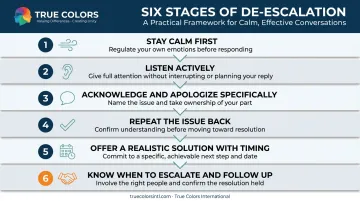
No single certified sequence fits every industry. Contact center research and programs from Zendesk and ICMI still point to the same core pattern. Here's a six-step version most reps can apply in real time:
- Stay calm first. Before responding, manage your own reaction. A rep's tone sets the ceiling for how heated the conversation gets. Take a breath, slow your speech, and lower your own volume even if the customer's is rising.
- Listen actively without interrupting. Let the customer fully explain the problem. Interrupting to correct or clarify too early almost always backfires, even when the correction is accurate.
- Acknowledge feelings and apologize specifically. A generic "sorry for the inconvenience" lands flat. "I'm sorry your order arrived three days late during a week you needed it" acknowledges the actual impact.
- Repeat the issue back. Summarizing what you heard confirms understanding and builds trust. It also gives the customer a chance to correct you if you missed something, which itself feels validating.
- Offer a realistic solution with clear timing. Vague promises ("we'll look into it") create new frustration. Specific commitments ("you'll have a refund confirmation by end of day Thursday") don't.
- Know when to escalate, and follow up. Some situations need a supervisor. Escalating early, rather than after ten more minutes of a losing battle, protects the customer relationship and the agent. After resolution, a follow-up confirms the fix held.
The Personality Factor: Why Understanding Temperament Improves De-Escalation
Most de-escalation advice assumes every customer reacts the same way under stress. They don't. Someone's temperament shapes what sets them off and what actually calms them down, which is why a script that works beautifully on one caller can fall completely flat on the next.
At True Colors International, we've spent 45+ years working with organizations like Amazon, Ford, and Marriott on exactly this problem. We use a four-temperament framework (Gold, Blue, Green, Orange) to explain why identical de-escalation language produces different results depending on who's on the other end of the line.
How Each Temperament Escalates and Calms
| Temperament | Escalates over | Calms with |
|---|---|---|
| Gold | Broken policy, process failures, inconsistency | Clear structure, specific timelines, direct action steps |
| Blue | Feeling emotionally unheard or dismissed | Empathy, validation, rapport before problem-solving |
| Green | Illogical, vague, or repetitive explanations | Clear, factual reasoning without redundancy |
| Orange | Delays, bureaucracy, slow responses | Fast, flexible action and concise next steps |
A Gold-dominant customer wants to know exactly what went wrong in the process and what will happen next, with dates attached. A Blue customer needs to feel genuinely heard before any solution will register.
Tell a Green customer "I hear you saying that," then follow with vague reassurance, and you'll lose them—they want the logic gap addressed directly. An Orange customer will tune out a long explanation of why the delay happened; they want to know what happens now.
Reading Cues in Real Time
Training reps to spot these patterns quickly—through word choice, pacing, and what the customer emphasizes—lets them adapt tone and phrasing on the fly instead of relying on a generic script. A rep who notices a customer fixating on "the policy says" versus one who keeps saying "nobody's listening to me" is picking up two very different signals that call for two different responses.
This is the gap our ASI-certified personality assessment and Conflict Navigation training are built to close. Rather than treating conflict as a procedural problem, we start with the behavioral "why" behind it, so teams build a shared, memorable language for temperament that holds up under real pressure, not just in a training room.
Building an Effective De-Escalation Training Program
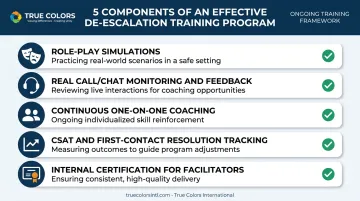
A single workshop won't build lasting skill. The strongest programs stack a few practices and keep them running after the workshop ends:
- Role-play difficult conversations with scenario-based simulations before reps face them live
- Ground feedback in real call or chat monitoring, not hypotheticals alone
- Coach continuously through short one-on-ones on recorded interactions so skills stay sharp
- Track CSAT and first-contact resolution before and after rollout—and adjust if the numbers stall
- Build the skill into certification so internal facilitators sustain it organization-wide
True Colors International's Advanced Certification programs in Communication and Conflict Navigation train those facilitators to carry the methodology forward long after the initial session.
Frequently Asked Questions
What is de-escalation training for customer service?
It's skills-based training that teaches reps to recognize emotional cues, stay calm under pressure, and resolve tense customer interactions before they require a supervisor. The focus is on emotional regulation, not just policy knowledge.
What are the steps of de-escalation in customer service?
Stay calm, listen actively, acknowledge feelings, confirm the issue, offer a realistic solution with clear timing, then follow up. Knowing when to hand off to a supervisor is part of the process too.
How long does de-escalation training typically take?
Programs range widely, from short 60-90 minute refresher sessions to multi-day certification workshops. True Colors' foundational Personal Success Workshop, for example, runs about three hours, while Advanced Certifications span multiple days.
Can de-escalation techniques prevent every angry customer situation?
No. Good training reduces the frequency and severity of escalations, but some situations still require supervisor involvement or a different resolution path. The goal is fewer, less severe escalations, not zero.
How does personality or temperament affect how customers react to conflict?
Different temperaments have different stress triggers and calming needs. A Gold customer wants structure and timelines, while a Blue customer needs empathy first. This is why identical scripts often underperform across different customers.
How often should teams refresh their de-escalation training?
Periodic refreshers and ongoing coaching beat a one-and-done session. Brief, regular touchpoints—like reviewing a recorded call together—keep skills sharper than an annual workshop alone.