For most managers, this isn't a bad day. It's every day. Communication isn't a side task that competes with "real work" — it is the work. A 2018 Harvard Business Review study tracking 27 large-company CEOs found they spent 72% of their working hours in meetings. Managers at every level face a similar squeeze, just with more email and fewer assistants filtering it.
This article breaks down the four core types of communication managers rely on, practical strategies to cut wasted time, and how personality-based frameworks like the one from True Colors International help you say the right thing the first time.
Key Takeaways
- Communication efficiency is a direct productivity lever that shapes your team's daily output
- Saving time means being clearer and better organized in how you communicate
- Matching your message to someone's communication style cuts back-and-forth
- Small habits, like repeating key points and confirming understanding, add up to hours saved weekly
Why Effective Communication Is a Time Management Issue for Managers
Managing people means managing the flow of information between them. Every missed instruction, vague deadline, or unclear expectation doesn't just create friction. It creates rework.
The math is brutal. A Grammarly and Harris Poll survey estimated that poor workplace communication costs businesses 7.47 hours per employee per week, translating to roughly $12,506 per employee annually and an estimated $1.2 trillion across U.S. businesses each year.
That's the hidden tax on unclear communication:
- Duplicated work because two people interpreted a task differently
- Missed deadlines caused by ambiguous priorities
- Resources allocated to the wrong problem entirely
- Meetings scheduled just to clarify an earlier meeting
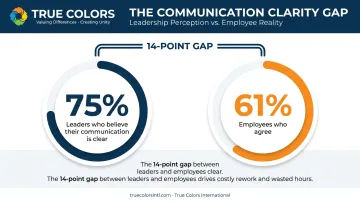
There's also a perception gap between what leaders believe and what employees experience. A recent Axios HQ survey of leaders and employees found that 75% of leaders believed their communication was clear, while only 61% of employees agreed. That's a 14-point gap between what managers think they're sending and what teams actually receive.
Managers who close that gap don't necessarily communicate more. They communicate with more precision, and they check whether the message landed before moving on. That single habit prevents the rework cycle described above, which is where most of the wasted hours actually come from.
The 4 Types of Communication Every Manager Should Master
Talking clearly is only one piece of the puzzle. Managers who save the most time understand that messages travel through four distinct channels, and each one has its own rules for speed and clarity.
Verbal Communication
Verbal exchanges are the fastest channel for real-time alignment. A two-minute conversation can resolve what a five-email thread cannot.
To keep it efficient:
- Lead with your main point before adding context
- Cut filler words ("just," "kind of," "I think maybe") that dilute urgency
- Confirm understanding with a quick recap before ending the exchange
Nonverbal Communication
Tone, posture, and facial expressions either reinforce your words or quietly undermine them. If your words say "great job" but your tone says "I'm distracted," the team notices the tone first.
Misreading these cues is expensive. A manager who seems dismissive in a two-minute hallway chat can trigger a 30-minute damage-control conversation later. Staying present and matching your body language to your message avoids that entirely.
Visual & Written Communication
Use visual aids (charts, one-page slides) when you need to convey complexity fast. Use written communication (email, shared docs) when you need a record people can reference later.
Quick tip: Keep written messages scannable. Lead with the ask, bullet the details, and skip the preamble. A dense paragraph invites a "wait, what do you need from me?" reply — a costly detour compared to writing it clearly the first time.
Time-Saving Communication Strategies for Busy Managers
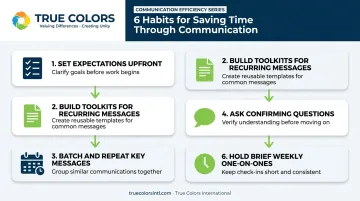
Here's where the real hours get saved. These six habits compound over a week, a quarter, and a year.
Set expectations upfront. Define roles, deadlines, and what "done" looks like at the start of any task. Skipping this step is why you get three clarifying emails on day four instead of zero.
Build toolkits for recurring messages. If you explain the same project kickoff or policy change more than twice, write it once as an FAQ or talking-points doc. Reuse it. Update it quarterly.
Batch and repeat key messages. People rarely absorb something fully on the first pass. Instead of repeating updates ad hoc throughout the day, fold them into scheduled touchpoints, such as a Monday team huddle, so the message lands with context intact.
Ask questions that confirm understanding. Don't assume a nod means clarity. Try:
- "What's your key takeaway from this?"
- "How would you explain this to someone else on the team?"
- "What's your first step after this conversation?"
Match the channel to the message. A quick decision rule: if the topic is ambiguous, emotionally sensitive, or needs back-and-forth, talk in person or on a call. If it's a routine update with no debate needed, send it in writing.
Hold brief, regular one-on-ones. A short, consistent weekly check-in with each direct report replaces a dozen scattered interruptions. Gallup's research on manager habits recommends conversations in the 15 to 30-minute range held on a predictable weekly cadence, rather than reactive check-ins whenever something breaks.
Understanding Communication Styles to Communicate Faster and Clearer
Here's a scenario every manager has lived through: you explain a project the same way to two people. One gets it instantly. The other asks five follow-up questions and still seems unsure. Usually, the mismatch is between how you communicated and how that person actually processes information.
This is where personality-based communication frameworks earn their keep. True Colors International, which has taught temperament-based communication for more than 45 years, uses a four-color framework (Orange, Gold, Green, and Blue) to give teams a shared language for these differences.
In practice:
- Orange communicators tend to move fast and want the bottom line first, not the backstory
- Gold communicators respond well to structure, clear steps, and defined expectations
- Green communicators tend to want the logic and the data before they commit to a decision
- Blue communicators often prioritize the relationship and the "why" behind a request
If you brief a Green-leaning analyst the same way you'd brief a Blue-leaning relationship builder, one of you walks away confused. Match your detail level and tone to the listener instead of defaulting to your own style, and you'll stop re-explaining the same point three different ways.
True Colors' training has been used across a wide range of organizations, from Fortune 500 companies to school districts and healthcare systems, specifically to build this kind of shared vocabulary around personality differences. The goal is to give managers a faster read on how to deliver a message so it sticks the first time, not to label people.
Common Communication Mistakes That Waste a Manager's Time
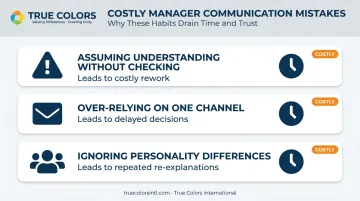
Even experienced managers fall into these traps, usually because they feel efficient in the moment and prove expensive later.
- Assuming understanding without checking. Skipping the confirmation step feels faster, but fixing a misunderstood task later takes far longer than the 30 seconds it takes to ask, "Does that make sense?"
- Over-relying on one channel. Sending everything through email, regardless of urgency, slows decisions that a two-minute conversation would have resolved same-day.
- Ignoring personality differences. Using the same tone and detail level for every team member forces repeated re-explanations for anyone who processes information differently than they do.
Frequently Asked Questions
What are the 7 C's of effective communication?
The 7 C's are clear, concise, concrete, correct, coherent, complete, and courteous. They matter for managers because each principle reduces the odds of a message needing a follow-up clarification.
What is the role of communication in effective management?
Communication is the vehicle managers use to set expectations, align teams, resolve conflict, and drive performance. Without it, even a great strategy fails at the execution level.
How much time do managers spend communicating each day?
No single figure applies to every manager, but a Harvard Business Review study found CEOs spend 72% of their time in meetings. Most managers spend a similar share of their day communicating in person, in writing, and nonverbally.
How can I improve communication with my team quickly?
Set clear expectations before any task begins, then hold short, consistent check-ins instead of ad hoc interruptions. Adjust your message style to how each person processes information best.
What's the difference between communication and effective communication?
Communication is simply sending a message. Effective communication means the recipient understood the message, acted on it correctly, and didn't need it repeated.
How does understanding personality styles improve workplace communication?
Recognizing temperament-based preferences, such as those in the True Colors framework, helps managers adjust tone and detail level for each person. That reduces misunderstandings and cuts the time spent re-explaining the same point.