Introduction
Marketing launches a campaign that sales never sees coming. IT rolls out new software that nobody on the front lines asked for. Two departments spend weeks building the same report, unaware the other team already finished it last month.
Sound familiar? This is what happens when organizational silos take over.
Silos aren't inherently bad. Specialized teams need room to focus. But when specialization hardens into a silo mentality, collaboration frays and wasted effort piles up.
A 2017 Harvard Business Review Analytics Services survey found that 67% of collaboration failures trace back to organizational silos.
This article covers what silo mentality looks like, the types of silos you're likely dealing with, why they form, and a practical playbook for cross-team collaboration.
Key Takeaways
- Silo mentality is a mindset problem: teams protect self-interest over shared goals
- Watch for three silo types: departmental, hierarchical, and project- or location-based
- Unified leadership, shared language, and aligned incentives break silos better than new software alone
- Personality-based communication training builds trust faster between teams that speak different languages
What Is Silo Mentality? Recognizing the Signs in Your Organization
Silo mentality describes a reluctance to share information, resources, or credit outside your immediate team. It's different from healthy specialization, where teams focus deeply on their expertise but still stay connected to the bigger picture.
A 2020 peer-reviewed scoping review defines organizational silos as barriers to communication and exchange between groups. The same research notes that silo mentality reduces operational efficiency and erodes morale over time.
Warning Signs You're Dealing With Silo Mentality
Watch for these patterns:
- Information hoarding: teams struggle to access data or updates from other departments
- Duplicated work: two groups solve the same problem without knowing it
- "Us vs. them" attitudes: departments treat each other as competitors, not colleagues
- Weak alignment: teams can't explain how their work connects to company-wide goals
- "Not my job" thinking: people decline tasks outside a narrow role definition
Silo mentality often starts at the top. When leadership hoards information or competes for influence across divisions, employees mirror that behavior. It trickles down until it becomes "how things work here."
The downstream cost shows up as misaligned processes, burned-out teams, and avoidable rework. A 2024 study in the Journal of Public Health Management and Practice notes that silos can be effective ways to organize people — the trouble starts when groups stop sharing knowledge and information with the rest of the organization.
Structure and expertise still matter; silos become harmful only when groups stop exchanging knowledge and credit across the organization.
The Types of Organizational Silos You're Likely Dealing With
Most workplace silos fall into three main categories. Each one has a different root cause, which means each needs a different fix.
Departmental Silos
These form between functions like marketing, sales, IT, and HR when each group optimizes for its own goals instead of shared ones. A common example: IT rolls out new software without asking end users what they actually need, then wonders why adoption stalls.
Functional or Hierarchical Silos
These form along expertise lines or up and down the org chart. Leadership may withhold strategic context from frontline staff, and specialist teams may guard best practices instead of sharing them. Knowledge stays uneven, and decisions slow down.
Project-Based or Location Silos
Temporary project teams often lose institutional knowledge the moment a project wraps up. Geographically dispersed teams, or teams split across shifts and time zones, face a similar problem: they don't sync often enough to stay aligned.
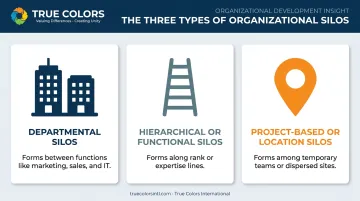
Name the type (or mix) you are dealing with before you pick a remedy. A departmental silo needs a different intervention than a location-based one.
Why Silos Form in the First Place
Silos rarely form on purpose. They're usually a byproduct of specialization, unclear priorities, and a natural human tendency to cluster with people who think and work like we do.
Several structural and cultural factors accelerate the problem:
- Weak interdepartmental leadership — no one owns cross-team alignment, so it falls through the cracks
- Misaligned incentives — performance metrics reward single-team wins, not shared outcomes
- Tools that don't scale — communication platforms built for one team create blind spots for everyone else
Research from PwC's 2016 Global Operations Survey found that 55% of companies reported working in silos. In the same survey, 61% said greater cross-functional collaboration paired with faster decision-making was key to reaching strategic goals.
Remote and hybrid work has widened these gaps further. A large-scale study of over 61,000 Microsoft employees, published in Nature Human Behaviour, found that firm-wide remote work made collaboration networks more static and siloed, with fewer bridges connecting disparate groups.
Microsoft's own research summary put the drop in cross-group collaboration time at roughly 25% compared to pre-pandemic levels. Without deliberate effort to reconnect teams, those gaps keep widening.
How to Break Down Organizational Silos: 6 Proven Strategies
There's no single fix here. Lasting change comes from combining leadership commitment, a shared language, and consistent reinforcement, not a one-time training day.
1. Drive a Unified Vision From Leadership
Leaders need to set goals that go beyond divisional priorities. When executives model collaborative behavior themselves (sharing information openly, crediting other teams publicly), employees follow suit. Vision without visible modeling rarely sticks.
2. Build a Shared Organizational Language for Communication
Many silos persist simply because teams don't understand how their colleagues communicate. Marketing might value speed and energy; finance might value structure and detail. Neither is wrong, but without a common vocabulary, friction is constant.
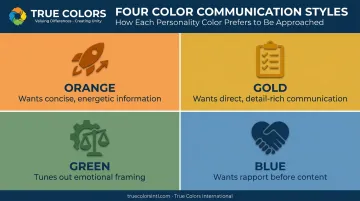
This is where personality-based frameworks earn their keep. True Colors International's methodology, built on more than 45 years of organizational development work, gives teams a color-based language for understanding communication styles:
- Orange personalities prioritize action and respond to concise, energetic information
- Gold personalities prioritize structure and need direct, detail-rich communication
- Green personalities prioritize logic and tune out emotional framing
- Blue personalities prioritize connection and need rapport before diving into content
Once teams learn this vocabulary, they apply it in meetings, feedback conversations, and cross-functional handoffs. As Brenda Huizinga, Senior Manager of Leadership and Development at Servus Credit Union, put it: "True Colors builds a common language and the same understanding of that language throughout the organization."
3. Create Cross-Functional Teams and Projects
Temporary or permanent cross-functional teams break down departmental walls by design. When people from different functions work toward one shared deliverable, alignment and shared accountability follow naturally. It also surfaces innovation that siloed teams rarely stumble into on their own.
4. Implement Centralized Collaboration Tools and Systems of Record
Shared platforms (project management software, internal wikis, company intranets) keep information from getting trapped in one department. The tool matters less than the habit: information should live somewhere everyone can find it, not in one manager's inbox.
5. Align Incentives and Recognize Cross-Team Collaboration
If bonuses and recognition only reward individual-team KPIs, people will keep optimizing for their own team. Rewarding joint wins changes the calculus. That might mean:
- Recognition programs that spotlight cross-team projects publicly
- Bonus structures tied partly to shared organizational outcomes
- Performance reviews that ask, "How did you help another team succeed?"
6. Invest in Trust-Building and Interpersonal Relationships
Structural fixes fail without genuine trust between people. Team-building exercises, mentoring programs, and facilitated workshops help build bridging ties: relationships that connect otherwise separate groups.
Practical ways to invest here include:
- Facilitated workshops that surface how different styles handle conflict
- Mentoring pairs drawn from different departments
- Recurring cross-team forums, not one-off offsites
Structured programs make those habits stick. True Colors' Advanced Certification tracks in Team Building and Conflict Navigation target increased trust, faster friction resolution, and less damage to productivity and retention. Pairing those applications in one engagement helps teams practice the skills together instead of treating trust and conflict as separate problems.
Common Pitfalls to Avoid While Breaking Down Silos
Even well-intentioned silo-busting efforts fail for predictable reasons.
- Treating it as a one-time initiative. Culture work that stops after a single workshop tends to backslide within months. Reinforcement needs to be ongoing, not a checkbox.
- Skipping leadership buy-in. When new tools or trainings roll out without a clear "why" from leadership, adoption stays low. People need to understand the purpose, not just the process.
- Ignoring incentive structures. If departmental competition still gets rewarded after a collaboration initiative launches, employees will notice the mismatch and revert to old habits.
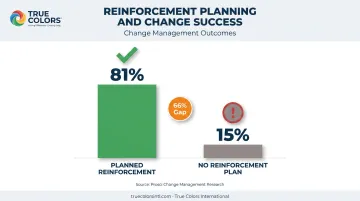
The reinforcement gap is especially costly. Prosci's change management research found that among organizations that planned for reinforcement after a change initiative, 81% met or exceeded their objectives, compared to just 15% among those that skipped it.
Conclusion
Breaking down silos means connecting teams through shared vision, shared language, and consistent reinforcement over time—without throwing out the structure that keeps work organized.
Most failed silo-busting efforts share one root cause: treating collaboration as a one-time project instead of an ongoing culture practice. The organizations that get this right build systems that keep reinforcing the behavior long after the initial training ends.
If your teams are stuck talking past each other, True Colors International's research-validated, assessment-based training gives them the shared language and self-awareness to collaborate for the long haul.
Frequently Asked Questions
What are the three types of silos?
The three most common types are:
- Departmental silos (between functions like marketing and IT)
- Hierarchical or functional silos (between rank levels or same-expertise teams)
- Project-based or location silos (temporary teams or dispersed sites)
What are the signs of silo mentality?
Common signs include difficulty accessing cross-team information, duplicated work, "us vs. them" attitudes, weak alignment around shared goals, and a "not my job" mindset.
What is another way of saying working in silos?
People often describe it as "working in isolation," "siloed operations," "departmental tunnel vision," or "operating in a vacuum."
How long does it take to break down organizational silos?
Timelines vary by organization size and culture. Meaningful change usually takes several months to a year or more of consistent leadership reinforcement—not a single event or workshop.
Can silos ever be beneficial for an organization?
Yes. Specialized silos provide structure and deep expertise. Keep that structure; focus on stopping silo mentality from blocking collaboration between teams.
What role does leadership play in eliminating silo mentality?
Leadership sets the tone through visible collaboration, unified company-wide goals, and incentive structures that reward joint outcomes. Without leadership buy-in, silo-busting efforts rarely stick long term.