That gap often comes down to leadership "color," a shorthand for the communication and decision-making style a person defaults to under pressure. Search around and you'll find conflicting numbers of leadership styles. Gallup lists four. Harvard Business Review outlines six. A popular workplace model uses eight colors. None of these lists agree, and that's confusing if you're trying to figure out which one to trust.
This article breaks down two frameworks worth knowing: the informal 8-color "rainbow" of leadership styles, and the four validated leadership colors used in temperament-based systems like True Colors International. You'll also learn how to identify your own color and flex it when the moment calls for something different.
Key Takeaways
- Leadership colors describe communication and decision style, not a fixed personality box
- Two frameworks dominate: an informal 8-color rainbow and structured 4-color temperament systems
- Motivational colors reveal what energizes a leader; behavioral colors show how they act day to day
- Strong leaders flex styles based on the person or situation instead of defaulting to comfort
- Validated assessments identify your color more reliably than self-guessing ever will
What Are Leadership Colors?
Leadership colors are a visual shorthand for how someone naturally provides direction, motivates a team, and makes decisions. Instead of saying "she's directive and impatient with process," you say "she leads Red" or "she's a strong Orange." It's faster, and it sticks.
Colors work as a leadership framework for a few practical reasons:
- Stick in memory — nobody forgets "I'm a Gold" the way they forget "conscientious, structured, and detail-oriented"
- Lower defensiveness in coaching, since no color ranks above another
- Fit a two-minute Slack exchange without re-explaining a full personality theory
Not every color model means the same thing. Some lists are informal metaphors from individual coaches and consultants, meant to be blended, renamed, or dropped as needed.
Others, like True Colors International's four-color system, rest on decades of validated temperament research and third-party assessment standards. Both use the word "color." Only one has been independently tested for reliability and legal defensibility in hiring and development contexts.
The Four Leadership Colors: The True Colors Framework
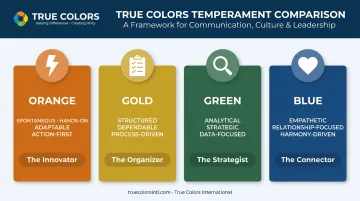
True Colors International's four-color system—Orange, Gold, Green, and Blue—traces back to 1978 and more than 45 years of temperament theory.
The Assessment Standards Institute (ASI) evaluated the current instrument against 10,000 respondents. All four color scales scored in the "Very Good to Excellent" range for reliability, a result ASI noted it doesn't see consistently across the tools it reviews.
Here's what each color tends to look like in a leader:
Orange leaders are spontaneous, hands-on, and adaptable. They thrive in fast-moving environments and would rather try something and adjust than plan it to death. Think of the founder who launches first and iterates in public—the way Richard Branson has described building Virgin around bold bets rather than cautious rollouts.
Gold leaders are structured, dependable, and process-driven. They value order, tradition, and clear expectations, and they make sure the trains actually run on time. Tim Cook's quiet, methodical operational discipline at Apple fits this pattern well.
Green leaders are analytical and strategic, driven by ideas and competence. They want the data before the decision. Jeff Bezos's preference for slow, high-quality decisions over fast, easy ones illustrates this well.
Blue leaders are empathetic and relationship-focused. They put harmony, connection, and team well-being ahead of pure output. Satya Nadella's "learn-it-all" culture shift at Microsoft, built on listening and empathy, reflects this style.
Almost nobody is a pure color. Most leaders carry a dominant and a secondary color, which is why a validated assessment matters more than a quiz you skim in five minutes. It gives you and your team a shared, practical language instead of a guess.
The Rainbow of Leadership Styles: 8 Colors and What They Reveal
The 8-color "rainbow" model comes from leadership coach Lara Hogan, who first published it in 2018 as an intentionally incomplete, customizable shorthand. It was never meant to be a validated assessment. It's a situational communication tool.
| Color | What it looks like |
|---|---|
| Red | Urgent, edgy, task-focused; pushes for speed |
| Orange | Cautious, hesitant, low-risk; tiptoes before acting |
| Yellow | Lighthearted, effervescent, relationship-first |
| Green | Emotionally attuned, high-EQ, loyal |
| Blue | Calm, steady, detail-oriented |
| Purple | Creative, flowy, strong at storytelling |
| Brown | Comfortable with nuance, complexity, ambiguity |
| Black | Direct, rational, cut-and-dried |
A quick warning: Hogan's "Orange" (cautious, low-risk) means the opposite of True Colors' "Orange" (bold, action-first). Same word, different frameworks. Don't assume they're interchangeable.
Hogan's point wasn't to sort people into boxes. It was to give leaders a menu of styles to draw from depending on the audience, the stakes, and the message. Blend them, rename them, or swap in your own labels. No leader is stuck with one color for life.
Motivational Colors: What Energizes Each Leadership Style
Behavioral colors describe what a leader does. Motivational colors describe why they do it, the underlying driver behind the behavior. Two leaders might both show up as organized and detail-focused, but one is driven by a sense of duty and the other by a need for control. Same behavior, different fuel.
Within the True Colors framework, each temperament is energized by different things:
- Orange — freedom, variety, and tangible, visible impact
- Gold — structure, service, and a clear sense of responsibility
- Green — knowledge, innovation, and demonstrated competence
- Blue — connection, meaning, and harmony within the team
That difference shows up in everyday recognition. A Gold employee who gets a spontaneous shoutout in a team chat might feel more embarrassed than motivated. A Blue employee who receives a cash bonus with no personal note might feel unseen.
Knowing what fuels each color helps leaders design recognition and feedback that actually lands, instead of assuming everyone wants the same praise.
How to Identify and Flex Your Leadership Color
Start with honest self-reflection. Ask yourself:
- What's my default style when I'm stressed and don't have time to think it through?
- What's hardest for me to embody — the style that feels unnatural even when it's needed?
- Which styles drain me, and which ones energize me even after a long day?
Honest answers give you a useful starting map. Self-guessing still has limits. People are notoriously inaccurate judges of their own default patterns, especially under pressure.
This is where situational leadership comes in: matching your color to what a specific person, team, or moment actually needs, rather than defaulting to whatever feels comfortable. A Green leader managing a Blue employee through a personal crisis has to consciously dial up warmth, not analysis. That kind of flexibility is a skill you can build with practice.
The most reliable way to pinpoint your dominant and secondary colors isn't a five-minute online quiz. Use a research-validated personality assessment that ranks your full spectrum instead of pinning you with a single label.
Building a Color-Confident Leadership Culture
When teams share a color vocabulary, communication friction drops. People stop taking style differences personally and start recognizing them as, well, just style. That shift shows up in:
- Fewer misunderstandings
- Faster conflict resolution
- Stronger cohesion across departments that used to talk past each other
The stakes are real. Gallup has found that only 13% of employees strongly agree that leadership communicates effectively across their organization. That's a massive gap. A shared framework for how people naturally communicate is one practical way to close it.
True Colors International has spent more than 45 years building that shared language for organizations including Google, Amazon, Ford, and Marriott. Assessments, workshops, and facilitator certification programs put the framework into daily use. The certified-facilitator network is intentionally selective: only 11 people nationwide currently hold Elite Facilitator status, reserved for those who've completed advanced certifications beyond the foundational training.

If you're ready to move past guessing your color, a professional workshop or assessment is the fastest path to building that culture of understanding at scale.
Frequently Asked Questions
What are the four leadership colors?
Orange, Gold, Green, and Blue. In the True Colors framework, each color maps to a distinct temperament and leadership approach, from action-oriented to relationship-focused.
What are motivational colors?
Motivational colors describe the underlying drivers, like structure, freedom, connection, or knowledge, that energize a person's behavior. They're distinct from behavioral colors, which describe visible actions rather than internal drivers.
What is the most common leadership color?
No single color dominates the workforce. Validated assessments typically show a fairly even distribution across temperaments, and most leaders show a blend of two colors rather than one dominant type.
Can a leader have more than one leadership color?
Yes. Most leaders have a primary and secondary color, and shifting between styles when the situation calls for it is a mark of adaptable leadership.
How do I find out my leadership color?
Start with self-reflection on your default habits under pressure. For reliable, actionable results, take a validated True Colors assessment from an ASI-certified provider rather than relying on guesswork.
Are leadership colors the same as personality types like MBTI or DISC?
Related but distinct. True Colors draws on core temperament ideas also found in MBTI and turns them into a practical workplace tool, with assessment validation from the Assessment Standards Institute (ASI).