Introduction
Most leadership training focuses on decision-making style: autocratic, democratic, hands-off. Fewer programs address something just as powerful — the emotional residue a leader leaves on their team every single day.
Many organizations struggle with this blind spot. They train managers on frameworks and models, but rarely on how a leader's mood "leaks" into meetings, one-on-ones, and Slack messages, shaping whether employees speak up, take initiative, or shut down.
Research backs this up. A three-week diary study of leaders and employees found that a leader's daily mood directly predicted employee mood and task performance the very same day, according to a 2022 Purdue University study.
This article unpacks both dimensions, leadership style and emotional expression, and shows how understanding their interaction drives measurable performance gains.
Key Takeaways
- Daily emotional expression, not just leadership style, drives performance through contagion
- Positive leader affect lifts performance; negative affect drags down output and support
- Transformational and participative styles paired with emotional intelligence deliver the most consistent results
- Temperament assessments help leaders spot blind spots in style and emotional habits
Leadership Styles and Their Direct Impact on Employee Performance
Leadership style is the behavioral pattern a leader consistently uses to direct, motivate, and influence employees toward goals. Decades of leadership theory, starting with Lewin, Lippitt, and White's 1939 experiments on group climates, have tried to pinpoint which patterns actually drive performance.
Autocratic vs. Democratic Leadership
Autocratic leaders make fast, unilateral decisions, which creates clarity in high-pressure moments. But the tradeoff shows up in retention.
A study of 110 Thai SME owner-managers and 951 employees found authoritarian leadership positively linked to firm-level voluntary turnover, with the highest turnover occurring under high-authoritarian, low-benevolent leadership styles. That said, context matters: a 2025 study of 231 employees in resource-constrained Malawian SMEs found autocratic leadership actually predicted higher engagement and performance — suggesting this style isn't universally harmful, just situationally risky.
Shared decision-making, by contrast, tends to boost morale and ownership. A classic meta-analysis spanning 106 satisfaction studies found participation correlated with job satisfaction at r=.34, but only r=.15 with productivity.
Translation: participative leadership is a stronger morale lever than a guaranteed output multiplier. The tradeoff? Slower consensus-building when speed matters most.
Transformational Leadership
This style centers on vision, inspiration, and individualized development. A study of 254 employees across Iranian teaching hospitals found transformational leadership had a striking positive effect on employee productivity, reported at .83 (p=.001). This individualized attention, tailored coaching based on each employee's motivations and strengths, likely explains why the effect size dwarfs the mechanical compliance produced by transactional rewards alone.
Transactional and Laissez-Faire Leadership
Transactional leadership (contingent reward) carries a strong overall validity of .39, according to Judge and Piccolo's 2004 meta-analysis, and works best when roles and rewards are clearly defined. Laissez-faire leadership tells a different story: validity drops to -.37, including -.58 for follower satisfaction, making it risky with newer or less-structured teams that need guidance.
The contingency principle stands firm: no single style wins universally, and fit between style and situation matters as much as the style itself. This is exactly why True Colors International's leadership development programs train managers to read team dynamics and flex their approach, rather than defaulting to one fixed style.
The Emotional Dimension: How Leader Emotions Directly Shape Employee Performance
Emotional contagion describes how employees unconsciously absorb a leader's emotional state, the same way a tense room goes quiet when the boss walks in irritated.
The Purdue diary study tracked leaders and employees over three work weeks and found a clear chain reaction:
- Leader's positive daily affect increased employee positive affect
- Higher employee positive affect predicted higher task performance that day
- Improved task performance increased leader helping behavior the following day
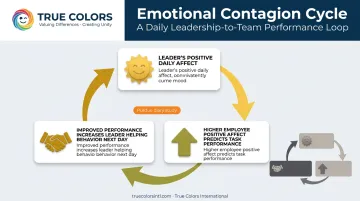
The reverse held true as well. Leader negative affect decreased employee relationship satisfaction and task performance — which then reduced how much the leader helped their team afterward. A downward spiral, not just a bad day.
Why This Happens
Emotional cues act like a signal for safety or threat. When a leader seems calm and open, employees take initiative, ask questions, and offer ideas. When a leader seems tense or volatile, employees withdraw and protect themselves instead of contributing.
Emotional expression is independent of leadership style. An autocratic leader can be calm and encouraging. A democratic leader can be volatile and unpredictable.
This is the piece most leadership programs miss: style and emotion are two separate levers, and both need active management.
Where Style Meets Emotion: The Compound Effect on Employee Performance
Leadership effectiveness depends on two combined variables. WHAT a leader does (style) combines with HOW employees feel while it happens (emotional tone) to produce the actual result.
Consider two transformational leaders:
| Leader A (Low EQ) | Leader B (High EQ) |
|---|---|
| Inspiring vision, but snaps under pressure | Same vision, stays composed under pressure |
| Team hesitates to bring problems forward | Team raises issues early, before they escalate |
| Performance dips during high-stress periods | Performance holds steady or improves under stress |
Same style. Wildly different outcomes. The differentiator is emotional regulation.
Emotionally intelligent leaders flex their style to match the situation and the person in front of them, without leaking frustration or anxiety onto the team in the process.
That flexing starts with self-awareness: understanding your own natural temperament, default communication tendencies, and emotional triggers before they show up unmanaged in a team meeting.
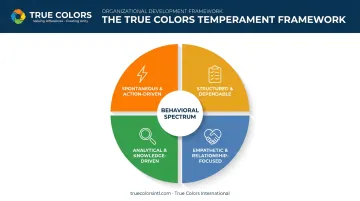
This is where personality-based self-awareness tools support leadership development. True Colors International, an organizational development company that has built communication and leadership frameworks for more than 45 years, uses an ASI-certified personality assessment to map a leader's natural behavioral spectrum across four temperament styles:
- Orange: spontaneous and action-driven, energized by variety
- Gold: structured and dependable, focused on order and responsibility
- Green: analytical and logical, driven by knowledge and competence
- Blue: empathetic and relationship-focused, driven by connection and harmony
Instead of a single label, leaders see a full color spectrum, revealing both their default decision-making tendencies and the stress patterns that surface under pressure.
That combination gives leaders a starting point for recognizing blind spots in both dimensions: how they naturally lead, and how they emotionally show up while doing it.
Warning Signs Your Leadership Approach May Be Undermining Performance
Some performance problems trace back to leadership behavior, not employee capability. Watch for these patterns:
- High turnover or quiet disengagement despite decent performance metrics, often linked to unchecked negative emotional expression rather than skills gaps.
- Employees hesitating to raise problems or new ideas. This signals psychological unsafety, often tied to a leader's emotional volatility or an overly rigid style that punishes dissent.
- Inconsistent performance across similarly skilled teams led by different managers. When capability is equal but results vary, the gap usually sits in leadership style and emotional consistency, not employee talent.
Turnover data backs this up: Gallup found that 42% of voluntary turnover was preventable, based on what former employees said their manager could have done differently.
None of these show up cleanly on a performance dashboard. They show up in exit interviews, engagement surveys, and the quiet absence of employee voice.
Building Emotionally Intelligent, Adaptive Leaders
Style and emotional intelligence are both learnable, not fixed traits. Building them takes deliberate practice, not a one-off workshop.
Practical steps organizations can take:
- Build feedback loops. Regular self-reflection practices help leaders notice emotional reactions before they spill onto the team.
- Pair style-flexibility training with EQ coaching. Programs that combine both, such as True Colors International's leadership development and emotional intelligence training, teach leaders their natural behavioral tendencies alongside practical tools for managing emotional reactions in real time.
- Run ongoing pulse checks. Periodic surveys or informal check-ins catch early warning signs (hesitant voice, dipping morale) before they harden into turnover.
Leadership training that only covers decision-making style leaves half the job undone. The emotional half is where daily performance gets won or lost.
Frequently Asked Questions
What is the most effective leadership style for employee performance?
Transformational and participative styles generally show the strongest links to performance. Effectiveness still depends on situational fit and whether the leader stays emotionally consistent while applying that style.
How do a leader's emotions affect employee performance?
Leaders' emotions are contagious. Daily mood directly shapes employee mood, willingness to help colleagues, and task output, often within the same workday.
What is emotional contagion in leadership?
It's the unconscious transfer of a leader's emotional state to employees, which then shapes how employees behave, collaborate, and perform.
Can leadership style and emotional intelligence be developed over time?
Yes. Both develop through self-awareness tools, coaching, and consistent practice rather than staying fixed as personality traits.
How can organizations identify which leadership style their managers naturally use?
Personality and temperament assessments can reveal natural style tendencies and communication patterns before they turn into visible performance issues on a team.
Does one negative interaction with a leader really impact long-term performance?
Isolated incidents matter less than patterns. Repeated negative affect gradually erodes trust, satisfaction, and performance through sustained accumulation, not single moments.