Introduction
Hiring based on degrees and job titles is losing ground fast. McKinsey, BCG, and Deloitte have all documented the same shift: organizations are moving toward evaluating what candidates and employees can actually do, not just what credentials they hold.
But there's a catch. Most skills-based frameworks lean heavily on technical, measurable hard skills. They often overlook the human element: skills like communication, collaboration, and emotional intelligence that determine whether those technical skills ever translate into real performance.
This post breaks down what a skills-based approach actually means, along with its proven benefits and core building blocks. You'll also see why soft skills can't be an afterthought, plus a practical roadmap for rolling it out across your organization.
Key Takeaways
- Skills-based hiring evaluates demonstrated ability, not degrees, titles, or years in a seat
- Companies using this model see better hiring accuracy, lower bias, and stronger retention
- A skills taxonomy, objective assessment, and continuous learning form the foundation
- Technical skills alone don't predict performance unless communication and EQ are part of the mix
- Real implementation touches hiring, learning and development, technology, and culture together
What Is a Skills-Based Approach?
A skills-based approach evaluates people by verified capabilities and proficiency levels rather than resumes, degrees, or job tenure. Instead of asking "Does this person have a bachelor's degree?" the question becomes "Can this person do the work?"
Traditional hiring models rely on proxies like education and years of experience to predict job performance. The problem: those proxies often screen out high-potential talent who never had access to a four-year degree but can absolutely do the job.
What This Looks Like in Practice
Consider a software company evaluating a candidate for a backend developer role. Instead of requiring a computer science degree, the hiring team runs a live coding assessment measuring actual problem-solving and syntax proficiency.
Goldman Sachs uses a similar model. Its "skillset recruiting" program lets candidates apply to skill areas rather than specific job openings. They complete online skill testing and get matched to roles based on demonstrated ability, not a resume line item.
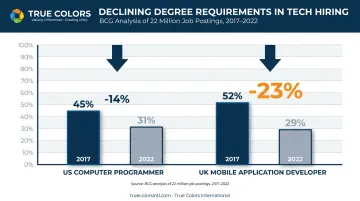
This shift isn't marginal. BCG analyzed 22 million job postings across five countries and found degree requirements fell sharply between 2017 and 2022. Requirements dropped 14% for US computer programmer roles and 23% for UK mobile application developer roles, according to BCG's Competence Over Credentials report.
Skills-Based Approach to Learning and Development
In an L&D context, a skills-based approach means building capability through hands-on practice and application, not passive knowledge transfer. Employees learn by doing the actual work, not by sitting through slide decks.
This model shows up in two places at once. Corporate training uses apprenticeships, simulations, and project-based learning tied to real business problems, while higher education redesigns curricula to close the gap between classroom theory and workplace readiness.
Both are trying to solve the same disconnect: knowing something and being able to apply it under real conditions are not the same skill.
Key Benefits of a Skills-Based Approach
Organizations that shift to skills-based practices see measurable gains across hiring, retention, and workforce flexibility. Here's what the research shows:
- Improved hiring accuracy: Role fit is based on proven ability, not a credential that may have little bearing on job performance
- Broader talent pool: Removing unnecessary degree filters opens the door to overlooked, capable candidates
- Higher retention and engagement: Visible internal growth paths keep employees invested longer
- Greater workforce agility: Talent gets redeployed quickly as business priorities shift
- Reduced bias: Standardized, objective evaluation replaces gut-feel judgment in hiring and promotion decisions
Hiring for skills is 5 times more predictive of job performance than hiring for education, and more than twice as predictive as hiring for prior work experience, according to McKinsey's research on skills-based hiring.
McKinsey's data also shows workers without degrees stay in their jobs 34% longer than degree-holding peers in comparable roles. That retention gain comes down to matching people with work they're actually equipped to do.
Key Aspects of a Skills-Based Approach
A well-structured skills-based strategy isn't one initiative. It's a handful of interlocking building blocks that have to work together.
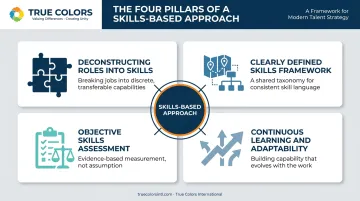
Deconstructing Roles Into Skills
Rather than treating a job description as a fixed, static document, roles get broken into:
- Core skills: non-negotiable capabilities needed on day one
- Adjacent skills: related abilities that support growth into the role
- Future skills: capabilities the role will require as the business evolves
This reframing turns a job title into a living map of what the work actually requires.
A Clearly Defined Skills Framework
A shared skills taxonomy gives HR, managers, and employees a common language. Instead of one manager calling something "communication" and another calling it "stakeholder management," everyone is working from the same defined terms and proficiency levels. Without this shared framework, skills-based initiatives tend to fragment across departments.
Objective Skills Assessment
Subjective judgment (gut feel, interview chemistry, resume polish) gets replaced with validated, standardized assessments. This might include technical tests, simulations, or structured work samples that produce comparable, evidence-based results across candidates. True Colors International's own assessments, for example, are ASI-certified and meet the EEOC's 80% guideline for reliability and fairness, exactly the rigor a skills-based system depends on.
Continuous Learning and Adaptability
Skills data doesn't just inform hiring. It drives targeted upskilling and reskilling, and it supports internal mobility as business needs shift. When an organization knows exactly what skills exist across its workforce, it can move people into new roles faster than it could ever hire externally.
Where Soft Skills and Emotional Intelligence Fit In
Here's the gap most skills-based frameworks miss: they focus almost entirely on technical or hard skills, treating communication, collaboration, and emotional intelligence as "nice to have" rather than measurable competencies.
That's a mistake employers are correcting fast. According to the World Economic Forum's Future of Jobs Report, 72% of US job postings now mention at least one human skill. Resilience, flexibility, and leadership have all climbed sharply in employer priority rankings since 2023.
A technical skills framework tells you whether someone can code, analyze risk, or run a P&L. It doesn't tell you whether that person communicates clearly under pressure, adapts their style to a frustrated client, or navigates conflict on a cross-functional team.
Personality and temperament-based assessments fill this gap by turning soft skills into measurable, trainable dimensions:
- Communication style – how someone naturally expresses ideas and takes in feedback
- Collaboration tendencies – how they engage with teammates and contribute to shared goals
- Emotional intelligence – how they manage stress, empathy, and conflict under pressure
True Colors International offers one example of how this works in practice. Its ASI-certified personality assessment, validated through a 10,000-person study, maps communication styles and behavioral tendencies with the same rigor a technical assessment brings to hard skills.
Organizations such as Google, Ford, and Marriott use this approach, built on more than 45 years of temperament-based research. It gives teams a shared language for how people actually work together, not just what they know.
Pairing a technical skills framework with this kind of behavioral model gives organizations a complete picture of workforce readiness. It predicts not only whether someone can do the job, but whether they'll thrive doing it alongside other people.
How to Implement a Skills-Based Approach
Implementation works best as a coordinated shift across hiring, learning, technology, and culture, not a siloed HR project.
Redesign Hiring Around Skills
Rewrite job postings around required skills instead of years of experience or degree requirements. Train hiring managers to run structured interviews and skills-based assessments that evaluate demonstrated ability rather than resume polish. Talent selection tools, such as True Colors International's Talent Selection Assessments, give hiring teams a validated way to measure that ability directly.
Build Skills-Based Learning and Assessment Programs
Create personalized learning plans tied to identified skill gaps. Use validated assessments, both technical and behavioral, to track proficiency over time rather than relying on course completion as a proxy for capability.
Use Technology to Scale
AI-driven skills platforms and learning management systems help match people to roles based on verified capability and flag development opportunities automatically. Without this layer, skills data quickly becomes too fragmented to act on at scale.
Foster a Skills-First Culture
None of this works without leadership buy-in. Promotion practices need to reward demonstrated ability over tenure, and skill growth needs visible recognition.
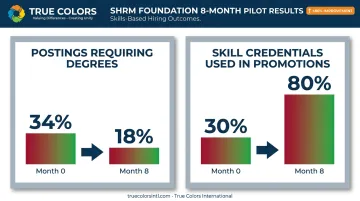
Bringing these four areas together doesn't happen overnight, and a phased rollout tends to work better than an all-at-once overhaul. SHRM Foundation's pilot program ran an eight-month implementation cycle. Postings requiring traditional degrees dropped from 34% to 18%, while use of skilled credentials in promotion decisions jumped from 30% to 80%. Small, structured pilots produce real, measurable movement.
Frequently Asked Questions
What is a skills-based approach to learning?
It means building capability through hands-on practice and real application rather than passive knowledge transfer. Learners gain job-ready proficiency faster because they're practicing the actual skill, not just studying it.
What is an example of a skills-based activity?
A simulation-based coding test for a developer role, or a role-play exercise assessing communication and problem-solving under pressure. Both measure demonstrated ability instead of self-reported experience.
How is a skills-based approach different from traditional hiring?
Traditional hiring evaluates resumes, degrees, and years of experience as proxies for ability. A skills-based approach evaluates the ability itself, through assessments, work samples, or structured interviews.
What role do soft skills play in a skills-based approach?
Communication, emotional intelligence, and collaboration are increasingly treated as measurable skills alongside technical ones. Frameworks that ignore this only capture half the picture of workforce readiness.
How long does it take to become a skills-based organization?
Full transformation typically takes multiple years and works best through phased pilots rather than a single company-wide rollout. Pilot programs often run 8 weeks to 8 months before scaling further.
What tools help implement a skills-based approach?
Skills taxonomies, AI-driven skills platforms, and validated assessments covering both technical and behavioral capabilities are the core enablers. Without these, skills data stays too scattered to act on consistently.