Pizza parties and swag give a short-term bump. Sustainable morale comes from managers who communicate clearly, read people accurately, and recognize contributions consistently. That's a trainable skill set, not a personality trait some managers happen to have.
This article covers a step-by-step framework for using management training to boost morale: when to invest, what to prepare before starting, the factors that separate successful programs from forgettable ones, and the mistakes that quietly undo results.
Key Takeaways
- Manager behavior, not perks, drives morale: Gallup ties managers to 70% of engagement variance
- Strong training blends communication skills, personality awareness, and structured recognition systems
- One workshop rarely sticks; lasting culture change needs continuous reinforcement
- Treating morale-boosting as a checklist, not a management skill, is why most programs fail
How Management Training Boosts Team Morale: A Step-by-Step Framework
Identical training content can produce wildly different morale outcomes depending on how it's sequenced and applied. Here's the framework that actually moves the needle.
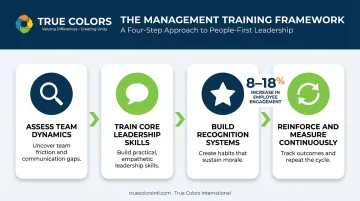
Step 1: Assess Current Team Dynamics and Communication Gaps
You can't fix what you haven't measured. Before any training begins, gather baseline data:
- Run a personality or behavioral assessment (such as True Colors' four-color framework: Orange, Gold, Green, and Blue) to surface communication gaps and pinpoint where friction is likely
- Deploy an engagement survey or culture diagnostic, such as a Culture Clarity Assessment, to identify where leadership perception and employee experience don't line up
- Record three numbers before training starts: engagement score, employee Net Promoter Score (eNPS), and turnover rate
Skipping this step is the fastest way to waste a training budget. Without a baseline, you have no way to prove the program worked later.
Step 2: Train Managers in Core Interpersonal and Leadership Skills
Generic leadership theory doesn't move morale. Practical, applied skills do. Focus training on:
- Active listening: responding in ways that make employees feel understood, not just heard
- Emotional intelligence: reading stress, disengagement, and motivation before they surface as conflict
- Conflict resolution: de-escalating tension between team members with different working styles
- Recognition technique: delivering specific, timely acknowledgment rather than generic praise
Personality-based communication frameworks help here because they replace one-size-fits-all advice with a shared language. A manager who understands that a Gold-dominant employee wants structure and a Green-dominant employee wants autonomy can adjust their approach on the spot instead of guessing.
Role-play and real scenarios matter too. Managers who only sit through lectures rarely change behavior; managers who practice a difficult conversation in the room are far more likely to handle the real version well.
Step 3: Build Structured Recognition and Communication Systems
Skills fade fast without a system to apply them. Build structure around two habits:
- Consistent one-on-ones and team huddles: same cadence, every week, no exceptions
- Recognition tied to specific behaviors: not just outcomes, and not limited to managers; peer recognition counts too
The payoff is measurable. A Gallup meta-analysis of manager development programs found teams saw 8% to 18% higher engagement and 21% to 28% lower turnover after managers received structured, strengths-based development. Those gains show up directly in retention numbers, not just engagement scores.
Step 4: Reinforce and Measure the Culture Change Continuously
Training decays fast if it's never revisited. This is where a continuous-loop model helps: awareness, alignment, action, and reinforcement cycle continuously instead of happening once.
- Schedule pulse surveys every few months to catch drift early
- Revisit core training content quarterly or bi-annually, not annually
- Compare current engagement and eNPS scores against your Step 1 baseline, not against a generic industry number
When and Why to Invest in Management Training for Morale
Management training works best as a proactive investment, not merely a crisis response. The ideal timing often comes before problems fully surface:
- Rising turnover trends, even before they spike into a full crisis
- New-manager promotions, especially first-time managers stepping up from individual contributor roles
- Mergers, restructuring, or leadership transitions
- Hybrid-work shifts that have quietly eroded informal team connection
Signs you need training now:
- Declining engagement survey scores quarter over quarter
- Recurring themes in exit interviews (not feeling valued, poor communication, lack of belonging)
- Rising interpersonal conflict or complaints between team members
Before committing budget, confirm you have:
- Leadership buy-in and budget approved at the level needed to sustain the program past one session
- Baseline assessment data collected from your initial culture or engagement assessment
- Certified facilitators or Master Trainers — look for credentials from bodies like ICF, SHRM, or HRCI-approved providers, such as True Colors International's Master Trainer network, rather than a generic online course with no accountability behind it
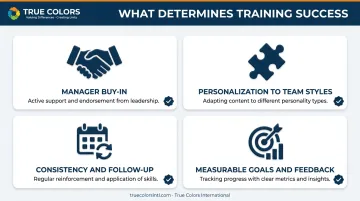
Key Factors That Determine Training Success
Two organizations can buy the same training program and get opposite results. These four variables explain why.
Manager Buy-In and Active Participation
Skeptical managers pass their skepticism straight to their teams. If a manager treats the workshop as a box to check, employees notice, and the training's credibility drops before it's even applied. Manager engagement in training correlates directly with downstream team engagement scores. Teams with engaged managers consistently outperform those left to a passive rollout.
Personalization to Team Personality and Communication Styles
Generic communication advice fails diverse teams. A team mixing fast-paced, big-picture communicators with quieter, detail-focused planners needs training that accounts for those differences, not a single script for everyone. Personality-based, tailored approaches — like True Colors' proprietary methodology — improve how well managers actually apply and retain the skills once the workshop ends.
Consistency and Follow-Up Reinforcement
Morale gains from a single workshop fade within weeks without reinforcement. Organizations that pair initial training with ongoing coaching, such as quarterly refresher sessions, see more durable culture shifts than those that run a one-time seminar and move on.
Measurable Goals and Feedback Loops
Without clear metrics, you can't prove ROI or catch problems early. Pulse surveys and eNPS tracking tied to training milestones, checked at 30, 90, and 180 days, keep the program honest and give leadership a reason to keep investing in it.
Common Mistakes That Undermine Morale-Boosting Training
Most failed training programs fall into one of these traps:
- Treating training as a single event. Fix it by scheduling recurring refreshers and coaching touchpoints instead of a "one and done" session
- Training only senior leadership. Frontline and middle managers have the most daily contact with employees; leaving them out limits impact
- Choosing generic, off-the-shelf content. Personality- or communication-based training tailored to your actual team outperforms a canned curriculum
- Failing to measure impact. Without tracking, disengagement can resurface undetected months later, undoing whatever progress the training created
This gap shows up in the data: according to McKinsey's survey of 510 executives, only 11% strongly agreed their leadership-development programs achieved and sustained the results they wanted. Weak follow-through and missing measurement explain most of that shortfall.
Conclusion
Boosting team morale through management training works best as a continuous system, not a one-time initiative. Most failures trace back to the same three culprits: poor preparation, a lack of personalization, or missing follow-through after the initial session ends.
The right approach balances practical manager skill-building with measurable, reinforced culture change over time. Organizations like True Colors International have spent decades helping teams build that shared communication language, treating morale as a management skill to develop rather than a perk to offer.
Frequently Asked Questions
How to strengthen team morale?
Morale improves through consistent manager behaviors, such as recognition, clear communication, and fairness, reinforced by ongoing training rather than isolated perks. One-off events help temporarily, but the daily manager relationship is what sustains it.
What are the 5 C's of team building?
The commonly cited 5 C's are Communication, Camaraderie, Commitment, Contribution, and Conflict resolution. Trained management practices directly support each one, especially communication and conflict resolution, which depend on manager skill.
How long does it take to see results from management training?
Initial shifts in communication can appear within weeks of training. Measurable morale and retention improvements typically take a few months of consistent reinforcement to show up in survey and turnover data.
What's the difference between employee morale and employee engagement?
Morale is the emotional or attitudinal state of a team; engagement is the behavioral investment employees put into their work. They're related and often move together, but they're measured differently and require different interventions.
Can small businesses afford management training programs?
Yes. Scalable training options exist for organizations of all sizes, and low-cost internal practices, such as structured check-ins and peer recognition, can complement formal programs without a large budget.
How often should manager training be refreshed?
Periodic refreshers, ideally quarterly or bi-annual, work better than a single annual session. Tie the timing to pulse survey data rather than a fixed calendar so refreshers address real, current gaps.