Most sales training programs skip that part entirely. They drill scripts, product features, and software workflows while ignoring the emotional undercurrent that actually drives buying decisions. This article breaks down what emotional intelligence in sales really means, its core components, and how to build it into a training program that produces results you can measure.
Key Takeaways
- EQ predicts sales success better than IQ or product mastery alone
- American Express field data showed EQ-trained teams grew revenue faster than untrained peers
- Goleman's five EQ pillars map onto every stage of a sales conversation
- True Colors temperament assessments turn EQ theory into skills reps can use on the next call
What Is Emotional Intelligence in Sales?
Emotional intelligence (EQ) is the ability to recognize, understand, and manage your own emotions while reading and responding to someone else's. Applied to sales, "sales EQ" shows up in moments like these:
- Catching a buyer's unspoken hesitation
- Staying composed when a deal stalls
- Adjusting your tone to how the person across the table processes information
EQ vs. IQ: What the Research Actually Shows
Daniel Goleman's analysis of competency models across 188 large global companies found that emotional intelligence mattered twice as much as technical skill or raw intellect in predicting standout performance.
Among senior leaders specifically, nearly 90% of the difference between star performers and average ones traced back to emotional competencies rather than cognitive ability.
That finding was about leadership, not sales specifically, but the parallel holds: technical skill gets you in the room. EQ decides whether you close.
Why Buyers Don't Decide With Logic Alone
Harvard Business School researcher Gerald Zaltman has argued that most purchase decision-making happens in the subconscious mind, with buyers later constructing logical justifications for choices they've already made emotionally. That's the entire premise behind consultative selling: if the decision is emotional first, the rep who reads emotion wins.
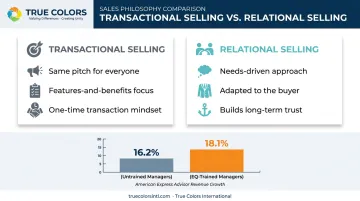
This is what drives the shift from transactional selling (features and benefits, delivered the same way to everyone) to relational selling (needs-driven, adapted to the buyer in front of you). Relational selling builds the trust that turns a one-time buyer into a repeat client.
There's field evidence behind this shift, too. An American Express program trained financial-advisor managers as emotional coaches focused on self-awareness, composure, and empathy.
Advisors under those trained managers grew their business 18.1%, compared to 16.2% for advisors under untrained managers. The gap is modest, but it shows up when EQ becomes part of how a sales organization actually operates.
The 5 Pillars of Emotional Intelligence — and the 4 Components of Sales EQ
The 5 Pillars, Applied to Sales
Goleman's original framework breaks EQ into five components. Here's how each one shows up in a sales conversation:
- Self-awareness — Recognizing your own tone, triggers, and body language, and how they read as trustworthy (or not) to a wary prospect
- Self-regulation — Staying level when a buyer pushes back hard, instead of getting defensive or over-explaining
- Motivation — Bouncing back from a lost deal fast enough that the next call still has real energy behind it
- Empathy — Picking up on the concern a buyer hasn't said out loud yet, and addressing it before it becomes a dealbreaker
- Social skills — Actively listening, then adjusting pace and word choice to match how the person you're talking to actually communicates
The 4 Components of Sales EQ (Blount's Model)
Sales trainer Jeb Blount's book Sales EQ adds a practitioner's lens on top of Goleman's academic framework. He describes four types of sales intelligence:
- IQ — Innate cognitive ability
- AQ — Acquired intelligence, built through continual learning and reps
- TQ — Technological intelligence, using CRM and sales tools effectively
- EQ — Emotional intelligence, the human layer
Blount's argument is simple: the other three only work if EQ is present. A rep with perfect product knowledge and a flawless CRM setup still loses the room if they can't read it. Ultra-high performers combine all four intelligences fluidly, moment to moment—not IQ or tech stack alone.
How to Build Emotional Intelligence Into Your Sales Training Program
Most soft-skills training fails for one reason: it teaches EQ as a concept instead of a skill. Telling a rep to "be more empathetic" doesn't give them anything to actually do differently on their next call.
Start With a Practical Self-Awareness Tool
Personality-based assessments solve this by giving reps a concrete map of their own communication style before asking them to read anyone else's.
True Colors International's temperament framework, built on decades of organizational psychology work, sorts communication tendencies into four styles: Orange, Gold, Green, and Blue. Reps who understand their own default style spot their blind spots faster.
Match Your Pitch to How the Buyer Actually Decides
Once reps understand their own style, the next step is reading the buyer's. Different personality types process a sales pitch in different ways:
| Buyer Type | What They Respond To | Pacing |
|---|---|---|
| Green (analytical) | Data, logic, specific facts | Deliberate, question-friendly |
| Gold (structured) | Clear sequence, timelines, deliverables | Methodical, no interruptions |
| Blue (relational) | Trust and personal connection first | Slower, relationship-first |
| Orange (action-oriented) | Concise, outcome-focused pitch | Fast, cut to the chase |
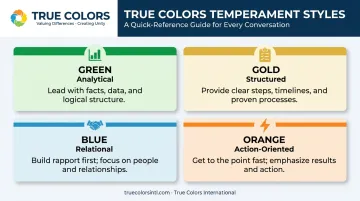
A rep who leads with dense data for a Blue-style buyer, or opens with small talk for a Green-style buyer, is fighting the conversation from the first sentence.
Reinforce It So It Sticks
Assessments alone don't change behavior. Effective programs pair them with:
- Role-play drills on common objections
- Recorded call reviews to catch tone and pacing patterns
- Active-listening exercises that force reps to summarize before responding
True Colors structures this reinforcement through the True Culture Loop (Awareness, Alignment, Action, Reinforcement), a cycle designed to keep insight from fading into a one-time workshop memory.
Its Advanced Certification in Consultative Selling builds on this loop, training reps to identify a buyer's personality type in real time and adjust their approach mid-conversation.
Sales managers matter here more than most people assume. Blue Cross Blue Shield of Oklahoma VP Nikki Hanna put it plainly: "We also use True Colors to teach our sales staff how to sell to the different personality types." That kind of manager-led reinforcement, not a single training day, is what makes EQ skills durable.
Applying Sales EQ Across the Customer Journey
EQ isn't a single skill you deploy once. It shows up differently at each stage of the sale.
Prospecting and First Impressions
Self-awareness keeps a rep's opening energy in check, while empathy helps them read whether a prospect wants a quick, direct exchange or a warmer, slower introduction. First impressions built on genuine attentiveness land better than any polished script.
Handling Objections
Emotionally intelligent reps treat objections as useful signals. A pushback on price might really be a concern about internal buy-in. Reading the emotion behind the objection, rather than arguing past it, uncovers what's actually blocking the deal.
Closing and Follow-Up
Confidence at close comes from having read the room accurately the whole way through. Post-sale, the same empathy that won the deal keeps the relationship alive, which drives renewals and referrals.
Measuring Impact and Overcoming Common Training Challenges
EQ training only earns its budget line if you can show it changed outcomes. Track it the same way you'd track any sales initiative:
- Close rates: before and after training, by rep or team
- Client satisfaction scores: tied to accounts where reps applied new techniques
- Retention and repeat business: the clearest sign trust was built, not just a transaction closed
Common Barriers — and What Actually Works
Rolling out EQ training hits predictable resistance:
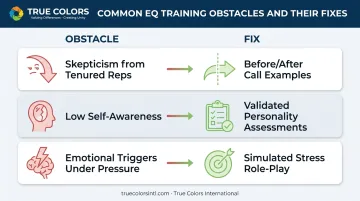
- Skepticism from tenured reps: counter "soft skills fluff" objections with before/after call examples, not theory
- Low self-awareness: validated personality assessments give reps an objective starting point
- Emotional triggers under pressure: role-play under simulated stress builds muscle memory
Initial rollout is rarely where EQ training fails. Skills degrade without practice, feedback, and manager reinforcement. Treat EQ as an ongoing habit, not a one-time workshop checkbox, or the investment fades with the binder.
Frequently Asked Questions
How do you use emotional intelligence in sales?
Reps apply EQ throughout the sales cycle by practicing active listening, reading buyer emotional cues, adapting their communication style, and staying composed during objections. This builds the trust that closes deals.
What are the four intelligences that drive sales performance?
Jeb Blount's model names four: innate intelligence (IQ), acquired intelligence (AQ), technological intelligence (TQ), and emotional intelligence (EQ). EQ is the human layer that makes the other three work in front of a buyer.
What are the 5 pillars of emotional intelligence?
Self-awareness, self-regulation, motivation, empathy, and social skills. Each one maps directly onto building trust and rapport during a sales conversation.
Can emotional intelligence be taught or trained?
Yes. Goleman's research confirms EQ can be learned through sustained practice, not a one-off workshop. Personality assessments, coaching, and structured drills turn it into a repeatable skill.
How does emotional intelligence differ from IQ in sales?
IQ reflects analytical and technical ability. EQ reflects how well you read and manage emotions—yours and the buyer's. In sales, EQ usually predicts performance more reliably than cognitive ability alone.
What's the ROI of emotional intelligence training for sales teams?
Teams usually track revenue growth, close-rate lift, and client retention. A documented American Express comparison found emotionally trained teams grew revenue at 18.1% versus 16.2% for untrained peers.