Talent doesn't guarantee performance. Leadership behavior does. How a leader communicates, resolves conflict, and sets expectations determines whether a group of skilled individuals becomes a real team, or just a collection of frustrated people sharing a calendar.
The numbers back this up. Collaborative work added $46 billion to Australia's economy in a single year, with employees completing tasks 15% faster when they worked together well, according to Deloitte's Collaborative Economy report.
This article breaks down what team dynamics actually are, the leadership styles that shape them, and practical strategies, including personality-based frameworks, for building teams that hold together under pressure.
Key Takeaways
- Leaders, not talent alone, determine whether teams collaborate or collide
- Team dynamics move through five predictable stages, each requiring a different leadership approach
- Role clarity, shared goals, and personality awareness prevent most day-to-day friction
- Psychological safety is the strongest predictor of team performance, according to Google's Project Aristotle study
- Structured feedback rhythms and shared frameworks keep dynamics healthy long after a workshop ends
What Is Team Dynamics in Leadership?
Team dynamics describe the behavioral, psychological, and communication forces that shape how team members interact, make decisions, and handle conflict. It's the invisible current running underneath every meeting, deadline, and disagreement.
In a leadership context, these dynamics rarely form by accident. A leader's tone, expectations, and modeled behavior function like an operating system: everything the team does runs on top of it. If a leader avoids conflict, the team learns to avoid it too. If a leader rewards only individual wins, collaboration quietly dies.
Team Dynamics vs. Group Dynamics
The terms get used interchangeably, but they're not the same thing, and confusing them leads leaders to apply the wrong management approach.
| Type | Characteristics |
|---|---|
| Groups | Share information and work in parallel, with limited interdependence |
| Teams | Share accountability toward a common goal, meaning one person's failure affects everyone |
A sales floor where reps hit individual quotas is a group; each rep succeeds or fails independently. A product launch team where marketing, engineering, and support all depend on each other's timelines is a team, since one late deliverable stalls the whole launch.
Leaders need different tools for each: individual coaching and quota tracking for groups, shared goals and joint accountability for teams.
Why Team Dynamics Matter for Organizational Success
Google's multi-year Project Aristotle study set out to find what separated high-performing teams from mediocre ones. The answer wasn't intelligence or experience. It was psychological safety, the shared belief that team members can take risks and speak honestly without fear of punishment, according to Google's research on team effectiveness.
Unresolved personality clashes are often the root cause when that safety erodes. Before training with True Colors, staff at Blue Cross/Blue Shield of Oklahoma reportedly struggled to appreciate differences among colleagues, until they realized, in their own words, "it's a good thing we're not all alike."
That shift, from treating differences as friction to treating them as an asset, tends to be the turning point for teams stuck in dysfunction.
Key Elements That Shape Team Dynamics
Several core elements determine whether a team's dynamics are healthy or dysfunctional. Leaders influence every one of them, whether they realize it or not.
Communication Styles and Self-Awareness
Most team friction stems from mismatched communication styles, not genuine disagreement. A direct communicator can read as blunt to someone who prefers nuance. A big-picture thinker can frustrate a detail-oriented colleague who just wants specifics.
This is where personality-based frameworks earn their keep. True Colors' four-color system (Orange, Gold, Green, and Blue) gives teams a shared vocabulary for describing how colleagues think, decide, and communicate, without resorting to vague labels like "difficult" or "not a team player."
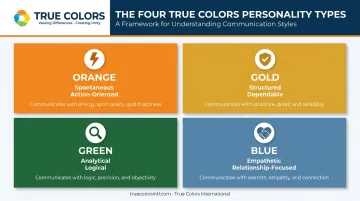
Staff testimonials from the University of Texas Permian Basin pointed to exactly this gap: employees needed sharper internal and external communication, and self-awareness was the missing piece.
Clearly Defined Roles and Responsibilities
Unclear roles cause two predictable problems: duplicated work and dropped tasks. When two people think they own the same deliverable, effort gets wasted. When nobody thinks they own it, deadlines slip quietly until someone finally notices.
Leaders should revisit roles:
- After a team grows or shrinks
- Following a reorg or new product launch
- Whenever the same task keeps falling through the cracks
Personality and Temperament Diversity
Balanced teams need a mix of temperaments:
- Results-driven members who push initiatives forward
- Relationship-focused members who protect team cohesion
- Process-oriented members who manage structure and consistency
- Big-picture thinkers who spot new opportunities
Too much of any one type creates blind spots. An all big-picture team generates exciting ideas but misses deadlines, while an all process-oriented team hits deadlines but resists new ideas.
Shared Goals and Vision
When pressure hits, teams without a shared purpose default to protecting individual turf. Teams aligned around a common goal prioritize collective success instead, even when that means one person absorbs extra work temporarily.
How Leadership Styles Shape Team Dynamics
A leader's default style directly determines whether a team's dynamics feel collaborative, stagnant, or tense. Most leaders default to one style without realizing it, often the one modeled by their own first manager.
The Four Common Leadership Styles
| Style | How It Shapes Dynamics |
|---|---|
| Autocratic | Centralized decisions, fast in a crisis, but limits long-term collaboration and buy-in |
| Democratic | Invites feedback and shared ownership, generally builds stronger cohesion over time |
| Transformative | Motivates through vision and innovation while still coaching individuals directly |
| Laissez-faire | Hands-off, can spark creativity in self-motivated teams but risks drift without direction |
None of these styles is inherently right or wrong. A hospital emergency team benefits from autocratic clarity during a code. That same style, applied to a marketing brainstorm, shuts down every good idea in the room.
Characteristics That Make Leaders Effective at Shaping Dynamics
Leaders who consistently build strong dynamics share three traits: empathy, clarity, and a willingness to show vulnerability. Together, these build the psychological safety Google identified as the top predictor of team performance.
Adaptability matters more than raw leadership talent here. True Colors' Master Trainers, including Dr. Bill Behrens, who has coached organizational development since 1985, work with leaders to identify their natural style and adjust it based on the temperament mix in front of them.
Consider a leader who is naturally structured and rule-following, managing a team full of spontaneous, action-oriented types. They'll clash constantly unless they consciously flex their approach.
The 5 Stages of Team Dynamics
Teams don't arrive fully formed. They move through a predictable sequence, first mapped by psychologist Bruce Tuckman in 1965, and leaders need a different playbook at each stage.
- Forming - Members orient themselves, roles feel unclear, and politeness masks uncertainty. Leaders provide structure, clear expectations, and early wins.
- Storming - Conflict surfaces as personalities and working styles clash. Skipping this stage usually means the conflict resurfaces later, worse. Leaders mediate directly, often using a shared-language framework like True Colors International's to resolve friction instead of avoiding it.
- Norming - Cohesion builds as roles solidify and trust replaces suspicion. Leaders reinforce collaboration norms and recognize progress publicly.
- Performing - The team operates efficiently and interdependently, often anticipating each other's needs. Leaders shift from directing to empowering.
- Adjourning - The team disbands or transitions to a new project. Leaders ensure recognition happens and that institutional knowledge doesn't walk out the door.
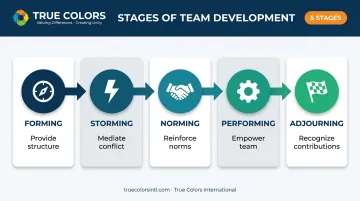
Most leaders get comfortable at one stage and try to keep their team there. But teams cycle back through storming whenever a new member joins or priorities shift.
Expect it. Don't panic when it happens.
Signs Your Team Dynamics Need Attention
Dysfunction rarely announces itself. It shows up in small behavioral shifts that leaders miss if they're not paying attention.
Trust is eroding when you see:
- Feedback avoidance or hesitancy to speak up in meetings
- People agreeing quickly just to end a conversation
- Concerns raised privately instead of in the room where decisions happen
Expectations are unclear when you see:
- Role confusion and duplicated work
- Dropped tasks nobody claims ownership of
- Inconsistent follow-through on commitments
Psychological safety has broken down when you see:
- Low engagement and missed meetings
- Clique formation, where sub-groups form based on comfort rather than function and undermine trust across the wider team, not just within the clique itself
Catching these signs early costs far less than fixing a fractured team later. One honest conversation during the storming phase, when conflict naturally surfaces, beats months of quiet disengagement.
Leadership Strategies to Build Successful Teams
Strong team dynamics don't maintain themselves. They require consistent leadership habits, practiced week after week.
Build structured reflection into the calendar. Weekly or biweekly check-ins, plus post-project retrospectives, give teams a scheduled space to surface friction before it festers. Without that structure, small frustrations pile up until someone explodes over an issue that had nothing to do with the real problem.
Establish shared conflict-resolution norms. Teams that agree in advance on how they'll disagree, such as committing to address issues directly rather than through a third party, resolve friction faster. This approach turns conflict into a tool for better decisions instead of a threat to avoid.
Replace annual reviews with feedback rhythms. Employees are 5.2 times more likely to find feedback meaningful when it's delivered frequently rather than saved for a once-a-year review, according to Gallup's research on fast feedback. Annual reviews also tangle pay decisions with development conversations, which discourages honesty on both sides.
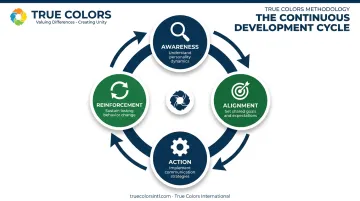
These habits create the right conditions for trust, but sustaining them requires a repeatable process. Use a structured framework to turn insight into habit. True Colors' True Culture Loop moves teams through four stages:
- Awareness - understanding temperament differences across the team
- Alignment - connecting those insights to team goals and norms
- Action - applying the framework to real decisions and real conflicts
- Reinforcement - revisiting and strengthening habits so they don't fade after the workshop ends
Leaders who skip straight to "action" without building awareness first usually see improvement that fades within weeks. The loop works because it treats culture-building as ongoing, not a one-time event.
Frequently Asked Questions
What is team dynamics in leadership?
Team dynamics are the behavioral and communication patterns among team members, shaped directly by a leader's style, expectations, and modeled behavior. Leaders set the conditions under which a team collaborates or fractures.
What are the 5 stages of team dynamics?
Teams typically progress through forming, storming, norming, performing, and adjourning. Leaders need a different approach at each stage, from providing structure early to empowering the team once it's performing well.
What are 5 examples of team dynamics?
Common examples include open communication habits, clearly defined roles, established conflict-resolution routines, shared accountability for outcomes, and psychological safety that lets people speak up without fear.
What are the 4 leadership styles of group members?
The four common styles are autocratic, democratic, transformational, and laissez-faire. No single style fits every team; effective leaders adapt based on context and team makeup.
How does personality awareness improve team dynamics?
Understanding temperament differences, such as those mapped by True Colors' four-color system, helps teams reduce miscommunication and recognize each other's strengths instead of mistaking differences for dysfunction.
How can leaders measure whether their team's dynamics are improving?
Regular pulse surveys, engagement metrics, and consistent feedback loops give leaders a way to track shifts over time, rather than waiting for a crisis to surface problems.