Soft skills lists and leadership blogs have talked about this for years, but the real proof shows up in harder places: retention numbers, engagement scores, team performance data. Many organizations still hire and promote based on technical résumés alone, then wonder why turnover stays high and change initiatives stall.
This article breaks down why human skills now outweigh hard skills in practice, using measurable business outcomes rather than abstract claims.
TL;DR
- Human skills like communication and empathy determine whether technical expertise delivers results
- They carry low automation risk and transfer across roles, industries, and career stages
- Strong human-skill cultures show measurable gains in engagement and retention
- Ignoring them causes miscommunication and turnover, regardless of technical talent
- Building these skills requires a structured, ongoing framework, not a single workshop
What Are Human Skills?
Human skills are the interpersonal behaviors that shape how people work with others: communication, empathy, adaptability, collaboration, and leadership. They're distinct from job-specific technical competencies like coding, accounting, or operating machinery.
These skills show up everywhere:
- Hiring decisions and candidate evaluation
- Leadership effectiveness and team trust
- Cross-functional collaboration and project delivery
- Customer relationships and conflict resolution
This pattern reveals the real function of human skills: they determine whether technical skill actually produces results.
A brilliant engineer who can't collaborate creates bottlenecks, and a manager with deep domain expertise but no communication skill loses their team's trust. The technical work only matters if it reaches other people effectively.
Key Advantages of Human Skills Over Hard Skills at Work
These advantages aren't leadership theory. Each one maps to a KPI leadership already tracks (retention, performance, risk), so the business case doesn't require a leap of faith.
Stronger Employee Engagement, Retention & Team Cohesion
Communication, empathy, and active listening aren't abstract virtues. They show up in daily check-ins, feedback conversations, and recognition moments. When managers handle these well, friction eases, miscommunication fades, and turnover risk shrinks, especially on hybrid and remote teams where tone and intent are easy to misread.
The data backs this up. Gallup's 2024 Q12 meta-analysis, covering more than 183,000 business units across 90 countries, found that teams in the top engagement quartile saw 23% higher profitability, 78% lower absenteeism, and turnover reductions ranging from 21% to 51% compared to bottom-quartile teams.
Gallup also attributes 70% of the variance in team engagement to management behavior, not compensation or perks.
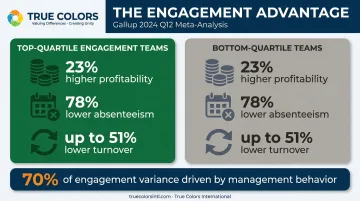
That's a management skill problem before it's a pay problem.
KPIs impacted:
- Retention rate
- Absenteeism
- Employee satisfaction and engagement scores
- Time-to-productivity for new hires
This advantage matters most in hybrid and remote teams, high-growth companies scaling fast, and industries with historically high turnover like retail, hospitality, and healthcare.
Better Leadership, Decision-Making & Psychological Safety
Emotional intelligence and adaptability let leaders manage ambiguity and conflict without derailing team trust. Operationally, this means employees feel safe speaking up, sharing half-formed ideas, and flagging risks before they become expensive mistakes.
Frazier et al.'s 2017 meta-analysis in Personnel Psychology, drawing on 136 samples and nearly 22,000 individuals, found a meaningful team-level relationship (rho=.35) between psychological safety and performance. Teams where people feel safe to speak up simply perform better, and that safety is built through leadership behavior, not policy documents.
KPIs impacted:
- Team performance ratings
- Idea and innovation output
- Conflict resolution time
- Internal trust and culture survey scores
This becomes critical during organizational change, mergers, cross-functional projects, or crisis response, exactly when technical playbooks run out.
Long-Term Career and Business Resilience Against Automation
Technical skills have a shorter shelf life now. Tools change every 18 months; the underlying human capabilities don't. Companies future-proofing their workforce are prioritizing adaptability and critical thinking over tool-specific training alone.
The World Economic Forum's Future of Jobs Report 2025 found that 69% of more than 2,800 assessed skills have low or very low potential to be substituted by generative AI, with none rated as very high substitution risk. Skills rooted in human interaction, including empathy and active listening, sit firmly in that low-substitution category.
Employers also expect 39% of workers' core skills to change by 2030, with 63% citing skill gaps as a major barrier to transformation.
KPIs impacted:
- Workforce future-readiness scores
- Skills-gap metrics
- Internal promotion and mobility rates
Highest-impact for organizations undergoing rapid AI adoption or industry disruption, where the workforce needs to bend without breaking.
What Happens When Human Skills Are Missing or Ignored
Skip human-skill development, and the consequences show up predictably, regardless of how technically strong your team is.
- Recurring miscommunication and unresolved conflict that resurfaces in every project cycle
- Higher turnover and quiet disengagement, even among technically skilled staff who simply stop trying
- Siloed teams with poor cross-functional collaboration and duplicated work
- Stalled change initiatives and tech rollouts that die from resistance or unclear communication
- Struggling new managers, technically strong employees promoted into leadership who can't hold people accountable or give feedback that lands
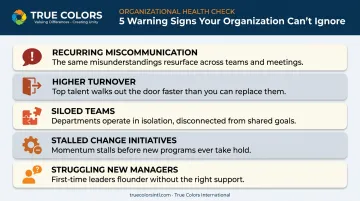
That last point deserves attention. Promoting your best individual contributor into management makes intuitive sense on paper. But leadership is a different job entirely.
Technical mastery doesn't automatically teach someone to navigate different personalities, manage tension without escalating it, or deliver feedback that changes behavior. This is a training gap, not a character flaw, but it's one most organizations never address until turnover on that person's team starts climbing.
How to Get the Most Value from Human Skills Development
Human skills don't stick after a single afternoon workshop. They develop through structured, ongoing frameworks, the same way technical skills require repetition and coaching, not a one-time seminar.
Start With a Shared Language
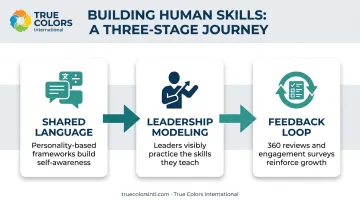
Self-awareness comes first. Employees and leaders need a common vocabulary for understanding behavioral and communication differences before they can adapt to them. This is where personality-based frameworks earn their place.
True Colors International's assessment methodology gives teams that shared language. Rather than treating communication style as guesswork, it maps out how people naturally process information, handle conflict, and make decisions, then uses that map to support:
- Hiring alignment and interview design
- Conflict navigation between clashing working styles
- Leadership development for newly promoted managers
For example, True Colors' programming for technically promoted leaders (including the Business Leadership program and the Connected Leadership Guided Experience) targets the gap between subject-matter expertise and people management. It helps new managers build trust and adapt their style, rather than defaulting to how they'd want to be managed themselves.
Make Leadership Modeling Non-Negotiable
A shared vocabulary only goes so far if leadership doesn't reinforce it. Training only compounds if leaders visibly practice what they teach. A manager who completes an emotional intelligence workshop and then reverts to old habits signals to the team that the skill wasn't important. Consistent modeling and coaching are what turn a workshop concept into daily behavior.
True Colors points to research showing emotionally intelligent companies are six times more innovative than peers, and inclusive teams are twice as likely to hit financial targets. Google's own internal study of high-performing teams, Project Aristotle, found trust was the single shared trait across top-performing groups, not skill level or tenure.
Close the Loop With Feedback
Modeling keeps skills alive day to day, but leaders still need proof the investment is working. Skill investment fades without measurement. Reviewing progress through 360 reviews and engagement surveys shows whether behaviors are actually shifting or whether the training was just a nice day out of the office. True Colors backs this consultative, ongoing relationship model with its own network of certified Master Trainers and facilitators, treating certification as an ongoing relationship rather than a finish line.
Conclusion
Human skills create measurable value in every team interaction. They build the clarity, trust, and consistency that carry teams through meetings, hiring decisions, and conflicts alike.
These skills compound. The longer a team practices clear communication and adaptive leadership, the stronger its culture, retention, and performance become. Treat human skills as an ongoing organizational investment, not a training checkbox you tick once and forget.
Frequently Asked Questions
Are human skills the same thing as soft skills?
They're often used interchangeably, but "human skills" better reflects that these capabilities, such as communication, empathy, and adaptability, are complex and learnable, not easy or secondary to technical ability.
Can human skills actually be taught, or are they innate personality traits?
Some traits come more naturally to certain personalities, but skills like communication and conflict management develop through coaching, feedback, and structured frameworks like personality assessments.
Why do hard skills still matter if human skills are more important?
Hard skills remain the baseline for job competence, such as coding, accounting, and operations. Human skills determine whether that technical work translates into real team results and business outcomes.
How can employers evaluate human skills during hiring?
Use behavioral interview questions, structured personality or communication assessments, and observe how candidates describe past collaboration or conflict situations in detail.
Which human skill matters most for leaders specifically?
Emotional intelligence and communication are foundational. They enable the trust-building, feedback, and psychological safety that most other leadership skills depend on.
How is AI changing the importance of human skills at work?
As AI automates technical and procedural tasks, human skills like judgment, empathy, and adaptability become the harder-to-replicate differentiator for employees and leaders alike.