Introduction
Only 20% of employees worldwide are engaged at work. Another 64% are just showing up, and 16% are actively disengaged enough to affect the people around them.
According to Gallup's latest State of the Global Workplace report, that disengagement drains roughly $10 trillion from the global economy every year, close to 9% of global GDP.
Yet plenty of organizations still run the same annual survey they've used for a decade, or skip measurement entirely and rely on gut feel. A question list alone won't fix engagement. Leaders need to know how to read the answers and turn scores into action that sticks.
This guide covers what engagement surveys measure, the best questions to ask by category, how to design a survey people will answer honestly, and how understanding personality differences turns flat survey scores into a real culture change plan.
Key Takeaways
- Engagement surveys measure how employees think, feel, and act toward company goals—beyond simple satisfaction
- Strong surveys combine core drivers—recognition, communication, growth, leadership trust—with rating scales and open-ended questions
- Data only matters once it becomes an action plan with owners and deadlines
- Personality insights explain why identical scores can have completely different root causes
What Is an Employee Engagement Survey?
An employee engagement survey is a structured tool that measures how employees think, feel, and behave toward their organization's goals. It asks a different question than "are you happy here?"
A satisfaction survey checks whether people like their pay, their manager, or the break room coffee. An engagement survey digs into whether employees are emotionally invested in the company's success: whether they'll go the extra mile, stick around, and recommend the workplace to others.
Gallup draws this line clearly: satisfaction measures contentment, but it rarely predicts better business outcomes on its own. Engagement measures commitment. That distinction is what actually moves your bottom line.
Are Employee Engagement Surveys Worth It?
Short answer: yes, but only if you act on what you learn.
Gallup's 11th Q12 meta-analysis drew on 736 studies covering 183,806 work units and more than 3.3 million employees. Top-quartile engagement units outperformed bottom-quartile units by wide margins:
- 23% higher profitability
- 18% higher sales productivity
- 14% higher production productivity
- 10% higher customer loyalty
- 78% lower absenteeism
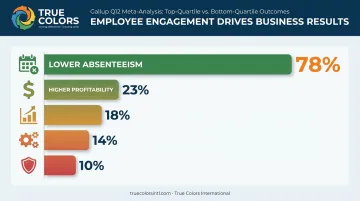
Gallup notes these are strong associations, not proof that surveys alone cause better results. But the pattern holds across 90 countries and 53 industries, which makes it a business risk to ignore, not just an HR nicety.
What Does an Employee Engagement Survey Measure?
Good surveys separate two things: engagement outcomes and engagement drivers. Outcomes tell you the score. Drivers tell you why.
Core outcome measures include:
- Intent to stay with the organization
- Discretionary effort, meaning going beyond the minimum
- Involvement in day-to-day work
- Pride in the company
- Willingness to recommend the organization as an employer
Surveys also surface harder-to-quantify signals like trust in leadership and a genuine sense of belonging, both strong predictors of turnover risk long before someone gives notice.
None of this works if employees don't trust the process. Response quality depends almost entirely on whether people believe their answers are anonymous and will lead somewhere.
True Colors International's Employee Experience Survey is administered by a third party for exactly this reason. It removes any doubt about who reads individual responses.
Core Themes Every Engagement Survey Should Measure
Effective surveys aren't a grab bag of random questions. They're built around themes that research consistently links to retention and performance.
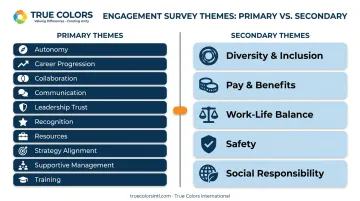
Primary Themes to Include Every Cycle
These themes should appear in nearly every engagement survey, regardless of industry:
- Autonomy & Empowerment: how much control employees feel over their own work
- Career Progression: visibility into growth paths and promotion criteria
- Collaboration: ease of working across teams and departments
- Communication: quality and consistency of information sharing
- Leadership Trust: confidence in senior leadership's decisions and honesty
- Recognition: how often good work gets acknowledged
- Resources: access to the tools, staffing, and time needed to do the job
- Strategy Alignment: whether employees understand and buy into company direction
- Supportive Management: whether direct managers coach rather than just supervise
- Training & Development: access to skill-building opportunities
Recognition deserves a closer look. Gallup and Workhuman's longitudinal data found well-recognized employees were 45% less likely to leave their organization within two years. One theme, moved deliberately, can shift retention more than almost anything else on this list.
Secondary Themes Worth Adding
Layer these in based on what's happening in your organization right now:
- Diversity & Inclusion: whether people feel they belong and can contribute fully
- Pay & Benefits: perceived fairness of compensation and total rewards
- Work-Life Balance: ability to manage work demands without constant burnout
- Safety: physical and psychological safety on the job
- Social Responsibility: pride in the organization's impact beyond the bottom line
A practical rule of thumb: keep the full survey to roughly 30-50 questions. Use at least three questions per priority theme so scores rest on more than a single data point.
Review the theme list every cycle. What mattered during a hiring surge won't be what matters during a return-to-office push two years later.
25+ Best Employee Engagement Survey Questions by Category
Use this question bank as a starting point for your next engagement survey. Most items work on a five-point agree/disagree scale—adapt the wording so it matches how your teams actually talk.
Overall Satisfaction & Engagement Questions
These items capture loyalty, pride, and intent to stay—your core engagement signal.
- I would recommend this organization as a great place to work.
- I rarely think about looking for a job somewhere else.
- I feel proud to tell people where I work.
- Overall, I am satisfied with my experience at this company.
- I see myself working here two years from now.
Communication & Leadership Questions
Use these to test trust in leaders and whether information actually reaches the people doing the work.
- I trust senior leadership to make decisions that are good for employees.
- I receive the information I need to do my job well.
- Leadership explains the reasoning behind major decisions.
- My manager listens when I raise concerns.
- I feel comfortable disagreeing with my manager without fear of consequences.
Recognition & Growth Questions
These questions show whether people see a future here—or feel stuck and invisible.
- I have received recognition for good work in the last two weeks.
- I know what I need to do to advance my career here.
- I have access to training that helps me do my job better.
- I have a mentor or manager who supports my long-term development.
- I feel that hard work leads to real career opportunities here.
Team, Culture & Belonging Questions
Belonging and inclusion scores often explain engagement gaps that pay and perks alone can’t fix.
- Collaborating with my team is easy and productive.
- I feel like I belong here, not just that I work here.
- My workplace values employees regardless of background or identity.
- I feel comfortable being myself at work.
- My team includes and values different perspectives.
Scores tell you where friction sits. Open-ended questions tell you why.
Open-Ended Questions
Keep two or three of these on every survey—comments turn a “3 out of 5” into something you can act on.
- What's one thing we should stop doing right now?
- What would make you consider leaving this organization?
- What does this organization do well that we should protect?
- Is there anything you need that you're not currently getting?
- What's one change that would make the biggest difference in your day-to-day work?
Pair every rating question with an optional comment field. A "3 out of 5" on leadership trust means something entirely different depending on whether the comment says "I don't get enough context" versus "leadership has contradicted itself twice this quarter."
How to Design an Effective Engagement Survey
Great questions still fail if the survey itself is poorly built. A few design choices separate a survey people trust from one they click through just to be done.
Use One Consistent Rating Scale
Qualtrics recommends a consistent 5-point Likert scale, Strongly Agree to Strongly Disagree, across every rating question. Consistency matters more than which scale you pick. Switching between a 5-point and a 10-point scale mid-survey makes year-over-year comparison nearly impossible.
Keep Questions Short and Single-Issue
Avoid double-barreled questions that ask about two things at once.
- Bad: "My manager communicates clearly and recognizes my work."
- Good: "My manager communicates clearly." (Recognition gets its own question.)
If someone agrees with the first half and disagrees with the second, the response becomes unusable. Split it.
Balance Cadence Against Survey Fatigue
Pair a deeper annual survey with shorter quarterly pulse checks, typically 10-15 questions taking under five minutes. This tracks sentiment shifts without wearing people out.
Survey fatigue usually comes from missing follow-through, not from how often you ask. Employees generally don't mind answering questions quarterly. They mind answering the same questions for the third year running with nothing to show for it.
Protect Anonymity and Set Clear Ownership
Three non-negotiables for a credible survey process:
- Anonymity, ideally through third-party administration, so employees trust their answers can't be traced back to them
- A clear deadline, since open windows that drag on for weeks reduce response rates fast
- A single sign-off owner accountable for finalizing questions before launch, so the survey doesn't get redesigned by committee halfway through
Get these right and you'll collect data people actually believe in, which is the only kind worth acting on.
Turning Survey Data Into Real Culture Change
Collecting survey data is half the job. The other half is turning scores into action people can feel, and that's where most organizations stall.
The Same Score, Different Root Causes
Here's what standard survey guides skip: identical scores can hide completely different problems. Two employees might both rate leadership trust a 3 out of 5, for opposite reasons.
- An action-oriented (Orange) employee might score it low because approval processes slow them down.
- A detail-oriented (Gold) employee might give the same score because expectations feel unclear or inconsistent.
- An analytical (Green) employee might score it low because redundant tasks leave no room for independent problem-solving.
- A relationship-oriented (Blue) employee might score low because they don't feel personally known by their manager.
Roll out one generic fix, say, "more town halls," and you'll help one group while leaving the others exactly as frustrated as before.
Reading Scores Through a Personality Lens
This is where True Colors International's four-color framework helps. When managers can read a low score as Orange frustration with red tape, a Gold need for clearer expectations, a Green push for autonomy, or a Blue need to feel known, they stop reaching for one-size-fits-all fixes. Survey data becomes a shared language for the person in front of them—not just a number to move.
The True Culture Loop
True Colors organizes this work into a four-stage cycle called the True Culture Loop:
- Awareness: surface culture patterns through the Employee Experience Survey and personal awareness training
- Alignment: build shared language and expectations across teams, starting at the hiring stage
- Action: turn insight into a concrete Culture Action Plan with owners and timelines
- Reinforcement: sustain change through coaching, cultural champions, and certified internal facilitators
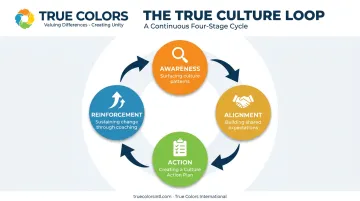
Unlike a one-time workshop, the loop is cyclical. Organizations keep moving through it as teams grow, leadership changes, and priorities shift.
True Colors has supported this kind of culture work for more than 45 years, with clients spanning Fortune 500 companies, government agencies, healthcare systems, and school districts. That experience gives leaders a tested path from survey scores to behavior change they can sustain.
Frequently Asked Questions
Are employee engagement surveys worth it?
Yes. Gallup's research links top-quartile engagement to 23% higher profitability and far lower turnover. The ROI only shows up when scores lead to a real action plan, not a report that sits in a shared drive.
What does an employee engagement survey measure?
It measures outcomes like intent to stay, discretionary effort, and pride in the company, alongside drivers like leadership trust, recognition, and connection to the company's mission.
What are employee engagement survey questions?
They're structured rating-scale and open-ended prompts built around specific themes, such as communication, recognition, and growth, designed to reveal both a score and the reasoning behind it.
What are the 5 C's of employee engagement?
You'll sometimes see engagement summarized as Care, Connect, Coach, Contribute, and Congratulate. It's a helpful shorthand for manager behavior, though it isn't a formally validated research model, so treat it as a memory aid rather than a scientific framework.
How often should you conduct employee engagement surveys?
Most organizations run one annual deep-dive survey supplemented by shorter quarterly or monthly pulse checks. The right frequency depends on how quickly your organization can actually act on what it learns.
What is a good response rate for an employee engagement survey?
Benchmarks generally range from 65% to 90%, depending on company size, with smaller organizations trending higher. Anonymity guarantees and visible leadership buy-in are the two biggest levers for boosting participation.