This scenario plays out in offices everywhere, and it's rarely about character. It's about temperament. That's why more organizations now lean on personality frameworks like MBTI, DiSC, the Big Five, and True Colors to understand why teams struggle with communication, trust, and collaboration despite everyone trying their best.
This article breaks down how work personality types shape day-to-day dynamics, answers the common question "what are the 4 personality types at work?", and shows how a research-backed framework like True Colors turns personality insight into a stronger, more functional culture.
Key Takeaways
- Personality clashes, not dislike, explain most "no one likes me" feelings
- MBTI, DISC, Big Five, and Enneagram offer insight, but rarely drive culture change
- True Colors' four colors (Gold, Blue, Green, Orange) simplify the "4 types" question
- Temperament awareness improves communication, conflict resolution, and retention
Why Work Personality Types Matter More Than Ever
Most workplace tension doesn't come from actual dislike. It comes from mismatched communication styles that get misread as rudeness, coldness, or disinterest. A Gold employee's blunt feedback can feel harsh to a Blue coworker who values emotional nuance. Neither meant harm.
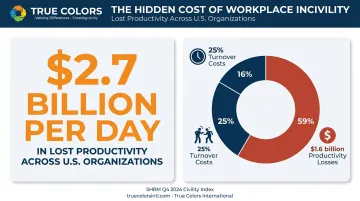
SHRM's Q4 2024 Civility Index found that workplace incivility costs U.S. organizations more than $2.7 billion per day through lost productivity and absenteeism, with $1.6 billion in productivity losses alone.
A common scenario:
Picture a project meeting. A task-focused employee jumps straight to deliverables and deadlines, while a relationship-focused employee wants to check in on the team's morale first.
The task-focused person reads the check-in as a waste of time. The relationship-focused person reads the rush to logistics as cold and dismissive.
Neither is trying to be difficult. They're just processing the same meeting through different lenses, and it's exactly this kind of mismatch that fuels the "no one likes me at work" feeling.
Why this matters for the bottom line:
- Miscommunication erodes trust faster than most managers realize
- Unresolved personality friction drives disengagement and, eventually, turnover
- Teams that lack a shared communication language repeat the same conflicts on a loop
True Colors International has spent more than 45 years helping organizations, including Amazon, Ford, and Google, build that shared language. The goal is to give teams a practical way to talk about differences before they become resentments, not to label people.
Popular Frameworks Used to Decode Workplace Personalities
Several personality models compete for space in workplace training. Each has strengths and real limitations worth knowing before you invest a training budget.
- MBTI: Sorts people into 16 types (e.g., Introversion/Extraversion). While widely known, its scientific backing is shaky. A 2023 peer-reviewed study found it explained only about 1% of variance in leadership behavior.
- DiSC: Measures behavioral blends—Dominance, Influence, Steadiness, and Conscientiousness—rather than fixed types. It's useful for communication workshops but focuses on surface behaviors over deeper motivations.
- The Big Five (OCEAN): This model assesses five core traits and has the strongest research backing. Its main drawback is that it wasn't built for practical team application, so it rarely translates into daily workplace habits.
- Other Frameworks: Models like the Enneagram (motivation), Hogan (leadership risks), and CliftonStrengths (talent themes) offer useful insights but often lack a simple, shared vocabulary for daily team interaction.
The 4 Personality Types at Work: Decoding the True Colors Model
True Colors takes a different approach. Instead of 16 rigid types or five abstract traits, it groups temperament into four colors: Gold, Blue, Green, and Orange.
The framework is rooted in decades of validated temperament theory. It's ASI-certified to exceed EEOC 80% Guideline standards for reliability and validity, based on a 10,000-person validation study.
That certification matters. It means the assessment was built with the same rigor HR teams expect from tools used in hiring and development, not just casual team-building icebreakers.
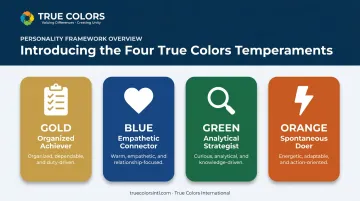
Gold — The Organized Achiever
Golds are structured, responsible, and detail-driven. They thrive on process and follow-through.
How it shows up at work:
- Builds detailed project timelines before anyone asks
- Shows up early and expects meetings to start on time
- Takes ownership of quality control and documentation
Example: A Gold project manager insists on a written checklist before a product launch. Colleagues joke about the extra paperwork, right up until the checklist catches a missed compliance step.
Blue — The Empathetic Connector
Blues are relationship-focused and values-driven. They read the emotional temperature of a room before they read the agenda.
How it shows up at work:
- Checks in on teammates before diving into tasks
- Mentors newer employees without being asked
- Notices when team morale is slipping
Example: A Blue team lead schedules a five-minute personal check-in at the start of every meeting. It feels unnecessary to some, but it's often why the team stays cohesive during stressful sprints.
Green — The Analytical Strategist
Greens are logical, curious, and independent thinkers. They want the reasoning behind a decision before they commit to it.
How it shows up at work:
- Asks "why" before "how" in strategy discussions
- Prefers solving problems solo before presenting to the group
- Spots systemic flaws others miss
Example: A Green analyst redesigns a clunky approval workflow no one else thought to question, cutting a five-step process down to two.
Orange — The Spontaneous Doer
Oranges are energetic, adaptable, and action-oriented. They'd rather move than plan endlessly.
How it shows up at work:
- Thrives during crunch time or unexpected changes
- Excels in sales, client-facing roles, or crisis response
- Gets restless in long, theoretical meetings
Example: When a client calls with a last-minute change, an Orange team member reworks the plan on the spot instead of waiting for a formal revision meeting.
How Personality Differences Shape Team Dynamics, Communication, and Conflict
Once you know the four temperaments, the friction points start making sense. Golds and Oranges often clash over structure — one wants a fixed plan, the other wants room to improvise. Blues and Greens often clash over decision-making: one weighs how a choice affects people, the other weighs whether the logic holds up.
This friction comes from temperament colliding with temperament, not personal rejection, and it's frequently the real answer to "why does no one like me at work?" Awareness training consistently reduces that feeling because it reframes friction as a style mismatch, not rejection.
That awareness translates directly into leadership practice. Communication adaptations for leaders:
| Temperament | What they need from you |
|---|---|
| Gold | Clear agendas, defined expectations, advance notice of changes |
| Blue | Personal check-ins, acknowledgment of feelings, collaborative tone |
| Green | Rationale behind decisions, time to think independently |
| Orange | Flexibility, variety, freedom from micromanagement |
Independent research backs the value of this kind of awareness training. A 2023 peer-reviewed evaluation tracked a multi-year graduate training program that included personality-awareness sessions. Participants rated the experience 4.91 out of 5 for encouraging honest feedback and 4.83 for increasing their sense of belonging on the team.
Beyond individual relationships, this pattern scales across entire organizations too. For large, cross-departmental organizations like Ford, Oracle, and Marriott, a shared color language does something subtler than resolving individual disputes. It gives thousands of employees, across different departments and time zones, a common shorthand for describing how they work best, which cuts down on the guesswork that normally slows collaboration at scale.
From Insight to Action: Building a Culture That Works
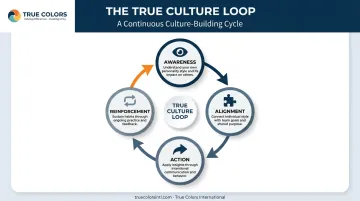
Knowing your color is only the starting point. True Colors structures ongoing culture work around what it calls the True Culture Loop: Awareness, Alignment, Action, Reinforcement. The idea is simple: personality insight fades fast if it stops at a one-time workshop.
Where this shows up in practice:
- Hiring alignment — using temperament insight to build interview approaches suited to team fit, not just résumé fit
- Leadership development — training managers to flex their style across Gold, Blue, Green, and Orange direct reports
- Conflict Navigation certification: an advanced track for facilitators who want to build durable conflict-resolution skills into their organization
Turning these practices into lasting culture change usually takes expert guidance. True Colors maintains a broad network of certified facilitators and Master Trainers, including Dr. Bill Behrens and David Eng, who bring decades of organizational development experience into these programs. Within that network, an Elite Facilitator tier (just 11 professionals nationwide) marks the highest certification level. Connecting with a certified facilitator is usually the fastest way to move a team from "we took a quiz once" to a working culture strategy.
Frequently Asked Questions
Why do I feel like no one likes me at work?
This feeling often comes from personality mismatches in communication style, not actual dislike. Understanding temperament differences, like the four True Colors types, usually clears up the confusion for both sides.
What are the 4 personality types at work?
True Colors identifies four temperaments: Gold (organized achiever), Blue (empathetic connector), Green (analytical strategist), and Orange (spontaneous doer). Each brings a different strength to a team.
How can understanding personality types improve workplace communication?
Recognizing temperament differences helps employees adjust their language and approach so colleagues actually hear what they're trying to say. It reduces the guesswork behind tone and intent.
Are personality assessments accurate for hiring decisions?
Accuracy varies by tool. ASI-certified assessments like True Colors meet EEOC reliability and validity standards, making them defensible for employment-related use.
Can someone's work personality type change over time?
Core temperament tends to stay fairly stable throughout life. People can, however, build flexibility and develop skills outside their natural preference, especially with practice and awareness.
What's the difference between MBTI and True Colors' four-color model?
MBTI sorts people into 16 fixed types based on four preference pairs. True Colors uses a simpler, ASI-validated four-color system built specifically for practical, everyday team application.