That gap is expensive. Organizations that communicate a clear, compelling vision are more than four times as likely to be organizationally healthy than those that don't, according to McKinsey's analysis of nearly 4,000 employees.
Leaders know alignment matters. The problem is most frameworks — OKRs, 4DX, the 7-S model — treat alignment as a strategy exercise. They map goals and structures beautifully, then ignore the fact that a detail-oriented project manager and a big-picture visionary executive hear "priorities" completely differently.
This article lays out a simpler approach: a four-stage loop built on 45+ years of organizational development work, one that treats communication style as seriously as it treats strategy.
Key Takeaways
- Alignment fails at the human level, where different communication styles derail even solid goals.
- Two types of alignment must both exist: vertical (leader-to-individual) and horizontal (cross-department).
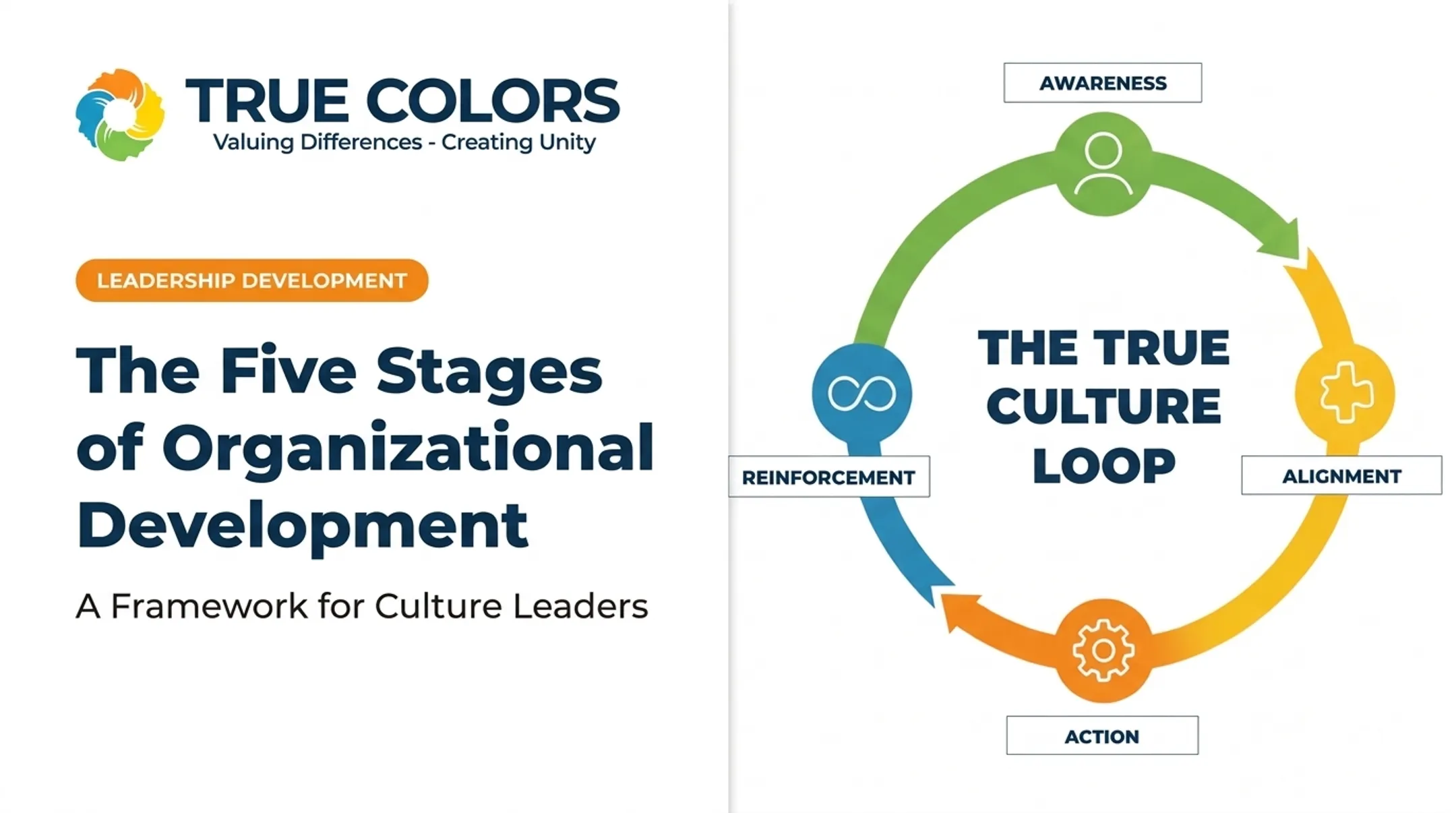
- A four-stage loop (Awareness, Alignment, Action, Reinforcement) creates a repeatable system, not a one-time initiative.
- Realignment reuses the same loop rather than starting over, beginning with reassessment.
What Is Organizational Alignment?
Organizational alignment is the process of connecting people, strategy, and daily execution so every level of the company moves toward the same goals. It sounds simple. It rarely is.
True alignment requires two dimensions working at once:
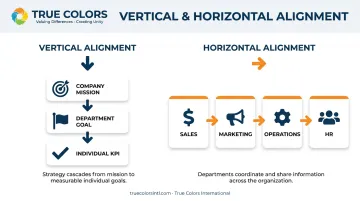
- Vertical alignment — goals cascading cleanly from leadership to teams to individuals
- Horizontal alignment — departments coordinating with each other at the same organizational level
Miss either one, and things break down. A company can have flawless top-down goal-setting and still watch marketing and sales undercut each other daily. Both dimensions have to hold simultaneously.
Vertical Alignment
Vertical alignment cascades goals from leadership down through departments to individual roles. Each employee should be able to explain, in a sentence or two, how their daily work connects to a larger company objective.
Here's what that looks like in practice: a company's mission to "become the most trusted provider in our region" cascades into a department goal ("reduce customer response time by 20%") and then into an individual KPI ("respond to support tickets within two hours"). When that chain breaks anywhere, employees start guessing at priorities.
That guesswork wastes time and pulls effort away from the goals that matter most.
Horizontal Alignment
Horizontal alignment coordinates goals and workflows across departments and functions operating at the same level. When it's missing, you see the usual suspects:
- Silos that duplicate work
- Sales and marketing chasing conflicting metrics
- Handoffs between teams that create delays instead of momentum
A practical example: HR and operations aligning on a single onboarding initiative instead of running separate, overlapping programs.
Harvard Business Review documents a similar shift at Bank of the West. The bank moved from siloed, product-centered teams to cross-functional groups that own entire customer outcomes — a structural fix for a horizontal alignment problem.
Why Alignment Efforts Commonly Fail
Most alignment initiatives start and end with a document: a new mission statement, a fresh set of OKRs, a slide deck from the offsite. Then leadership wonders why nothing changed six months later.
The reason is usually one of these four blockers:
- Unclear responsibilities: goals exist, but no one owns them
- Weak internal communication: the message gets lost or reinterpreted between levels
- Resistance to change: new goals threaten existing habits or turf
- Inconsistent review cadences: nobody checks progress until it's too late to correct course
The communication piece alone carries a real cost. Grammarly and The Harris Poll surveyed over 1,000 U.S. knowledge workers and found ineffective communication costs businesses roughly $12,506 per employee annually, an estimate that scales to $1.2 trillion across U.S. businesses.
Strategy documents don't account for the fact that a data-driven employee and a relationship-driven employee can read the exact same goal-setting memo and walk away with different interpretations. That gap is a communication problem disguised as a strategy problem.
A Simple 4-Stage Framework for Organizational Alignment
Complex strategic models often collapse under their own weight: too many inputs, too much theory, not enough repeatability. Most organizations do better with something simpler they can actually run quarter after quarter.
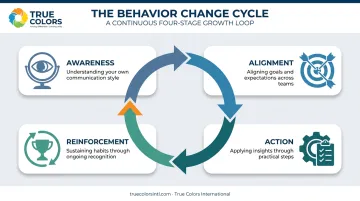
True Colors International built its True Culture Loop around that idea: a four-stage continuous system that treats alignment as an ongoing discipline, not a one-time project.
Stage 1: Awareness
Before anyone sets a goal, teams need to understand how they and their colleagues communicate, process information, and respond under pressure. This stage builds that self- and team-awareness using personality-based assessments as the foundation.
Actionable tip: Run a team communication or temperament assessment before goal-setting begins, using a validated tool such as True Colors' own online assessment, backed by an N=10,000 study and certified by the Assessment Standards Institute against EEOC guidelines. It surfaces differences in how people approach detail, risk, pace, and relationships before those differences turn into friction.
Stage 2: Alignment
This stage translates awareness into shared, cascading goals: the point where vertical and horizontal alignment actually get built, not just discussed.
Actionable tip: Hold a cross-functional goal-setting session where leadership priorities get translated into team-level objectives that every participant can restate in their own words. If people can't articulate the goal without checking notes, it isn't aligned yet.
Stage 3: Action
Daily execution and decisions now run on the shared goals and communication norms established earlier. This stage shows whether the framework holds up under real business pressure or breaks down.
Actionable tip: Implement a weekly or biweekly check-in cadence to track progress against goals and catch misalignment while it's still small. Waiting for the quarterly review to notice drift is how minor confusion turns into a real problem.
Stage 4: Reinforcement
Alignment erodes without maintenance. This stage sustains it through recognition and periodic reassessment, reinforced by ongoing training.
Actionable tip: Schedule quarterly reviews that celebrate wins directly tied to alignment goals, not just revenue numbers. Recognizing the behavior, not only the outcome, reinforces the connection between culture and strategy.
Signs Your Organization Needs Realignment
Realignment is the process of resetting alignment when strategy, structure, or culture drift out of sync. Drift is normal. Ignoring it isn't.
Common triggers include:
- Leadership change — new priorities without a clear communication plan
- Mergers or acquisitions — McKinsey finds 95% of executives view cultural fit as critical to integration success
- Rapid growth — the informal alignment that worked at 20 people breaks at 200
- Industry disruption — new technology or competitive pressure forces a strategy shift
- Declining engagement scores — often the earliest visible symptom of misalignment underneath
The good news: realignment doesn't mean starting over. It runs the same four-stage loop, just beginning with a reassessment of what's changed rather than a blank page.
Real-World Examples of Organizational Alignment
The Bank of the West case referenced earlier is a useful model for horizontal alignment. Instead of product teams working in isolation, cross-functional groups took ownership of complete customer outcomes together. This shared ownership reduced the handoff friction that comes from siloed structures.
That same emphasis on shared ownership shows up in personality-based communication training, which strengthens both dimensions of alignment across very different industries:
- Technology: engineering and product teams often skew toward detail-oriented, analytical communication styles, which can clash with relationship-driven sales or customer success teams
- Healthcare: clinical teams need fast, unambiguous communication where misread tone can affect patient safety
- Hospitality: front-line staff need shared language for handling pressure and customer variability consistently
True Colors International counts Amazon, Ford, Google, and Marriott among the organizations that have engaged this structured culture-alignment training, showing it isn't a small-business-only exercise. The same four-stage approach scales down just as well, applying to school districts, nonprofits, and government agencies working with far smaller budgets and headcounts.
Frequently Asked Questions
What is organizational realignment?
Realignment is the process of resetting strategy, structure, or culture when they've drifted out of sync. It's typically triggered by growth, leadership change, or shifts in the market.
What are the two main types of organizational alignment?
Vertical alignment cascades goals from leadership down to individual roles. Horizontal alignment coordinates goals and workflows across departments at the same level.
What is the meaning of organizational alignment?
It's the coordination of people, strategy, and daily execution toward the same organizational goals. Without it, teams pursue conflicting priorities even when working from the same mission statement.
Can you provide some examples of organizational alignment?
Examples include cascading OKRs from company mission to individual KPIs, cross-functional goal-setting sessions, and personality-based communication training that helps teams interpret shared goals consistently.
What is the difference between organizational alignment and organizational culture?
Culture is the shared values and behaviors within an organization. Alignment is the active process of connecting those values and behaviors to strategy and daily execution.
How long does it take to achieve organizational alignment?
Initial alignment can take a few months to establish through structured goal-setting and communication work. Sustained alignment, though, is an ongoing discipline that requires regular reinforcement, not a one-time fix.