Introduction
Sending leaders to a workshop doesn't tell you whether they lead differently on Monday morning. That gap between training delivered and behavior changed is where most leadership development budgets disappear.
Organizations aren't spending lightly on this problem, either. The global online corporate leadership training market alone was valued at $41.47 billion in 2025, according to Fortune Business Insights, with growth projected well into the next decade.
Yet many organizations still lack a reliable, repeatable way to track whether leader behaviors are actually shifting after that investment.
This article breaks down what you need before you start measuring, the three main methods available, and how to read the results without misdirecting your coaching dollars.
Key Takeaways
- Reliable measurement combines 360-degree feedback, validated personality assessments, and competency scorecards
- Method selection depends on whether you need self-awareness insight or hard performance data
- Interpreting results correctly matters more than simply collecting them
- Repeating assessments over time reveals real change; a single snapshot doesn't
What You Need to Assess Leader Behaviors
Before you measure anything, decide what "good" looks like. Inconsistent tools and undefined competencies produce data that can't be trusted or compared over time. That upfront clarity determines whether everything you measure afterward actually means something.
Tools and Indicators Required
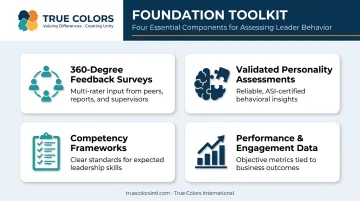
Most organizations rely on a combination of instruments rather than a single tool. The core set includes:
- 360-degree feedback surveys: capture how peers, managers, and direct reports experience a leader's behavior
- Validated personality or temperament assessments: reveal the tendencies driving how someone communicates and decides
- Competency frameworks or behavioral rubrics: define what effective leadership looks like in observable terms
- Supporting performance and engagement data: turnover, engagement scores, and retention trends that contextualize the behavior scores
You'll also need a defined leadership competency model. The Center for Creative Leadership, for example, uses a framework built around 16 competencies spanning categories like leading others, leading the organization, and leading yourself. Whatever model you choose, it becomes the benchmark every score gets measured against.
One thing that's non-negotiable: use scientifically validated, EEOC-compliant instruments. The EEOC's four-fifths rule treats a selection rate below 80% of the highest-scoring group as general evidence of adverse impact. Instruments like True Colors International's ASI-certified assessment, validated against a 10,000-person sample, meet this bar. Homemade surveys without reliability and validity testing put you at legal and practical risk.
Preconditions and Setup
Three things need to be in place before your first assessment cycle even starts:
- A clear baseline: define what effective leadership behavior looks like for your organization specifically, not generically
- Confidentiality and psychological safety: raters won't give honest input if they fear retaliation or exposure
- A consistent cadence: quarterly or annual cycles, so behavior change gets tracked over time rather than judged from one moment
Skip any of these and your data will reflect politics or guesswork more than actual leadership behavior.
Methods to Measure Leader Behaviors
There's no single "best" method. The right choice depends on how much depth you need, what resources you have, and whether you're after qualitative insight or hard numbers.
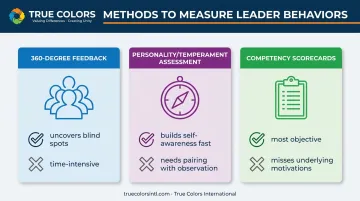
Method 1: 360-Degree Feedback Assessments
This method gathers behavioral observations from managers, peers, direct reports, and the leader's own self-rating, building a full-circle view of how someone actually behaves day to day.
How it works:
- Select the competencies raters will evaluate
- Distribute the survey and collect anonymous responses
- Aggregate scores and compare self-perception against how others actually see the leader
Pros: Excellent at uncovering blind spots: the gap between how a leader sees themselves and how their team experiences them.
Cons: Time-intensive and requires skilled facilitation. A 2005 meta-analysis of 24 longitudinal studies found that follow-up rating improvements after multisource feedback were generally small, ranging from roughly -0.04 for self-ratings up to 0.15 for supervisor and direct-report ratings. Treat 360 data as a development input, not proof that behavior has already changed.
Method 2: Personality and Temperament-Based Assessments
This approach measures the underlying tendencies that drive how a leader naturally decides, communicates, and interacts with a team, capturing the "why" behind the behavior rather than just the behavior itself.
How it works:
- The leader completes a validated self-report instrument
- A certified facilitator debriefs the results, connecting scores to specific, observable leadership behaviors
- The leader applies those insights to adjust communication and decision-making with their team
Pros: Builds self-awareness quickly and improves communication almost immediately. True Colors International's ASI-certified personality assessment is one example. Validated on a sample of 10,000 respondents and built to exceed the EEOC's 80% guideline standards, it translates personality insight into measurable behavior change rather than leaving it as an abstract typing exercise.
Cons: On its own, it doesn't tell you whether behavior actually changed on the job; it needs to be paired with observation or feedback data.
Method 3: Competency-Based Behavioral Observation and Scorecards
This method uses direct observation, documented scorecards, or manager ratings scored against a defined leadership competency framework.
How it works:
- Define observable behaviors for each competency — for instance, "delivers specific, timely feedback"
- Observe the leader's actions over a set period and score them against the rubric
- Use the scores to identify strengths and pinpoint targeted growth areas
Pros: The most objective method, directly tied to job performance rather than self-report.
Cons: Scorecards can miss the underlying motivations or communication style that a personality assessment would reveal, which is why pairing this method with Method 2 tends to give a fuller picture.
How to Interpret the Results
Misreading assessment results is where leadership development budgets go to waste. A misdirected coaching investment is bad enough; missing an early warning sign of derailment is worse.
| Result Pattern | What It Means | Recommended Next Step |
|---|---|---|
| Scores align with competency benchmarks across raters | Behavior is on track | Reinforcement, recognition, stretch assignments |
| Slight deviations in specific behaviors (delegation, feedback delivery) | Minor development area | Targeted coaching or peer mentoring on that competency |
| Consistently low scores across multiple raters, or misalignment with values | Red flag | Structured intervention, executive coaching, or a role-fit reassessment |
A few things matter more than the raw score itself:
- Look for patterns across raters, not a single low mark from one person
- Compare self-ratings to others' ratings — large gaps often signal a blind spot worth addressing before it becomes a bigger problem
- Weigh context: a leader six months into a new role will look different from one with five years of tenure, even with identical scores
Consistently low ratings on interpersonal or team-related behaviors across multiple raters often signal a derailment risk, though this is never a guarantee. Treat it as a cue to investigate further, not a verdict.
Common Mistakes and Best Practices in Assessing Leader Behaviors
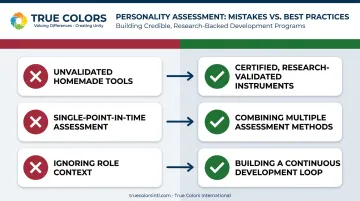
Common errors to avoid:
- Using unvalidated, homemade tools that lack statistical reliability or legal defensibility
- Assessing leadership only once instead of tracking change over a consistent time period
- Ignoring context like team size, tenure, or role complexity, which can skew comparisons and produce unfair conclusions
Best practices for reliable assessment:
- Use certified, research-validated instruments and trained facilitators to debrief results accurately. True Colors International's certified Master Trainers connect personality data to actual workplace conduct, not just quiz results.
- Combine multiple methods — pairing 360 feedback with a personality assessment builds a fuller, more accurate picture than either alone.
- Tie every result to a continuous development loop. A single assessment cycle without follow-through is closer to a report card than a development tool.
Conclusion
Measuring leader behavior accurately turns leadership development from guesswork into a data-informed, ongoing practice. No single tool tells the whole story.
Combining 360-degree feedback, validated personality assessments such as True Colors International's ASI-certified assessments, and competency scorecards gives you the clearest, most balanced view of how a leader actually behaves — not just how they perform on a single survey.
Whatever the results show, they need to lead somewhere concrete: coaching, recognition, a change in responsibilities, or a hard conversation about role fit. Data without action is just a file in a folder.
Frequently Asked Questions
What is cultivating leadership?
Cultivating leadership is the ongoing process of identifying, developing, and reinforcing effective leadership behaviors across an organization. It's an ongoing practice that requires consistent attention, not a single training event.
How do you cultivate leadership?
It involves setting clear behavior expectations, providing development opportunities like coaching or targeted training, and consistently measuring and reinforcing progress over time. Skipping the measurement step is the most common gap.
What are the key Cs of leadership?
Different frameworks vary, but commonly cited elements include communication, character, competence, and commitment. Some models expand this list further, adding cognition and connection as additional pillars.
What is the best way to measure leadership effectiveness?
Combining 360-degree feedback, validated personality assessments, and competency scorecards offers the most reliable, well-rounded measurement. Relying on just one method leaves blind spots the others would catch.
How often should leader behaviors be assessed?
A consistent cadence, such as quarterly or annually, works best for tracking real behavior change over time. A single assessment only captures a snapshot, not a trend.
Can personality assessments accurately predict leadership success?
Validated, research-backed personality assessments are best used to build self-awareness and improve communication, not to predict success on their own. They work best combined with 360 feedback and competency scorecards.