Job postings toss around "culture fit" like a checkbox requirement. The real value doesn't show up until months later, in retention numbers, team output, and how often managers get pulled into avoidable conflict.
This guide breaks down why culture fit actually matters, how to hire for it without introducing bias, and what happens to teams when it gets ignored.
TL;DR
- Culture fit means aligning a candidate's values and work style with how your organization operates - not personal likability.
- Strong culture fit hiring lowers turnover, speeds onboarding, and strengthens collaboration.
- Careless culture fit hiring risks costly bad hires, toxic dynamics, reduced diversity, and legal exposure.
- The strongest hiring processes pair culture fit with job fit, using validated assessment tools instead of gut feeling.
What Is Culture Fit (Brief Context)
Culture fit is the degree to which a candidate's values, communication style, and work habits align with an organization's stated and lived culture — not just what's written in the employee handbook.
It typically shows up in three places:
- Job description language that signals expectations around collaboration, pace, and decision-making
- Structured interview questions designed to surface real behavior patterns
- Panel interviews and reference checks that add multiple perspectives beyond a single hiring manager's impression
Used well, culture fit predicts retention, cohesion, and performance. It's a diagnostic tool for hiring decisions, never a rationale for "someone I'd hang out with after work."
Key Advantages of Culture Fit in Hiring
The advantages below tie to measurable business outcomes: turnover cost, ramp-up speed, team output, and engagement. Not vague talk about "vibes."
These advantages also compound. Every culturally-aligned hire reinforces the norms that make the next hire's onboarding easier, creating a flywheel effect rather than a one-time win.
Reduced Turnover and Lower Hiring Costs
Employees who feel misaligned with company values disengage faster and leave sooner, often within the first year. Screening for culture fit during interviews catches these mismatches before they become expensive mistakes.
Why this matters: Replacing an employee costs real money in recruiting time, onboarding resources, and lost productivity. Gallup's conservative estimate puts replacement cost at 0.5x to 2x an employee's annual salary, depending on the role.
That's a wide range, but even the low end adds up fast across a growing team.
KPIs impacted:
- Turnover rate
- Cost-per-hire
- Time-to-fill
- First-year attrition rate
This advantage matters most for small teams and fast-growing startups, where one bad hire disrupts a disproportionate share of total output. It's equally critical for roles with long ramp-up or training periods, where a departure six months in wastes months of investment.
Stronger Team Collaboration and Communication
Culturally-aligned employees tend to share expectations around communication style, feedback, and decision-making. That shared baseline reduces daily friction before it starts.
In practice, this looks like:
- Fewer misunderstandings derailing meetings
- Faster consensus on decisions
- Smoother handoffs in cross-functional work
Google's Project Aristotle study of 180 internal teams identified psychological safety as the leading driver of team effectiveness, ahead of seniority, team size, or whether members worked in the same office.
Teams where people feel safe communicating openly consistently outperform teams that don't, regardless of individual talent.
KPIs impacted:
- Team collaboration scores
- Project delivery timelines
- Internal conflict and escalation rates
Cross-departmental teams and matrixed organizations feel this benefit most acutely, since shared working norms have to bridge multiple functions. Fast-scaling companies face the same pressure — every new hire either reinforces or dilutes the collaborative habits already in place.
Higher Employee Engagement and Productivity
Employees whose values match the organization's are intrinsically motivated, not just compliant. That distinction shows up in behavior: volunteering for stretch projects, staying past minimum expectations, mentoring newer team members.
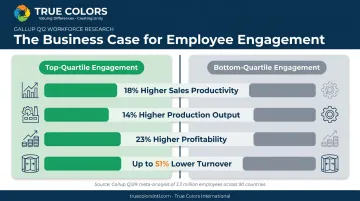
Gallup's 11th Q12 meta-analysis, covering over 3.3 million employees across 90 countries, found top-quartile engagement business units outperformed bottom-quartile units by 18% in sales productivity, 14% in production output, and 23% in profitability.
Turnover gaps were even larger, with top-quartile units seeing up to 51% less turnover in lower-attrition industries.
KPIs impacted:
- Engagement survey scores
- Productivity metrics
- Absenteeism rate
- Customer satisfaction scores
This advantage matters most for customer-facing roles and leadership positions, where disengagement is visible to clients and teams alike. It's also critical for organizations rebuilding trust after a culture disruption, since engaged hires can help reset team norms faster than policy changes alone.
What Happens When Culture Fit Is Missing or Ignored
Hiring purely on skills and experience while skipping fit often looks fine on paper. The problems surface only after onboarding, when they're harder and more expensive to fix.
Common consequences include:
- Elevated early attrition: repeated re-hiring cycles for the same role, draining recruiter time and budget
- Team morale dips: existing employees sense the new hire "doesn't get it," creating quiet resentment
- Slower time-to-productivity: onboarding drags because the new hire and team aren't operating on shared assumptions
- Reactive management: managers spend time on one-off conflict conversations instead of reinforcing consistent team norms
One important caution: culture fit, applied carelessly, becomes a liability. Screening for personal similarity rather than shared values can reduce diversity and create legal exposure. The EEOC applies standard adverse-impact rules to any selection procedure, including informal "fit" judgments, when it disproportionately excludes a protected group without job-related justification.
Culture fit still matters here. The real failure point is that most hiring processes never define it clearly enough to apply it fairly.
How to Hire for Culture Fit the Right Way
Culture fit works best when it's defined objectively, assessed consistently, and balanced against job fit. Not left to whatever an interviewer's gut says after 45 minutes.
Here's how to build that process:
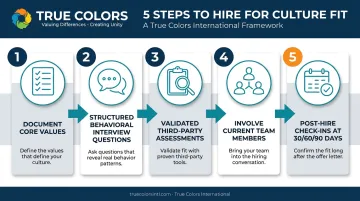
Document core values before writing job ads. Define specific behaviors, not adjectives like "friendly" or "driven." Vague traits invite bias; specific behaviors invite fair evaluation.
Use structured, behavioral interview questions. "Tell me about a time you disagreed with a teammate" reveals more than "Do you think you'd fit in here?" The second question just invites a rehearsed answer.
Bring in validated, third-party assessments. Generic personality tools weren't built for hiring decisions and can create legal risk if used that way. True Colors International's ASI-certified Talent Selection Assessment fits this need: it's validated for pre-employment use, applies consistent criteria to every candidate, and is designed to inform about 25% of the hiring decision, alongside structured interviews and reference checks, never as the sole factor.
Involve current team members. Panel interviews and informal meet-and-greets surface perspectives a single hiring manager will miss.
Keep assessing fit after the interview. Real alignment shows up in actual work, not interview answers. Build check-ins at 30, 60, and 90 days to confirm what the hiring process predicted.
Organizations using shared personality-spectrum frameworks, such as True Colors' four-color model, gain a common language for describing fit. This replaces personal impressions, which are harder to calibrate consistently across a hiring panel.
Conclusion
Culture fit matters because it directly shapes retention, collaboration, and engagement, well beyond making the interview process feel comfortable for hiring managers.
These advantages compound over time. Each aligned hire strengthens the very culture that makes the next hire's onboarding smoother and the next team project less chaotic.
Treat culture fit as one deliberate, ongoing input into hiring decisions. Pair it with job fit and objective tools, such as True Colors International's personality-based assessments, rather than treating it as a one-time gut check during a 30-minute interview.
Frequently Asked Questions
What is culture fit in recruitment?
Culture fit is the alignment between a candidate's values, communication style, and work habits and an organization's actual culture. It's distinct from job fit, which measures technical skills and experience for the role itself.
How do you hire based on culture fit?
Define your core values and behaviors first, then use structured behavioral interview questions rather than vague "do you fit in" prompts. Involve current team members in the process and use validated assessment tools to reduce subjective bias.
What to expect in a culture fit interview?
Expect questions about how you've handled feedback, conflict, or ambiguity in past roles, plus possible informal elements like a team meet-and-greet or office tour. These questions reveal how you actually work, not whether you'd fit in socially.
Does a company culture fit interview mean a job offer?
No. A culture fit interview is one evaluation stage among several, typically weighted alongside skills assessments, technical interviews, and reference checks. It doesn't guarantee an offer on its own.
Is culture fit the same as culture add?
No. Culture fit measures alignment with existing norms and values. Culture add focuses on what new perspective a candidate brings while still sharing those same core values. Both work together, not as substitutes.
How can employers avoid bias when hiring for culture fit?
Define values in specific, observable behavioral terms rather than personality labels. Use structured, validated assessments and train interviewers to separate "shares our values" from "reminds me of myself."